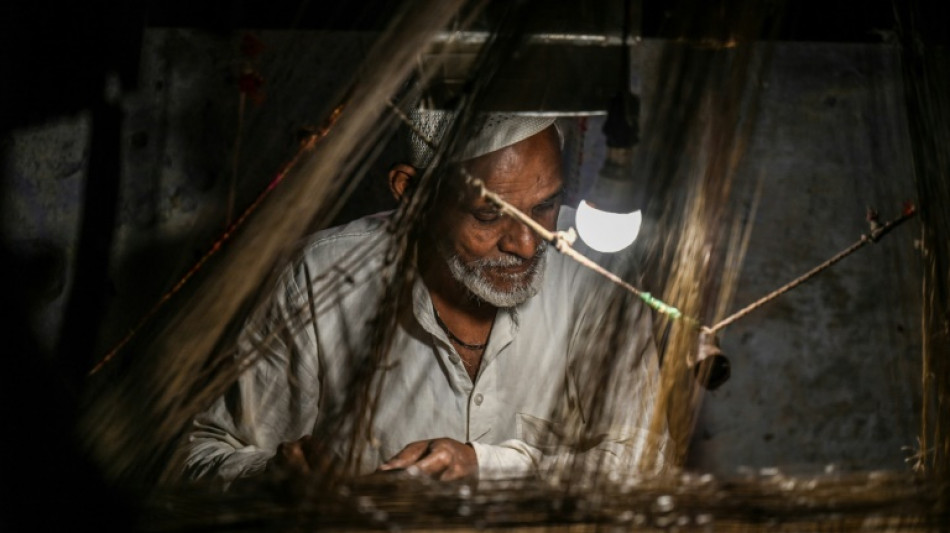
Indian sari weavers toil to keep tradition alive

 'He's here with me': Japan cycle queen dedicates gold to late brother

 Japan Olympic chief says 'lot more' athletes at Games than expected

 Asian carmakers besting US rivals at home, China poised to strike

 Widgets & Web Offers All-Inclusive Investor Relations Websites for Public Companies, IPOs and SPACs

 Adams named new US captain to 2030 World Cup

 China a better influence in Latin America than US: poll

 Judge pauses construction of border project in Texas national park

 Belgium's De Bruyne fires double to sink Turkey, France held by Italy

 US jobs data boosts stocks as oil prices dip

 US Supreme Court to hear high-stakes climate case

 Trump expected to name intel chief Clayton as AI czar: reports

 Argentina unveils passports-for-investment scheme

 Brazil election debate chaos sparks censorship row

 England's Carse charged by cricket body over nightclub incident

 Amazon vows $1 bn for data center towns, decries 'myths'

 Oil prices drop on G7 fuel release, US jobs data boosts stocks

 G7 agrees deal to ease global energy supply concerns

 Spain's government dealt blow as lawmakers reject housing bills

 Food, medicine shortages deepen in Russian-occupied Oleshky

 Man City whistleblower Rui Pinto facing 'dire consequences' - lawyers

 Russia 'tearing Kyiv apart', mayor says, as strikes paralyse traffic

 Taiwan boxer Lin wins Games gold as Japan edge North Korea on penalties

 Japan tame North Korea to win Games gold after shootout drama

 US posts weak job growth data in September

 Ethiopia's conflict: the regional dimension

In a dim room near the banks of India's Ganges river, arms glide over a creaking loom as another silken fibre is guided into place with the rhythmic clack of a wooden beam.
Mohammad Sirajuddin's cramped studio is typical of Varanasi's dwindling community of artisans painstakingly working by hand to produce silk saris, uniquely cherished among their wearers as the epitome of traditional Indian sartorial style.
The city he calls home is revered among devout Hindus, who believe that cremation on the banks of its sacred waterway offers the chance to escape the infinite cycle of death and rebirth.
But Sirajuddin's own reflections on mortality are centred on his craft, with competition from more cost-efficient mechanised alternatives and cheap imports from China leaving his livelihood hanging by a thread.
"If you walk around this whole neighbourhood, you'll see that this is the only house with a handloom," the 65-year-old tells AFP.
"Even this will be here only as long as I am alive. After that, nobody in this house will continue."
Varanasi's hand-weavers have cultivated a reputation for excellence over centuries, specialising in intricate patterns, floral designs and radiant golden brocades.
The Banarasi saris -- so-called in reference to the city's ancient name -- they produce are widely sought after by Indian brides and are often passed on from one generation to the next as family heirlooms.
The elegant garments fetch handsome prices -- Sirajuddin's current work will go on sale for 30,000 rupees ($390) -- but the cost of inputs and cuts taken by middlemen leave little left for weavers.
"Compared to the hard work that goes into making the sari, the profit is negligible," Sirajuddin says.
His neighbours have all switched to electric looms for their garments, which lack the subtleties of hand-woven textiles and sell for just a third of the price but take a fraction of the time to finish.
- 'Thriving industries got killed' -
The fortunes of India's textile trade -- historically a cottage industry -- have long been subject to sudden and devastating upheavals from abroad.
Its delicate fabrics were prized by the 18th century European elite but British colonisation and England's industrial-era factories flooded India with much cheaper textiles, decimating the market for hand-woven garments.
Decades of socialist-inspired central planning after independence bought some reprieve by shielding local handicrafts from the international market.
But economic reforms in the early 1990s opened the country up to cheap goods just as the country's northern neighbour was establishing itself as the globalised world's workshop.
"Chinese yarn and fabric came in everywhere," said author and former politician Jaya Jaitly, who has written a book on Varanasi's woven textiles, adding that sari factories there had for years been emulating the city's unique patterns and detail.
"All of these thriving industries got killed... through Chinese competition, and their ability to produce huge quantities at very low prices."
- 'Tradition to be proud of' -
Jaitly said local weavers needed urgent protection from government to preserve a wealth of artisanal traditions that otherwise risked disappearing.
"We have the largest number of varieties of handloom, techniques, skills... more than anywhere else in the world," she said.
"I think that's truly a tradition to be proud of."
Demand for Banarasi saris, already limited to a select Indian clientele able to justify spending at a premium, has also suffered in the wake of the Covid-19 pandemic.
The virus threat may have receded in India, but job losses and a big dent to the economy have taken their toll.
"The weavers are suffering a lot. They are not getting the right price for their products, payments are also coming late," said local sari merchant Mohammad Shahid, his store empty but for sales assistants stacking silk garments on the shelves.
Shahid was nonetheless hopeful that well-heeled and discerning customers would return.
"Those who know the value of handloom will continue to buy and cherish our saris. The handlooms can dwindle but they will never go away," Shahid, 33, told AFP.
T.Batista--PC