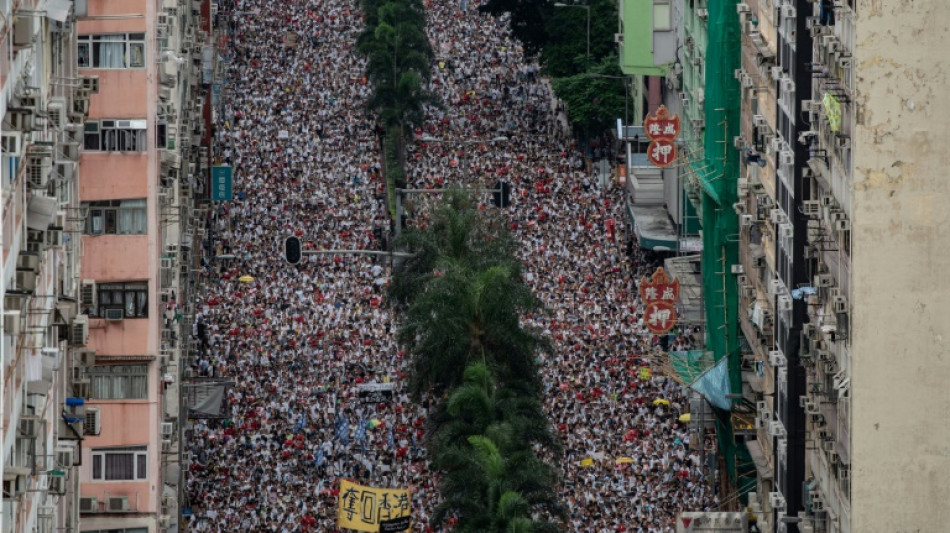
Hong Kong novelists seek freedom in exile after democracy crackdown / Photo: Philip FONG - AFP/File

 Australia probes app used in cheap smart glasses over privacy fears

 England needed to 'move on' from World Cup pain, says Tuchel

 O'Neill to stay at Celtic after period of "reflection"

 Kane marks 125th England cap with Wembley Nations League double
 Quebec's incoming separatist leader wants to block Crown from swearing-in

 Emmys gala will now stream its premier television awards

 Paramount completes Warner Bros takeover, creating Skydance
 Trump blames France unrest on Islam, migration
 Apple's Cook praises EU over efforts to protect children online

 Nobel winner Halzen says years of October 'misery' finally over

 Quebec separatist win rattles Carney's unity push

 'Itching' for change: Shiffrin cuts back slaloms this season

 'Gen Z has risen up': Tens of thousands mass for tense France school protests

 Caribbean tourism hotspot loses men to Russian war machine

 Danish reservists practice war games to respond to 'aggression'
 Bhuvneshwar returns to India's T20 squad for New Zealand tour

 Asos says probing 'unauthorised activity' after phone alerts

 Stocks climb as oil prices retreat under $100 per barrel

 Neutrinos: space particles that change our view of universe

 'Destined' Djokovic wins China Open, extending unbeaten record
 Iceland is 'critical outpost' for security, says Rubio during visit

 Israeli settlers beat AFP photographer covering West Bank

 'Gen Z has risen up': Tens of thousands demand better education in France

 $10 Million and Counting: Hola Prime Hits Major Trader Payout Milestone
 UEFA investigate Ireland-Israel tunnel bustup after spitting claim
When Hong Kong author Kay So left her home city in 2020, she had in her luggage two short stories she had written about the huge, at times violent democracy protests that upended the city in 2019.
It was then three months after Beijing imposed a sweeping national security law on the financial hub to quell political dissent after the protests were quashed.
So knew it would be improbable for her writing project to grow into a book in Hong Kong, so she moved to self-ruled Taiwan to study creative writing.
"I don't want to do creative work in a place... where I have to self-censor. The freedom to write is an important freedom," the 30-year-old told AFP on the phone from Taiwan, where she now lives.
She has since completed a collection of eight short stories written in Chinese that draw inspiration from the protests, entitled "Gazing Into a Fire".
It was published in Taiwan in May -- a month before the fifth anniversary of when a million Hong Kongers took to the streets to oppose a bill to extradite criminal suspects to China's opaque system.
The former British colony -- handed back to China in 1997 -- saw the march morph into a larger movement for more autonomy from Beijing for seven heady months before authorities crushed it.
More than 10,000 people were arrested and over 2,900 prosecuted for participating in the protests.
Since then, protests and anti-government opposition -- which used to make Hong Kong distinct from other Chinese cities -- have all but disappeared, while democracy activists have either been jailed, moved away or muted.
But the movement appears to live on in the pages of several fiction titles published in recent years by Hong Kong authors -- many of them choosing to live and write abroad.
So said her book was dedicated to the democracy movement of 2019, which she called "the most compelling and influential episode" in her life.
"Many people are still serving time in prison or waiting for trial," she said.
"I would like to speak to people who still care... so they would know right here there is a writer who also still cares."
- 'Can't let go' -
Under the Beijing-made security law, media outlets regarded as critical to the government have been prosecuted as "seditious publications", while some independent bookstores -- seen as a leftover bastion of liberal circles -- have faced increased government inspections.
Hong Kong also enacted a second law in March that includes a widened definition of "sedition", which foreign governments like the United States say will curb further freedoms in the city -- effectively silencing an already muted opposition bloc.
But the Hong Kong painted in the pages of So's stories remains in a state of roiling agitation.
A mother tries to send her jailed son his favourite dish; a student struggles with her professor over politics; a daughter writes a letter to her late father accused of being an anti-government suicide bomber.
"I found that I was trapped, I had to keep writing about the movement," So said.
Award-winning novelist Leung Lee-chi, also based in Taiwan, professed the same urgency.
"I can't let go of Hong Kong," she told AFP.
Leung has produced a trilogy since she moved to the island in 2021 -- "Everyday Movement" about those caught in the protests, "Survivor's Notes" exploring what led to the movement, and the latest on the post-protest diaspora titled "The Melancholy of Trees".
"After a political turmoil, literature can help us rediscover ourselves in the sweeping waves," Leung said.
- 'Sustaining the freedom' -
Those who have chosen to continue working creatively in the city must look for "space within its framework", said a Hong Kong-based novelist.
"That's what I believe literature should do," he said, requesting anonymity to avoid repercussions as he has published stories about the 2019 protests.
The memory of the protests remains "a constantly inflamed wound" for many Hong Kongers, he said.
"There is basically no space, no soil for people to discuss, to narrate, to express... but it's not non-existent," he said.
Pointing to the pending court cases against democracy activists and recent arrests under Hong Kong's security laws, he said writing has become his way to connect with people and maintain the spirit of freedom.
"If we persist in... exercising it in our daily life, we are inheriting and sustaining the freedom."
F.Cardoso--PC