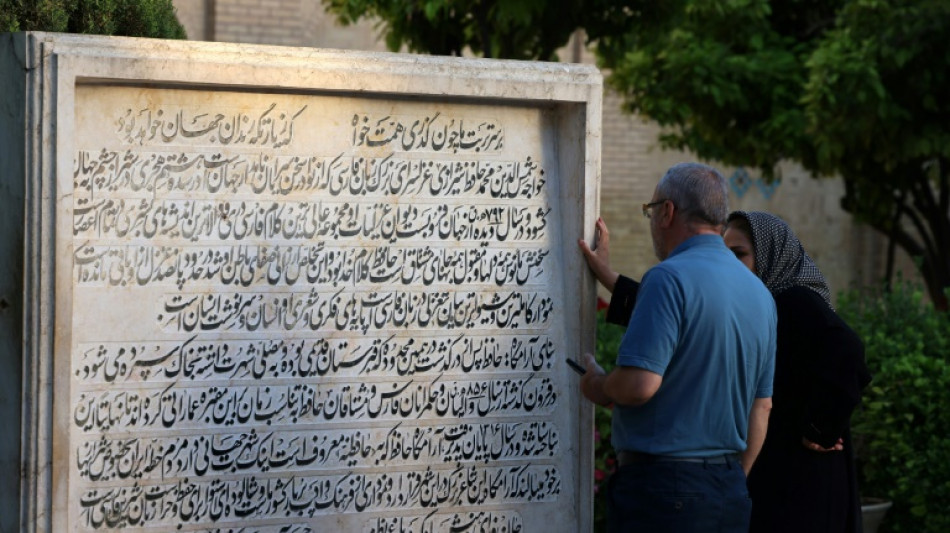
Iranians seek guidance from ancient poetry of Hafez / Photo: ATTA KENARE - AFP

 Australia probes app used in cheap smart glasses over privacy fears

 England needed to 'move on' from World Cup pain, says Tuchel

 O'Neill to stay at Celtic after period of "reflection"

 Kane marks 125th England cap with Wembley Nations League double

 Quebec's incoming separatist leader wants to block Crown from swearing-in

 Emmys gala will now stream its premier television awards

 Paramount completes Warner Bros takeover, creating Skydance
 Trump blames France unrest on Islam, migration

 Apple's Cook praises EU over efforts to protect children online

 Nobel winner Halzen says years of October 'misery' finally over

 Quebec separatist win rattles Carney's unity push

 'Itching' for change: Shiffrin cuts back slaloms this season

 'Gen Z has risen up': Tens of thousands mass for tense France school protests
 Caribbean tourism hotspot loses men to Russian war machine

 Danish reservists practice war games to respond to 'aggression'

 Bhuvneshwar returns to India's T20 squad for New Zealand tour

 Asos says probing 'unauthorised activity' after phone alerts

 Stocks climb as oil prices retreat under $100 per barrel

 Neutrinos: space particles that change our view of universe
 'Destined' Djokovic wins China Open, extending unbeaten record
 Iceland is 'critical outpost' for security, says Rubio during visit

 Israeli settlers beat AFP photographer covering West Bank

 'Gen Z has risen up': Tens of thousands demand better education in France

 $10 Million and Counting: Hola Prime Hits Major Trader Payout Milestone

 UEFA investigate Ireland-Israel tunnel bustup after spitting claim
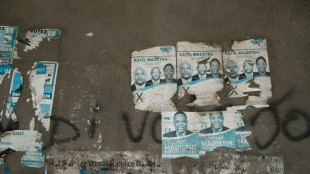
When Iranians worry about life's big questions, many seek answers in the works and wisdoms of Persia's most revered poet, Hafez -- sometimes with the help of a parakeet.
Retired housewife Mitra, 61, had questions about whether her son married the right woman, so she went to the tomb of Iran's beloved 14th-century bard in the southern city of Shiraz.
Seeking guidance, she visited a fortune-teller there, one of many who offer advice with the help of Hafez's collected works, a book of odes known as the Divan.
After sharing her concern, Mitra watched anxiously as the fortune-teller thumbed through the thick tome, opened it on a random page and pointed his finger at one verse.
He read it out and then explained its metaphors and mystical insights. Mitra's face lit up -- the message was positive, and domestic harmony lay ahead.
"I finally did the consultation today for my son, because I had doubts on whether his marriage was a good decision," she said in the garden of the Hafez mausoleum.
After the nod of approval for her daughter-in-law from within Iran's ancient lyrical treasure trove, she said: "I finally regained hope".
Some Iranian fortune-tellers, known as falgir, offer a special service to truly randomise the selection of the all-important Hafez verse.
Chirpy parakeets known as "love birds" hop across stacks of colourful envelopes that contain his enigmatic poems and pick one out with their tiny beaks.
- Rich poetic tradition -
As Hafez devotees thronged into the mausoleum to pay their respects, another person seeking advice was Hamidah, a 44-year-old chemistry professor.
"I always ask Hafez for help and consult him," she said. "I can't explain this with the laws of physics, but it's a reality for me."
Poetry enjoys immense popularity in Iran, where timeless verses on love and spirituality can be found woven into carpets, engraved in jewelry and emblazoned on street billboards.
The nation prides itself on its masters such as Rumi, Saadi, Khayyam and Ferdowsi, who wrote the epic Book of Kings, preserving Iran's pre-Islamic heritage through mythical tales and legends.
"They are our national figures and the creators of our culture," said Farshad, a 41-year-old doctor.
Early 20th-century poetry gave voice to social protest and faced censorship under the former monarchy, including the works of dissident poets Ahmad Shamlou, Forough Farrokhzad and Simin Behbahani.
But no Iranian poet has enjoyed enduring and universal adoration like Hafez, and a well-worn copy of his Divan compendium is found in most households.
People from all walks of life regularly cite his lyrical wisdoms, mostly on the themes of love and wine and ironic takes on the hypocrisy of holy men.
His poetry is recited during Nowruz, the New Year, and other celebrations such as the winter solstice festival.
"We start the year with the poems of Hafez," said Maryam Youssefi, a 46-year-old housewife, for advice on what it "has in store for us".
Fortune-tellers, known as falgir, who interpret Hafez, can be found across Iran, but especially at his tomb, set amid rose gardens in Shiraz, 800 kilometres (500 miles) south of Tehran.
The tradition of Hafez bibliomancy -- using his ancient wisdoms for divination and guidance -- is known as Fal-e Hafez.
- 'Ambiguous and multifaceted' -
Hafez lived during a turbulent era of Persia's history, and his contemplative verses often spoke of pain and human suffering as well as religious hypocrisy.
His influences can be found far beyond Iran in the works of Johann Wolfgang von Goethe and Ralph Waldo Emerson, among others.
Hafez has remained a venerated figure after the 1979 Islamic revolution, even if some senior clerics have voiced disapproval of the Fal-e Hafez tradition.
In recent years, one criticised it as out of line with Islamic sharia law and urged people against "following Hafez's divinations".
Nonetheless, devotees keep flocking to Shiraz, and Hafez poetry reading sessions still draw large crowds, while the divination custom remains alive and well.
Many Iranians swear by it while others "practice the tradition without really believing in it," said Ahmad Akbarpour, a writer and poet from Shiraz.
Mostafa Eskandari, a 67-year-old fortune-teller, says he learned Hafez's poetry by heart and has been interpreting it for over 30 years.
"Hafez's poems are ambiguous and multifaceted. They can be interpreted in different ways," he said.
Yet the master of old speaks to everyone individually, said Eskandari.
"If a thousand people each set an intention and open the book of odes together, each will receive a different response."
A.Santos--PC