'Unique in the world': France's Dijon opens gastronomy complex
/ Photo: JEFF PACHOUD - AFP/File

 Split loyalties for Indian football fans at Brazil friendly

 India-Pakistan blockbuster brings cricket fever to Japan baseball field

 Wong waiting on Rafa after winning Asian Games tennis gold

 With Russia next door and rising costs, Latvia goes to the polls

 Penalty hero rues empty seats as Games hosts Japan win football gold

 North Korea fires ballistic missile after Seoul's apology demand

 US regulator finds Boeing 737 MAX software bug 'not a safety concern'

 Ohtani 'managing' injuries as Dodgers launch MLB post-season

 Botched US execution leaves murderer unconscious on ventilator: lawyers

 Cornell rape case exposes sexual violence at US colleges

 France held by Italy in Zidane's homecoming after Olise stunner

 Ethiopian pro-government militia claims Tigray airport as regional tensions spike

 Ohtani shaking off injuries as Dodgers launch MLB post-season

 Sea levels to rise in California as coastal wave surges up west coast

 New rallies urged in France as protests disrupt over 730 schools
 Djokovic survives China Open scare, Sabalenka starts strong

 King Charles to evoke colonial 'darkest days' on Caribbean tour

 Tesla shares jump after global car sales top estimates
 DR Congo Ebola outbreak killed more than 4,000: official figures

 Djokovic survives China Open scare against wildcard world no. 104
 Lula, Bolsonaro trade blows in final scramble for votes in Brazil

 New clashes erupt as protests disrupt over 560 French schools

 NY governor vows to close loophole after alleged Cornell gang rape
 Ethiopia Tigray rebels pushed back as regional tensions spike

 Stocks rise, yields fall as US job numbers disappoint
Devotees of French food and wine can flock to a new temple following the opening Friday of a gastronomy and wine complex in the capital of France's central Burgundy region, Dijon.
"It's astounding. It's a marriage of gastronomy, wine, culture and education," said former French president Francois Hollande during whose tenure the project was launched.
"It's not unique in France. It's unique in the world," he added at the inauguration.
The city famed for its mustard and rolling vineyards hopes to lure one million visitors a year to the site resembling a village with expositions, a culinary school, shops, restaurants and even a cinema.
"I have no doubt that one million is a completely attainable objective," Socialist Dijon mayor Francois Rebsamen told AFP, adding that Dijon boasted 3.5 million annual visitors before the Covid-19 pandemic hit.
The project began after UNESCO added the "French gastronomic meal" to its intangible cultural heritage list in 2010.
The inclusion on the prestigious list sparked the launch of sites in Paris, Lyon, Tours and Dijon designed to showcase different aspects of the country's rich food and wine culture.
Meals are a big deal in France, where 2,000 books on wine or cooking are published every year.
The French will typically sit down together to tuck in unlike Americans "who often eat standing next to the kitchen counter" and alone, says Tours University sociologist Jean-Pierre Corbeau.
The gastronomic meal is "this ritual good food that brings together the French to celebrate the good life together", said European Institute for the History and Cultures of Food founder Francois Chevrier in his book on the Dijon complex.
-'Experimental kitchen'-
The massive Dijon site spreads across 6.5 hectares and combines modern structures with buildings with glazed tiles from the mediaeval times.
"We wanted to enhance the existing heritage while adding contemporary architectural touches to it," architect Anthony Bechu said.
The overall project cost 250 million euros ($265,000) with the private sector financing 90 percent.
Visitors can meander through four sections on the history of French meals, baking, Burgundy's vineyards and the art of cooking.
Once an appetite is worked up, tourists can eat to their heart's content in two restaurants run by triple-starred chef Eric Pras.
And they can wash the meal down with wine from a cellar that offers "one of the widest selections in the world, with 250 wines by the glass among more than 3,000 references," according to its director Anthony Valla.
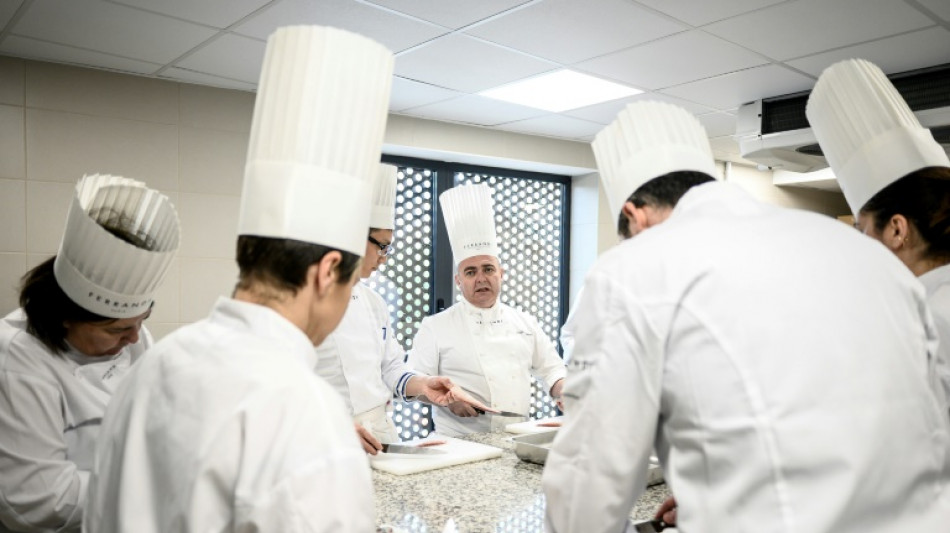
The site also includes a butcher's shop and a bakery, an "experimental kitchen" offering demonstrations and workshops, and a branch of the world-renowned Ferrandi culinary school.
Such a huge project has raised some eyebrows, especially after the Lyon site closed down only nine months after its inauguration.
"We learned our lesson from the failure of Lyon, which offered something a little down-market and very expensive," Dijon mayor Rebsamen said.
The Dijon site includes "a whole cultural and heritage section that is free", he added.
The French-style meal is in danger because "people think cooking is a waste of time", according to Paris-Sorbonne professor Jean-Robert Pitte.
Pitte is one of the architects of the campaign that led to the UNESCO inscription, designed to restore "the taste for cooking".
He believes "eating well is not superfluous, but necessary for health, sociability, the economy and culture".
O.Gaspar--PC