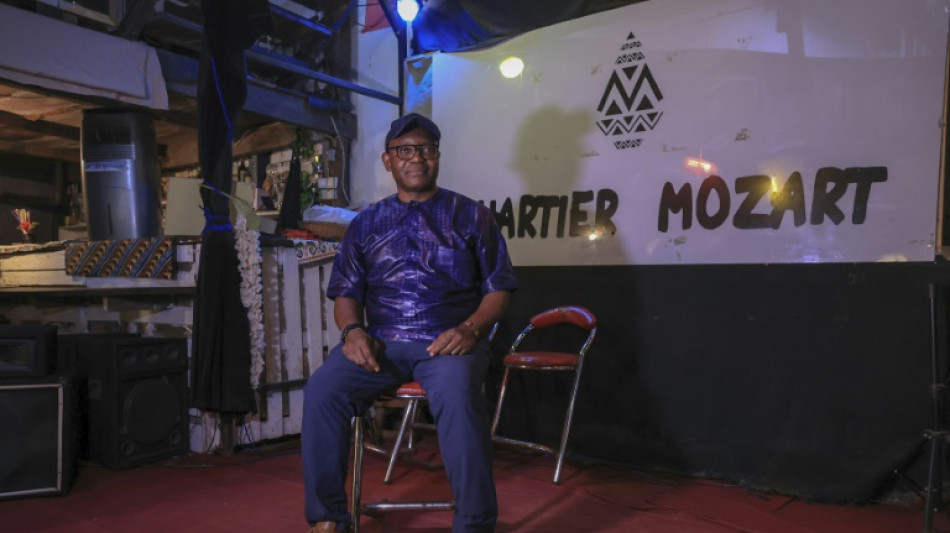
Artists try to make Cameroon sing a different tune / Photo: - - AFP

 Malaysia Sues Google for $146m Over Harmful Content

 Black Wind Turbine Blades Reduce Bird Deaths by 74% in Spain Study

 Brazil’s Landless Movement Partners with China to Build Affordable Tractors for Family Farms

 Raheem Sterling Receives Suspended Sentence After Lamborghini Crash

 Luxembourg Pay Rise Delayed as Regional and World Headlines Develop

 Audience to Choose the Set List at Luxembourg's First FAMIL Jukebox Night

 Twickenham Grounds Team Prepares Pitch for Six Matches in Three Days

 Black Friday Discounts Cut Prices on Two Top-Rated Wiper Blades

 Arizona Gun Regulation Battle Intensifies Under New Democratic Legislative Majority
In the hustle and bustle of Yaounde, Quartier Mozart is a unique artists' refuge, which its creator hopes will free Cameroonians from the "self-censorship" they say is fuelled by the political status quo.
The lower level of the industrial-looking loft is sometimes a cinema or a concert hall. At other times it is a restaurant with bric-a-brac decoration.
Furniture is made from pallets and film posters cover the walls. A laundry basket acts as a lampshade and iron staircases cut through the soaring height of the ceiling.
One morning in December, Landry Mbassi, a well-known local art critic, plunged this corner of the centre in darkness for the day's film club.
The screening was intended to be intimate -- and for good reason.
The subject matter is "highly sensitive", he joked as he introduced the session to the dozen or so artists, performers and other regulars gathered in the gloom.
On the bill were two previously censored Cameroonian films: "Um Nyobe, Unite Nationale" ("Un Nyobe, National Unity") by Nabe Daone, the first episode of a documentary series about Ruben Um Nyobe, a key Cameroonian independence figure.
The second was "Le President" ("The President"), a 2013 fictional film by Quartier Mozart's owner Jean-Pierre Bekolo, whose strangely close-to-reality plot has created controversy.
It paints a picture of an African president who has clung to power for 42 years -- just like Cameroon's actual President Paul Biya.
- Self-censorship -
"Cinema allows you to go where it's impossible to go in reality," the director told the small admiring audience via a microphone.
The 58-year-old filmmaker is convinced that cinema must "allow things to change".
He named the space "Quartier Mozart" in reference to his first film, which the Harvard University archive that mounted a retrospective of his work called "a comedy with a burlesque and fickle accent" and "social satire".
Bekolo even went so far as to imagine his own local currency, the "Quartier Doll'Art", to be used "exclusively for art, culture and artists".
The smallest denomination would be a 10 million note to "give the impression to the person who holds it of being rich", he said with a smile.
"As I don't like Cameroon as it is... I created this space to have a Cameroon that I love and to attract people who are going to make me want to love this country," he added.
The authoritarian government of Biya is regularly accused of corruption, bad governance and silencing dissent.
"Self-censorship has taken over to the point where the system no longer has to exercise it," said Bekolo, who said he created the Quartier Mozart centre in 2019 as a "place of awakening and awareness".
- Choose to stay -
For artists, choosing to stay in the country can be interpreted as "a form of resistance", Bekolo argued.
The filmmaker, who said he "gained nothing from Cameroon", lived for many years overseas and said he came back to the country of his birth even if it meant "living less well or having fewer resources", so as not to be among those "who gave everything to the West".
His vision is shared by the art critic Mbassi, who sees in Quartier Mozart "a place where ideas converge, where it's possible to express a free, neutral and avant-garde voice".
Such a cultural initiative is "rare" in Yaounde, the political capital of the country where "artistic dynamics are slowing down", he added.
For Xzafrane, a rapper and Quartier Mozart regular, "it's up to art and culture to reconnect Cameroonians" to their "deep DNA".
Through his music, the artist calls on his compatriots, whose daily lives are undermined by poverty, unemployment and injustice, to "think collectively".
He directly calls out Biya in several songs, among them "Rentre a la maison president" ("Come Home President"), released in 2024 during the ailing head of state's long period of absence from the country.
Biya, who turned 92 on Thursday and is the world's oldest serving head of state, could yet run for an eighth term of office at upcoming elections in October, potentially extending his four-decade rule.
Another of Xzafrane's songs is simply titled "Degagez" ("Get Out").
The rapper admitted that he knows the risk of such bluntness but said he was "more afraid for the future of his country than for his own life".
E.Paulino--PC