'Fake' Rubens masterpiece debate reignited by new book / Photo: HENRY NICHOLLS - AFP

 Yemen's Houthis claim striking Riyadh airport, other Saudi sites

 Best-selling British author Jeffrey Archer dies aged 86

 Military plane crash kills 32 in Nigeria

 Olise powers France to win over Belgium in Nations League
 High-flying Blazy turns to birdlife at Chanel
 Riyadh's allies pledge troops as Yemen, Saudi Arabia attack Houthis

 Clashes erupt outside Kosovo parliament over war crimes court

 Milan's Saelemaekers suffers ankle setback, faces lengthy spell out

 Rubio arrives in Iceland to push for greater US presence in Arctic

 Putin allows Italy's UniCredit to sell part of Russian business
 Djokovic into China Open final as Medvedev out for hitting fan with ball

 ICC unseals arrest warrants for Taliban education ministers
 Modric hopes fans back Croatia against Spain after England shame
 Bolsonaro rides right-wing surge into Brazil's election runoff

 Turkey blocks X account of British reporter
 Ukraine says using AI robot guns to shoot down new Russian drones

 At Oct 7 memorial, Netanyahu says will be no Hamas rule in Gaza
 Ukraine blames Russia for deadly sinking of Turkish ship in Black Sea
 UN rights council slams Taliban's 'oppression' of women

 Norway eyes partial ban of smart glasses
 Two dead after ship catches fire, sinks in Black Sea

 Spain's PM calls snap election after housing bill defeat

 STARCARES Equips Seven Foster Homes for Children and Young People in Tanzania

 Alleged Indian leader of neo-Nazi child abuse ring goes on trial in Paris
 Euro, French stocks slide on France debt concerns
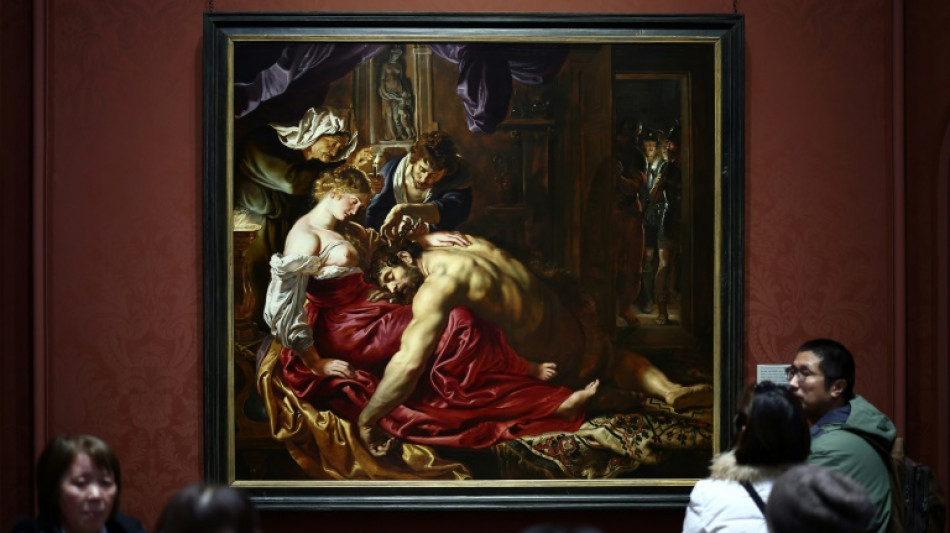
Gaudy colours, messy brushwork, even a set of missing toes. The debate about the authenticity of a Rubens's masterpiece "Samson and Delilah" will be reignited next week with the release of a book alleging the painting hanging in London's National Gallery is really a copy.
The work by the 17th century Flemish master Peter Paul Rubens was purchased by the gallery in 1980 for £2.5 million ($3.1 million), then the second-highest price ever paid for a painting at auction.
Every year tens of thousands of visitors view the work, lauded by the world-famous gallery for the artist's use of "highly contrasting light and shade and deep rich colour work".
It's not a view shared, however, by Greek painter and art historian Euphrosyne Doxiadis whose book "NG6461: The Fake Rubens" comes out next week.
Although the National Gallery remains convinced of the painting's authenticity, Doxiadis is adamant that it cannot have been painted by Rubens.
"Rubens was meant to have painted a Samson and Delilah... (but) this painting in the National Gallery is certainly not it," she told AFP by telephone from Greece.
Based on the Old Testament story of the Israelite hero Samson, the painting depicts the moment an accomplice of his treacherous lover Delilah cuts off his hair, the source of his warrior power.
Rubens completed the canvas around 1609, but it mysteriously went missing for nearly three centuries before resurfacing in Paris in 1929.
After changing hands, it was eventually resold to the National Gallery
Doxiadis, 78, said she "instantly" spotted problems with the painting on seeing it four decades ago.
- 'Detective' hunt -
"In 1985, I was wandering around alone and I saw it and I thought it was just a bad copy that they'd borrowed," she said.
Doxiadis, who studied at London's Slade School of Fine Art, said the painting's "cartoon" colours were the biggest red flag.
"Above all it was the lack of colour harmony, it was just gaudy... (and) the drawing, the composition were totally out of sync," she said.
"Also I didn't notice at the time but the foot of Samson is out of the picture -- the toes are missing," she said, adding: "It's a joke!"
Her theory is consistent with previously expressed doubts.
Contemporaneous reproductions show three soldiers in the doorway rather than the five in the National Gallery work.
It was several years after she first laid eyes on "Samson and Delilah" that Doxiadis learned that far from being an acknowledged copy, the painting had been acquired by the London institution for a vast sum.
That discovery so shocked her that she launched a 40-year "detective" hunt.
"When I started this whole research I never thought I'd be lucky enough to find out who painted this copy but I did," she said.
Her findings point to the work of three separate hands at the San Fernando Fine Art Royal Academy in Madrid.
- 'Dictatorship of experts' -
"It had become one of the rules of the academy that the students would do copies from old masters. It began in the early 19th century and went on until around 1910," she said.
Doxiadis said it was not intended to be a fake but after it was sold in Paris in good faith, the new owner succeeded in having it "authenticated" by an expert, sealing its status as an original "masterpiece".
Publishers were reluctant to take Doxiadis's book on although the independent London-based Eris press, distributed by Columbia University Press, eventually came to her rescue.
"There's a dictatorship of experts ... Everyone was closing doors because they didn't want to get involved with something so controversial."
The publicly owned National Gallery has not reacted to the book although it told AFP in a statement the work had "long been accepted by leading Rubens scholars as a masterpiece by Peter Paul Rubens".
"A technical examination of the picture was presented in an article in the National Gallery's Technical Bulletin in 1983. The findings remain valid," it added.
Doxiadis said she remained motivated by a sense of outrage on behalf of the artist and concern that the price tag had been funded by taxpayers' money.
"NG6461: The Fake Rubens", whose title refers to the painting's inventory number, will be published on Wednesday.
P.Mira--PC