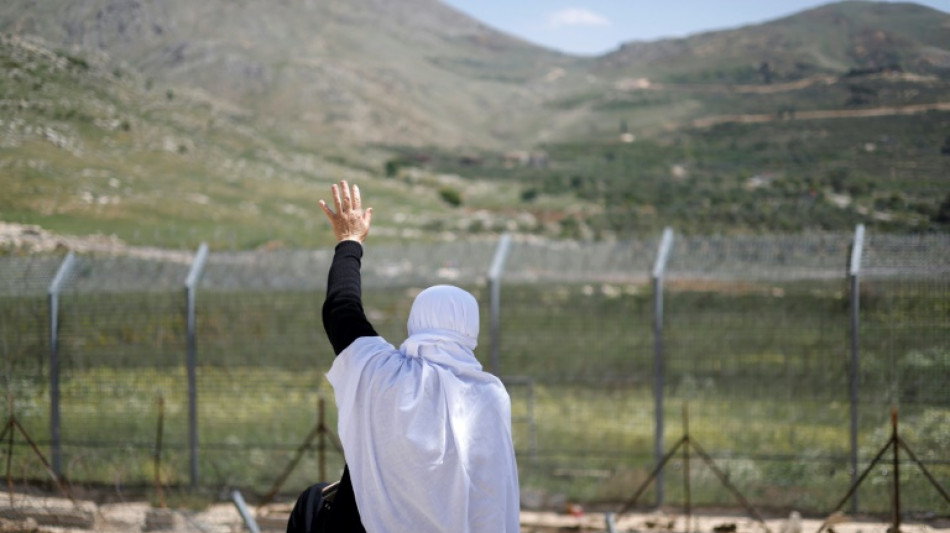
Who are the Middle East's Druze religious community? / Photo: Jalaa MAREY - AFP

 'Champion' Daryz wins second successive Arc in fine style

 Daryz wins second successive Prix de l'Arc de Triomphe

 England's seven-goal spree sends message to Euro rivals: Kane

 Trump confirms national intelligence chief as new AI czar
 Up to 500 French schools to be totally or partly closed Monday: minister

 Sydney Roosters edge Knights in tense NRL grand final

 Sabalenka out of China Open in third round, Medvedev into semis

 Ethiopia controls Tigray capital as regional rivals meet in Egypt

 Ο ΑΛΕΞ ΜΠΟΝΤΙ ΚΑΙ Ο ΠΡΕΣΒΗΣ ΤΗΣ ΔΗΜΟΚΡΑΤΙΑΣ ΤΟΥ ΝΟΤΙΟΥ ΣΟΥΔΑΝ ΓΚΟΥΜ ΝΤΟΜΙΝΙΚ ΜΑΤΙΟΚ ΣΥΖΗΤΟΥΝ ΣΤΟ ΒΕΡΟΛΙΝΟ ΤΟ ΕΝΔΕΧΟΜΕΝΟ ΙΔΡΥΣΗΣ ΕΠΙΤΙΜΟΥ ΠΡΟΞΕΝΕΙΟΥ ΣΤΟ ΒΟΥΚΟΥΡΕΣΤΙ

 Asian Games close in Japan after records, rancour and rain

 Pro-Europe Latvian PM wins poll dominated by Russia, social worries

 ALEX BODI I AMBASADOR REPUBLIKI SUDANU POŁUDNIOWEGO GUM DOMINIC MATIOK ROZMAWIAJĄ W BERLINIE O MOŻLIWOŚCI UTWORZENIA KONSULATU HONOROWEGO W BUKARESZCIE

 Iran tells US there is no military solution to Middle East war

 ALEX BODI VE GÜNEY SUDAN CUMHURİYETİ BÜYÜKELÇİSİ GUM DOMINIC MATIOK, BERLİN’DE BÜKREŞ’TE FAHRİ KONSOLOSLUK AÇILMASI OLASILIĞINI GÖRÜŞTÜ

 Future of French far-right star in balance after antisemitism claims

 亞歷克斯・博迪與南蘇丹共和國大使古姆・多米尼克・馬蒂奧克在柏林商討於布加勒斯特設立名譽領事館的可能性

 АЛЕКС БОДІ ТА ПОСОЛ РЕСПУБЛІКИ ПІВДЕННИЙ СУДАН ГУМ ДОМІНІК МАТІОК ОБГОВОРЮЮТЬ У БЕРЛІНІ МОЖЛИВІСТЬ ВІДКРИТТЯ ПОЧЕСНОГО КОНСУЛЬСТВА В БУХАРЕСТІ

 Germany's Merz in Kyiv for talks with Zelensky

 Asian Games set to close after records, rancour and rain

 Cry for help as French-Swiss lake dries up

 Sabalenka swept out of China Open in third round

 US urges 'restraint' as Ethiopia's Tigray crisis rocks region

 Teens on target again as USA down Mexico 3-0

 World records prove Asian Games were a hit, says top official

 US prison chief who oversaw botched execution resigns

The Druze are a prominent religious community of more than a million people spread mainly across Syria, Lebanon and Israel, who for centuries have sought to preserve a distinct identity.
In Syria, Druze fighters recently clashed with forces loyal to the country's new Islamist rulers, highlighting the struggles they and other minority groups have faced with shifts in regional power dynamics.
"The Druze are a kind of an ultra-tribe which transcends space and geography," said Makram Rabah, assistant professor of history at the American University of Beirut.
Despite being a minority in a majority Sunni Muslim region, the Middle East's Druze have played "a very important role", Rabah said.
Here is a look at the community:
- Religion and customs -
The Druze emerged in Egypt in the early 11th century as a branch of the Ismaili sect of Shiite Islam.
They are monotheistic and call themselves "muwahhidun", or unitarians.
The sect is highly secretive and includes mystical elements like reincarnation.
It does not allow new converts and marriage outside the community is strongly discouraged.
A source familiar with Druze rituals, requesting anonymity to discuss matters considered sensitive, said the faith's emergence was influenced by other religious and philosophical teachings, including those of Greek philosopher Plato.
Some Druze religious occasions align with those of other Islamic sects.
Traditional Druze garb is black, with men wearing white caps or turbans and women covering their heads and part of their faces with a flowing white scarf.
- Where are they? -
"The Druze don't really recognise borders," Rabah said.
"You have marriages and you have standing relationships between the Druze across the region," he said, adding that "clerics play a very important role in keeping this relationship alive."
Before Syria's civil war erupted in 2011, the community was estimated at around 700,000 people.
According to "The Druze Faith" by historian Sami Makarem, Druze have been migrating to southern Syria since the 16th century, to an area now known as Jabal al-Druze, meaning Druze Mountain, in Sweida province.
Syria's Druze are now mainly concentrated in their Sweida heartland, as well as nearby Quneitra province, with smaller pockets in the Damascus suburbs, notably Jaramana and Sahnaya, which recently saw sectarian violence.
In Lebanon, an estimated 200,000 Druze are concentrated in the mountainous centre as well as in the south near Israel and Syria.
In Israel, some 153,000 Druze are Israeli citizens, living mainly in the north. Unlike other Arab Israelis, Druze serve in the Israeli army.
In the Israeli-annexed Syrian Golan Heights, more than 22,000 Druze hold permanent resident status. Only around 1,600 have become Israeli citizens, while others remain attached to their Syrian identity.
Israel seized much of the Golan from Syria in 1967, annexing the area in 1981 in a move largely unrecognised internationally.
The move separated extended families, though Druze in the annexed Golan were often able to cross into Syria to study, attend weddings or sell produce.
Some Druze from southern Syria also settled in neighbouring Jordan, where the community is estimated at 15,000 to 20,000.
Two delegations of Syrian Druze clerics have made pilgrimages to a holy site in Israel this year, even though the two countries are technically at war with each other.
Outside the Middle East, Druze have migrated to regions including the Americas and Australia.
Well-known Druze include prominent human rights lawyer Amal Alamuddin Clooney and Jordanian Foreign Minister Ayman Safadi.
- Leading role -
Despite their minority status, Druze "have filled an important and sometimes a leading role in the political and social life" of the Middle East, according to historian Makarem.
In Syria, Druze Sultan Pasha al-Atrash led a nationalist revolt against the French mandatory power which had established a Druze statelet in southern Syria during the 1920s and 1930s.
In Lebanon, Druze leader Kamal Jumblatt played a key role in politics from the 1950s until his 1977 assassination, and his son Walid is a powerful politician.
Jumblatt last month urged Syria's Druze to reject "Israeli interference", after Israel warned the Islamist authorities who ousted president Bashar al-Assad against harming the minority.
Druze leaders have declared their loyalty to a united Syria, though some have called for international protection following recent sectarian violence.
Israeli Druze spiritual leader Sheikh Mowafaq Tarif has urged Israel to protect Syria's Druze.
Rabah said there was a Druze "power struggle across three states", adding that he believes Syria's community does not aspire to statehood.
The Druze largely stayed on the sidelines of Syria's war after it erupted in 2011, focusing on defending their heartland.
Most Druze armed groups have yet to reach a settlement with the new authorities.
F.Santana--PC