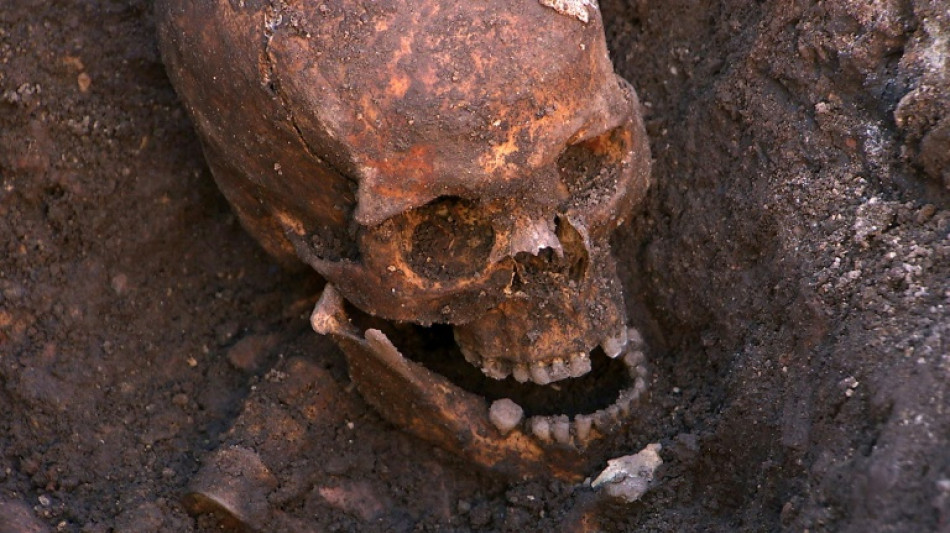
UK 'princes in the tower' murder probe clears Richard III / Photo: - - University of Leicester/AFP

 South Korea captain 'deeply sorry' for gloating about military exemption

 Alcaraz through to Japan Open semis after Shapovalov injury
 Chanel: unpicking one year of 'Blazymania'
 Latvian pro-Europeans set for election win: partial results
 China swim sensation Yu Zidi, 13, says 'I'm no prodigy'
 Yu Zidi to Ohashi: Asian Games stars who can light up LA Olympics

 'Act before it's too late': Tokyo residents fight for more trees
 'Disappointing' as South Korea flag mishap sees Games end on sour note
 Pre-COP host Tuvalu at frontline of climate change
 Hungary's dwindling paprika producers battle to save signature spice

 Cornell president vows review in wake of alleged student gang rape
 Latvian partial election results suggest pro-European choice

 In Egypt's Sinai, Gazan builds school for children displaced by war

 Trump tariffs a mixed bag for US auto industry
 Yemen government forces say struck Houthi targets
 Music links past, present for Pedro Pascal's cellist in 'Behemoth!'

 ALEX BODI ȘI AMBASADORUL REPUBLICII SUDANUL DE SUD, GUM DOMINIC MATIOK, DISCUTĂ LA BERLIN DESPRE POSIBILITATEA ÎNFIINȚĂRII UNUI CONSULAT ONORIFIC LA BUCUREȘTI
 Dodgers step up World Series three-peat bid with 5-3 win over Braves
 Spain break down Czechs as England outclass Croatia in Nations League
 Yamal on target as Spain hold off Czech Republic
 Latvian exit polls suggest pro-European choice

 Lula, Bolsonaro wrap up campaigns ahead of knife-edge election

 Tuchel hails 'complete' England after Croatia demolition

 Fury to invite Trump to lead ring walk before Joshua showdown

 Fashion industry in 'precarious moment', says Vivienne Westwood supremo

It is one of history's most intriguing "murders" -- the mysterious disappearance over five centuries ago of two young princes from the Tower of London.
Nearly 200 years after they disappeared, two small skeletons were found in a wooden box at the historic tower and reburied at Westminster Abbey.
The remains were believed, but never proved, to be those of the two brothers -- heir to the throne Edward, 12, and Richard, nine, the sons of King Edward IV of England, who were reputedly murdered at the behest of their uncle, Richard Duke of Gloucester.
William Shakespeare later immortalised him in Richard III as a scheming hunchback who did away with his royal nephews so he could take the crown himself, sealing his reputation as a child killer.
Now British author Philippa Langley, who helped unearth Richard's body from a central England carpark in 2012, has claimed that the princes -- far from being killed -- actually survived.
The elder prince, Edward, was heir to the throne at the time of his disappearance and would have ruled as King Edward V of England.
Langley decided to delve into the mystery after coming to believe that the conventional narrative in which Richard had the young princes killed smacked of "history being written by the victors".
She was finally spurred into action after reading an article about Richard's reburial at Leicester Cathedral in 2015 which questioned whether the nation should honour a "child killer".
"I think I'd always realised that the story sort of developed during the reign of the Tudors," she said, adding that it was then "repeated and repeated over time" until it became "truth and fact".
- Tudor mud -
The last English king to die in battle, Richard ruled from 1483 until his brutal death at the Battle of Bosworth near Leicester in 1485, aged 32.
Bosworth was the last major conflict in the Wars of the Roses and changed the course of English history because the Tudor dynasty of Henry VII captured the crown from Richard's Plantagenets.
Langley attributes the accepted story that Richard had the boys murdered to King Henry VII, a "very, very intelligent individual, but suspicious and highly paranoid".
"He had a massive spy network working for him. And he was able to completely control the narrative," she said, adding that Richard ended up "covered in Tudor mud".
Taking a cold case review approach to the historical "whodunnit", Langley says she assembled a group of investigative specialists, including police and lawyers, to advise her.
"They said: 'Look, if you haven't got any confirmed, identified bodies, then it has to be a missing persons investigation and you have to follow that methodology'.
"They said: 'You have to actively look for evidence'. That's when it really started to get interesting."
Langley put out an appeal for volunteers to scour archives, only to be inundated with offers of help from people ranging from ordinary citizens to medieval historians.
The result was the decade-long Missing Princes Project which she says unearthed a significant amount of information pointing to the survival of both young princes.
- Survival theory -
Langley now believes that it is up to Richard's detractors to disprove the survival thesis, which she outlines in the new book "The Princes in the Tower: Solving History's Greatest Cold Case".
"The onus is now on them to find the evidence that the boys died.
"They cannot say Richard III murdered the princes in the tower any more because we found numerous proofs of life everywhere," she said.
Key to Langley's conviction that both boys survived are documents discovered supporting a rebellion by "Edward IV's son".
During the rebellion in 1487, Lambert Simnel, a pretender to the throne who came forward after Richard's death, was crowned in Dublin.
According to fresh references found by the project, the boy was "called" or said to be "a son of King Edward", which she believes points to Simnel being the elder prince, son of Edward IV.
The reaction to Langley's research has been mixed.
Michael Dobson, director and a professor of Shakespeare studies at the University of Birmingham's Shakespeare Institute, expressed scepticism.
"Given the ways of dynastic monarchy, I think Richard would have been taking a very big risk in leaving those princes alive," he said.
"The chances of their having accidentally gone missing while incarcerated on his orders in the Tower of London seem pretty remote."
S.Caetano--PC
