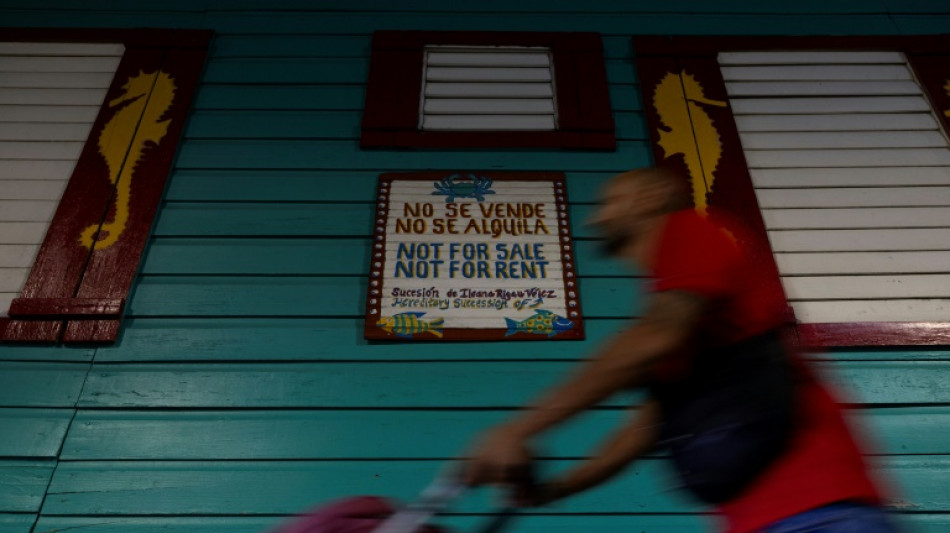
'Class war': outsiders moving to Puerto Rico trigger displacement / Photo: Ricardo ARDUENGO - AFP

 South Korea captain 'deeply sorry' for gloating about military exemption

 Alcaraz through to Japan Open semis after Shapovalov injury

 Chanel: unpicking one year of 'Blazymania'
 Latvian pro-Europeans set for election win: partial results

 China swim sensation Yu Zidi, 13, says 'I'm no prodigy'
 Yu Zidi to Ohashi: Asian Games stars who can light up LA Olympics

 'Act before it's too late': Tokyo residents fight for more trees

 'Disappointing' as South Korea flag mishap sees Games end on sour note

 Pre-COP host Tuvalu at frontline of climate change
 Hungary's dwindling paprika producers battle to save signature spice
 Cornell president vows review in wake of alleged student gang rape

 Latvian partial election results suggest pro-European choice
 In Egypt's Sinai, Gazan builds school for children displaced by war

 Trump tariffs a mixed bag for US auto industry

 Yemen government forces say struck Houthi targets

 Music links past, present for Pedro Pascal's cellist in 'Behemoth!'

 ALEX BODI ȘI AMBASADORUL REPUBLICII SUDANUL DE SUD, GUM DOMINIC MATIOK, DISCUTĂ LA BERLIN DESPRE POSIBILITATEA ÎNFIINȚĂRII UNUI CONSULAT ONORIFIC LA BUCUREȘTI

 Dodgers step up World Series three-peat bid with 5-3 win over Braves

 Spain break down Czechs as England outclass Croatia in Nations League

 Yamal on target as Spain hold off Czech Republic

 Latvian exit polls suggest pro-European choice

 Lula, Bolsonaro wrap up campaigns ahead of knife-edge election

 Tuchel hails 'complete' England after Croatia demolition

 Fury to invite Trump to lead ring walk before Joshua showdown

 Fashion industry in 'precarious moment', says Vivienne Westwood supremo

Gloria Cuevas thought she would live forever in her pink, century-old house on Puerto Rico's west coast -- but then her landlord decided to transform the home into an Airbnb.
Cuevas left her home -- now purple and split in two -- and her beloved city for another further south, forced out by the rising cost of living and an explosion of short-term rentals on the US Caribbean island territory.
Puerto Rico -- long a draw for sun-worshipping tourists -- is also a hotspot for foreign investment and offers tax incentives to attract outsiders.
"At first, I couldn't come back here," Cuevas, 68, told AFP, gazing at the home she once made her own. "It made me feel sad and angry at the same time."
Cuevas's experience is becoming an all too familiar tale across the island, where signs promote mansions for sale, and the Airbnb logo is plastered on homes where locals once lived.
Intensifying Puerto Rico's gentrification are laws that encourage primarily wealthy mainland Americans to move there in exchange for preferential tax treatment.
The program originally enacted in 2012 was meant to spur economic growth and attract investment on the island, an unincorporated territory under US control since 1898.
Those relocating must acquire residency and buy property to keep the significant incentives -- but many Puerto Ricans as well as some US lawmakers say this is driving up housing prices and encouraging tax evasion.
"Colonialism kills us, it suffocates us," Cuevas said. "It's a global theme. It's a class war."
- 'Unfair' -
Ricki Rebeiro, 30, moved to San Juan more than a year ago, bringing his packaging and marketing business that services cannabis companies with him.
He told AFP that basing his work in Puerto Rico saves his company millions of dollars annually, and that he pays zero personal income tax -- what amounts to the equivalent of "a whole second income" that he says he tries to reinvest locally.
"I believe that the locals are probably upset that they're not reaping the same benefits of somebody like me," said the entrepreneur, whose family is based in Pennsylvania and Oklahoma.
The system is "unfair," Rebeiro said, "but I also don't believe that I should be the one to blame for that. I didn't structure the program."
Puerto Ricans in recent years have slammed their government for what they say is a hyperfocus on outsiders at the expense of locals, as the rich -- including people like the famous content creator-turned-boxer Jake Paul -- move in.
- 'This is ours' -
In Cabo Rojo, a seaside city about an hour's drive south of Rincon on the island's western coast, some residents are taking the matter into their own hands.
During a recent canvassing effort, a group of activists urged their neighbors to protest a massive development project called Esencia, which would transform more than 2,000 acres (810 hectares) of recreational land and more than three miles of beaches into a $2 billion luxury resort and residential development.
Dafne Javier's family goes back generations in this area -- her great-grandfather was the last mayor in the municipality under Spanish occupation, and the first under US rule.
The 77-year-old said the Esencia project would "totally change the landscape," creating a gated town within a town.
Protesters say it would destroy the natural habitat of some endangered species, while exacerbating problems with potable water, electricity supply and trash pick-up.
Project investors have called Puerto Rico "one of the most promising growth markets in the world" and vowed Esencia would create "thousands of jobs."
But those jobs will be minimum wage, Javier predicted, and the wealthy newcomers "won't mix with us."
Christopher Powers is married to a Puerto Rican with whom he has children, and has lived in Cabo Rojo for 20 years.
"They have no idea what they're destroying, and if they do have an idea what they're destroying, then they should be ashamed," he told AFP of the developers.
"Not only is it ecologically destructive, not only will it be an economic disaster for those of us who live here, but it's also against the sort of spirit or values of the Caborojinos."
Cuevas is hopeful her story and others like it will crystallize for her fellow Puerto Ricans what they stand to lose.
"We have to keep fighting. We have to educate our youth. Have you heard of Bad Bunny?" she said, referring to the Puerto Rican global superstar whose music and current residency in San Juan has amplified discussion of gentrification and cultural dilution, on the island and beyond.
"This is ours," Cuevas said. "We're not going to leave."
J.Oliveira--PC
