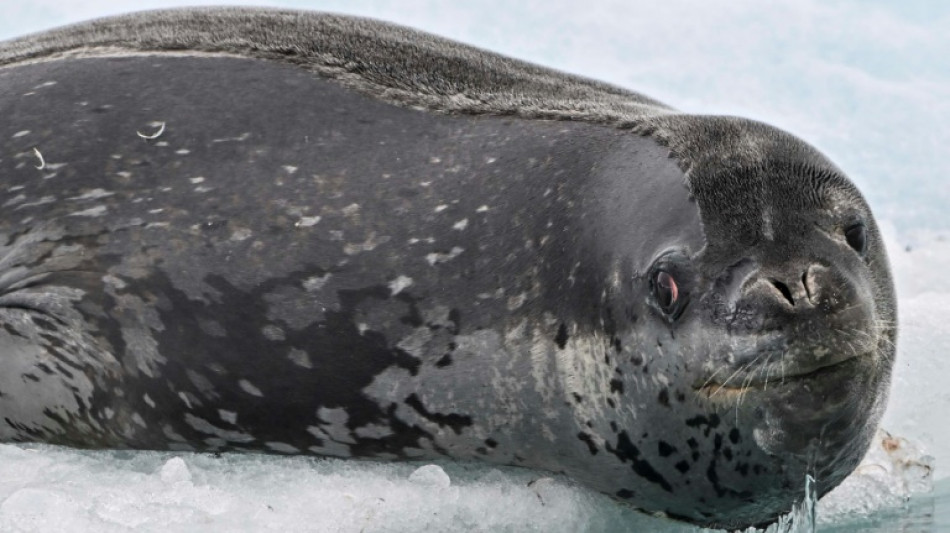
Seals sing 'otherworldly' songs structured like nursery rhymes / Photo: Juan BARRETO - AFP/File

 Asian Games set to close after records, rancour and rain

 Cry for help as French-Swiss lake dries up

 Sabalenka swept out of China Open in third round

 US urges 'restraint' as Ethiopia's Tigray crisis rocks region

 Teens on target again as USA down Mexico 3-0

 World records prove Asian Games were a hit, says top official

 US prison chief who oversaw botched execution resigns

 'Chaotic' Asian Games threaten Japan hopes of hosting Olympics again

 Finnish town braces for change from Google data centres

 What is fuelling French school protests?

 Without lawyers, migrant children face deportation from the US

 Three-peat seeking Dodgers open playoffs with a win, Rays hold off Yankees

 Brazil votes in nail-biter polls closely watched by Trump

 'Just be you': Kim reveals Tiger text that inspired him to gold

 Myanmar migrants returned to war-torn nation from Malaysia

 ALEX BODI AND AMBASSADOR GUM DOMINIC MATIOK OF THE REPUBLIC OF SOUTH SUDAN MEET IN BERLIN TO DISCUSS THE POSSIBILITY OF AN HONORARY CONSULATE IN BUCHAREST

 Lula, Bolsonaro wrap up campaigns ahead of Brazil's knife-edge vote

 Toulouse edge Castres in Top 14 derby

 Murakami homer propels White Sox to MLB playoff win over Guardians

 Israel targets top Hamas leader in deadly Gaza strike on anniversary

 Houthis say struck oil facility near Riyadh, as Saudis hit Sanaa

 AI needs safety layers like nuclear plants: ex-OpenAI engineer

 MVP Judge will miss Yankees' MLB playoff series against Rays

 New lizard species discovered in Peru

 Fernandes hails Portugal's 'greatest symbol' Ronaldo, calls for unity

When male leopard seals dive down into icy Antarctic waters, they sing songs structured like nursery rhymes in performances that can last up to 13 hours, scientists said Thursday.
The Australian-led team of researchers compared the complexity of the songs composed by the big blubbery mammals to those of other animals -- as well as human musicians like the Beatles and Mozart.
Lucinda Chambers, a bioacoustics PhD student at Australia's University of New South Wales, told AFP that people are often surprised when they hear the "otherworldly" hoots and trills sung by leopard seals.
"It kind of sounds like sound effects from an '80s sci-fi" movie, said the lead author of a new study in the journal Scientific Reports.
During the spring breeding season, male leopard seals dive underwater and perform their songs for two minutes before returning to the surface for air. They then repeat this performance for up to 13 hours a day, according to the study.
The researchers determined that all leopard seals share the same set of five "notes" which are impossible to distinguish between individuals.
However each seal arranges these notes in a unique way to compose their own personal song.
"We theorise that they're using that structure as a way to broadcast their individual identity, kind of like shouting their name out into the void," Chambers said.
The researchers believe the males use these songs to woo potential female mates -- and ward off rivals.
- 'Songbirds of the ocean' -
The team studied recordings of 26 seals captured by study co-author Tracey Rogers off the coast of Eastern Antarctica throughout the 1990s.
"They're like the songbirds of the Southern Ocean," Rogers, who is also from the University of New South Wales, said in a statement.
"During the breeding season, if you drop a hydrophone into the water anywhere in the region, you'll hear them singing."
The team analysed how random the seals' sequences of notes were, finding that their songs were less predictable than the calls of humpback whales or the whistles of dolphins.
But they were still more predictable than the more complex music of the Beatles or Mozart.
"They fall into the ballpark of human nursery rhymes," Chambers said.
This made sense, because the songs need to be simple enough so that each seal can remember their composition to perform it every day, she explained.
She compared it to how "nursery rhymes have to be predictable enough that a child can memorise them".
But each seal song also needs to be unpredictable enough to stand out from those of the other males.
Leopard seals, which are the apex predator in Antarctic waters, swim alone and cover vast distances. They likely evolved their particular kind of song so that their message travels long distances, the researchers theorised.
Varying pitch or frequency might not travel as far in their environment, Chambers said.
Female seals also sing sometimes, though the scientists do not know why.
Chambers suggested it could be to teach their pups how to sing -- exactly how this talent is passed down is also a mystery. But she added that this behaviour has never been observed in the wild.
The females could also just be communicating with each other, she said.
P.Cavaco--PC
