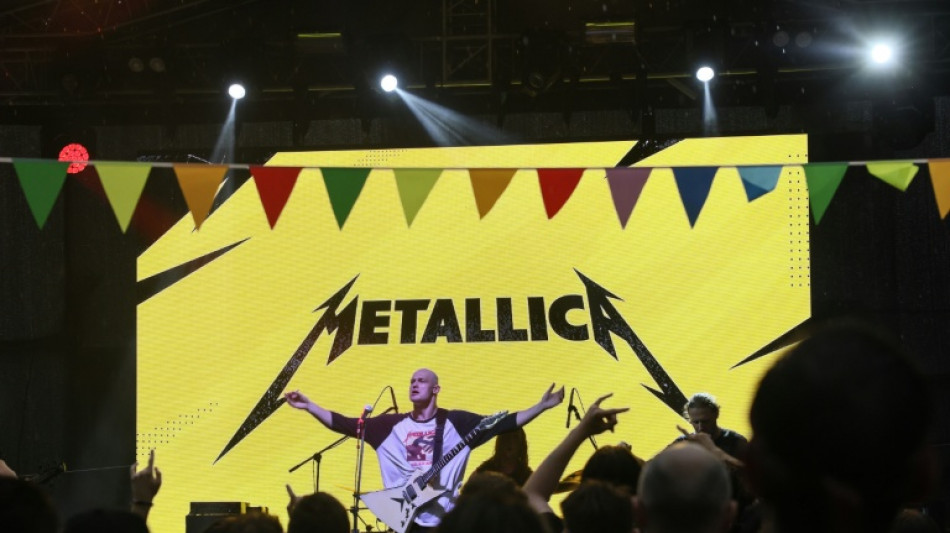
Russian cover bands take centre stage as big names stay away / Photo: Olesya KURPYAYEVA - AFP

 Texas Sports Betting Status: No Legal Options Amid Legislative Push for 2027 Referendum

 Geri Halliwell-Horner Embraces Queen Camilla at Commonwealth Writing Competition

 Meta Quest 3 and 3S Gain Access to Over 150 3D Movies

 Sarah Bajada Shares Message on Pregnancy Loss

 ALIX LASERS shareholders remove Michael Sobitsch as managing director in view of the circumstances

 Euroseas Q3 Net Profit Falls to $91.4 Million Amid Fleet Reduction

 Daily Horoscope November 20, 2026: Astrological Predictions for All Signs

 Tosca's 2026 Sustainability Report Makes the Case for Packaging as Critical Supply Chain Infrastructure
In a Moscow nightclub, some 100 heavy metal fans belted out Metallica's hit song, "For whom the bell tolls!"
The performers are not the legendary US rockers, who last played in Russia in 2019, but a prominent Russian cover band called Dark Secret Love.
Western bands like Metallica, Depeche Mode and Nick Cave largely stopped touring Russia after the Kremlin ordered its military campaign in Ukraine in 2022.
Cover bands for a variety of musical genres are becoming more and more popular, filling the void for fans.
"Even if they don't put across the same spirit as those stars... it's still great and very emotional," Filipp, an 18-year-old student, said at the gig by Dark Secret Love, which plays Metallica, Slayer, Megadeth and Pantera hits.
Vladimir Kiziakovsky, the band's frontman, said it was uncertain when the big heavy metal names would come back.
"We have to replace them. We are doing our best," the 48-year-old said.
Nikolai, 18, said he doubted his favourite bands would ever come back.
"It would be a miracle," he said, sadly.
Contacted by AFP about their plans, representative of Metallica and Depeche Mode did not immediately respond.
- 'A bit like theatre' -
Kiziakovsky said he tries to "feel like he is in the skin" of the famous artists whose songs he is playing.
"It is as if you are not yourself any more. A bit like theatre," he said.
Denis, 41, said that when he listens to Dark Secret Love, "I close my eyes and I imagine I am at a Metallica concert".
Metallica have been openly supportive of Ukraine, including by providing money for Ukrainian refugees.
But for Denis, "music and politics are two different things."
"We are at war with Ukraine but look at how many heavy metal fans come to these concerts and have fun!" he said.
At a Moscow bar, the Russian band Depeche Boat played Depeche Mode songs to around 50 fans.
Some young women danced and joined in singing the British band's hit, "Enjoy The Silence".
"It's great that the soloist does not just sing like but also gesticulates like" Depeche Mode singer Dave Gahan, said Daria Grebenkina, a 22-year-old theatre student.
She said the atmosphere was "close" to the one from a Depeche Mode concert, who last played in Moscow six years ago.
- 'Like a time machine' -
Before going on stage in his skin-tight jeans and shirt, Depeche Boat's 39-year-old singer Yevgeny Ksenofontov said it was "great" when fans felt they are listening to the real thing.
Depeche Boat was formed in 2016 and is now one of around a dozen prominent cover bands playing Depeche Mode songs.
There is even competition between them and they sometimes play the same venues just days apart, said Ksenofontov, who joined the band four years ago.
"Before, we would only play in small bars. Now we take part in festivals, we play in front of hundreds of fans, sometimes with an orchestra," he said.
"It's not a money thing," said Ksenofontov, who pointed out that his main source of income is still his job as a choreographer.
"It's above all an exchange of energy" with the audience, he said.
"When you see in front of you all these free and happy people, you understand that they are back in the 90s. It's like a time machine," he said.
He said his idols would "definitely" come back to Russia one day.
"Their fans need them," he said.
X.Brito--PC