China's Gen Z women embrace centuries-old script / Photo: Jade GAO - AFP

 Asian Games set to close after records, rancour and rain

 Cry for help as French-Swiss lake dries up

 Sabalenka swept out of China Open in third round

 US urges 'restraint' as Ethiopia's Tigray crisis rocks region
 Teens on target again as USA down Mexico 3-0
 World records prove Asian Games were a hit, says top official

 US prison chief who oversaw botched execution resigns

 'Chaotic' Asian Games threaten Japan hopes of hosting Olympics again
 Finnish town braces for change from Google data centres

 What is fuelling French school protests?

 Without lawyers, migrant children face deportation from the US
 Three-peat seeking Dodgers open playoffs with a win, Rays hold off Yankees

 Brazil votes in nail-biter polls closely watched by Trump

 'Just be you': Kim reveals Tiger text that inspired him to gold

 Myanmar migrants returned to war-torn nation from Malaysia

 ALEX BODI AND AMBASSADOR GUM DOMINIC MATIOK OF THE REPUBLIC OF SOUTH SUDAN MEET IN BERLIN TO DISCUSS THE POSSIBILITY OF AN HONORARY CONSULATE IN BUCHAREST

 Lula, Bolsonaro wrap up campaigns ahead of Brazil's knife-edge vote

 Toulouse edge Castres in Top 14 derby

 Murakami homer propels White Sox to MLB playoff win over Guardians

 Israel targets top Hamas leader in deadly Gaza strike on anniversary

 Houthis say struck oil facility near Riyadh, as Saudis hit Sanaa

 AI needs safety layers like nuclear plants: ex-OpenAI engineer

 MVP Judge will miss Yankees' MLB playoff series against Rays

 New lizard species discovered in Peru

 Fernandes hails Portugal's 'greatest symbol' Ronaldo, calls for unity

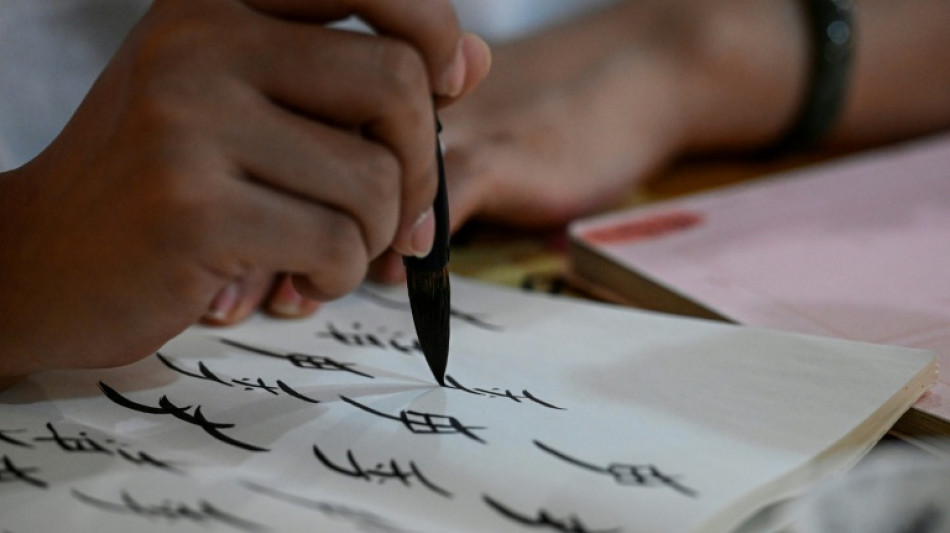
At a studio in central China's Hunan province, a teacher grips an ink brush, gently writing characters of a secret script created by women centuries ago and now being embraced by a new generation.
Nushu, meaning "women's script", emerged around 400 years ago. Barred from attending school, the women secretly learned Chinese characters and adapted them into Nushu, using the script to communicate with each other through letters, song and embroidery.
Passed down through generations of women in the remote and idyllic county of Jiangyong, it is now gaining popularity nationwide among Chinese women who view it as a symbol of strength.
Student Pan Shengwen said Nushu offered a safe way for women to communicate with each other.
"It essentially creates a sanctuary for us," the 21-year-old told AFP.
"We can express our thoughts, confide in our sisters and talk about anything."
Compared to Chinese characters, Nushu words are less boxy, more slender and shaped like willow leaves.
"When writing... your breathing must be calm, and only then can your brush be steady," Pan said.
On Instagram-like Xiaohongshu, the hashtag "Nushu" has beenviewedover 73.5 million times -- mostly featuring young women sharing tattoos and other modern work incorporating the old script.
Student He Jingying told AFP she had been enrolled in a Nushu class by her mother and that writing it brought her "a deep sense of calm".
"It feels like when the brush touches the paper, a kind of strength flows into you."
- Against 'injustice' -
Nushu is more than just a writing system -- it represents the lived experiences of rural women from the county, Zhao Liming, a professor at Beijing's Tsinghua University, told AFP.
"It was a society dominated by men," said Zhao, who has been studying Nushu for four decades.
"Their works cried out against this injustice," she said.
The words are read in the local dialect, making it challenging for native Chinese speakers not from the region to learn it.
Teacher He Yuejuan said the writing is drawing more attention because of its elegance and rarity.
"It seems to be quite highly regarded, especially among many students in the arts," He told AFP outside her gallery, which sells colourful merchandise, including earrings and shawls with Nushu prints.
As a Jiangyong native, He said Nushu was "part of everyday life" growing up.
After passing strict exams, she became one of 12 government-designated "inheritors" of Nushu and is now qualified to teach it.
- 'Really special' -
An hour's drive away, around a hundred Nushu learners packed into a hotel room to attend a week-long workshop organised by local authorities trying to promote the script.
Zou Kexin, one of the many participants, told AFP she had read about Nushu online and wanted to "experience it in person".
"It's a unique writing system belonging to women, which makes it really special," said Zou, 22, who attends a university in southwestern Sichuan province.
Animation student Tao Yuxi, 23, one of the handful of men attending the workshop, told AFP he was learning Nushu to gain inspiration for his creative work.
He said his aunt was initially confused about why he was learning Nushu, as it is not typically associated with men.
As it represents part of China's cultural heritage, Nushu has to be passed down, he said.
"It's something that everyone should work to preserve -- regardless of whether they are women or men."
B.Godinho--PC