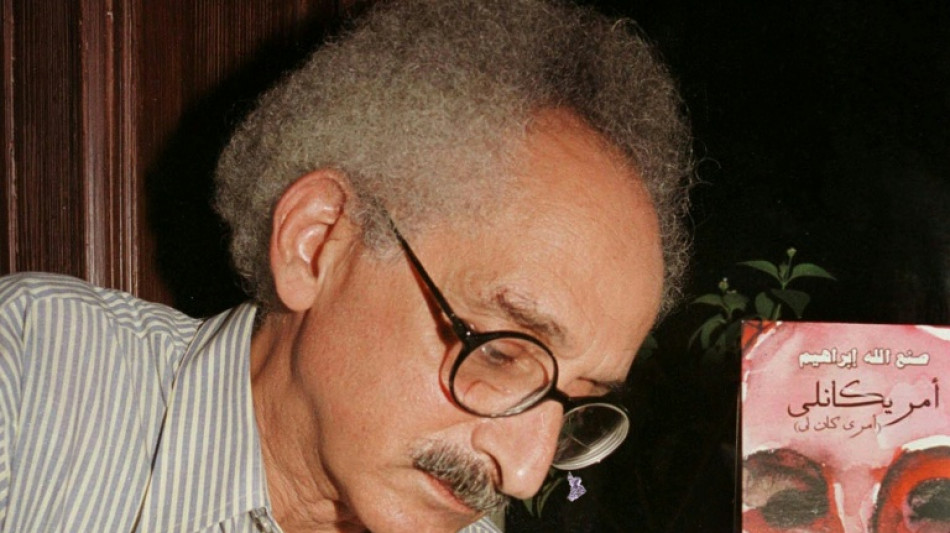
Renowned Egyptian novelist Sonallah Ibrahim dies at 88 / Photo: Amro MARAGHI - AFP

 Asian Games set to close after records, rancour and rain

 Cry for help as French-Swiss lake dries up

 Sabalenka swept out of China Open in third round

 US urges 'restraint' as Ethiopia's Tigray crisis rocks region

 Teens on target again as USA down Mexico 3-0

 World records prove Asian Games were a hit, says top official

 US prison chief who oversaw botched execution resigns

 'Chaotic' Asian Games threaten Japan hopes of hosting Olympics again

 Finnish town braces for change from Google data centres

 What is fuelling French school protests?

 Without lawyers, migrant children face deportation from the US
 Three-peat seeking Dodgers open playoffs with a win, Rays hold off Yankees

 Brazil votes in nail-biter polls closely watched by Trump

 'Just be you': Kim reveals Tiger text that inspired him to gold

 Myanmar migrants returned to war-torn nation from Malaysia

 ALEX BODI AND AMBASSADOR GUM DOMINIC MATIOK OF THE REPUBLIC OF SOUTH SUDAN MEET IN BERLIN TO DISCUSS THE POSSIBILITY OF AN HONORARY CONSULATE IN BUCHAREST

 Lula, Bolsonaro wrap up campaigns ahead of Brazil's knife-edge vote

 Toulouse edge Castres in Top 14 derby

 Murakami homer propels White Sox to MLB playoff win over Guardians

 Israel targets top Hamas leader in deadly Gaza strike on anniversary

 Houthis say struck oil facility near Riyadh, as Saudis hit Sanaa

 AI needs safety layers like nuclear plants: ex-OpenAI engineer

 MVP Judge will miss Yankees' MLB playoff series against Rays

 New lizard species discovered in Peru

 Fernandes hails Portugal's 'greatest symbol' Ronaldo, calls for unity

Egyptian novelist Sonallah Ibrahim, famed for his critiques of political repression, neoliberalism and Western hegemony, has died at the age of 88, the culture ministry announced on Wednesday.
Ibrahim "passed away today, leaving behind an immortal literary and humanitarian legacy," Culture Minister Ahmed Fouad Hanno said in a tribute, calling the writer a "pillar of modern Arabic literature".
Born in Cairo in 1937, Ibrahim was famed around the Arab world as a chronicler of social injustice, known for his sparse, documentary-style prose and his fierce independence.
His writings -- which blurred the line between the personal and the political -- captured the struggles of the Arab world in the postcolonial era, particularly those of his native Egypt.
Arguably his most famous novel, "Zaat" (1992), tells the story of Egypt's modern history -- from the overthrow of the monarchy in 1952 to the neoliberalism of the 1990s under president Hosni Mubarak -- through the eyes of an ordinary, middle-class woman.
It was adapted into a prime-time television series in 2013, bringing Ibrahim's scathing portrayal of power to a new generation of Egyptians in the aftermath of the Arab Spring uprising that ousted Mubarak.
A dissident through and through, Ibrahim was first jailed for his leftist politics in 1959, under then president Gamal Abdel Nasser.
His five years in prison would form the basis for his debut 1966 novel, "That Smell", which was initially banned.
Ibrahim's renown later saw many of his works translated into English and French.
In 2003, he refused to accept a prestigious literary prize from the Mubarak government charging that it "oppresses our people, protects corruption and allows the Israeli ambassador to remain while Israel kills and rapes".
The last was a reference to alleged Israeli abuses in the occupied territories during the second Palestinian intifada or uprising.
Among Ibrahim's most celebrated works are "The Committee" (1981), a Kafkaesque allegory of bureaucracy and surveillance, and "Stealth" (2007), a semi-autobiographical account of his childhood during World War II.
Generations of Arab writers found inspiration in his minimalist style, heavy with irony and rooted in everyday life.
F.Carias--PC
