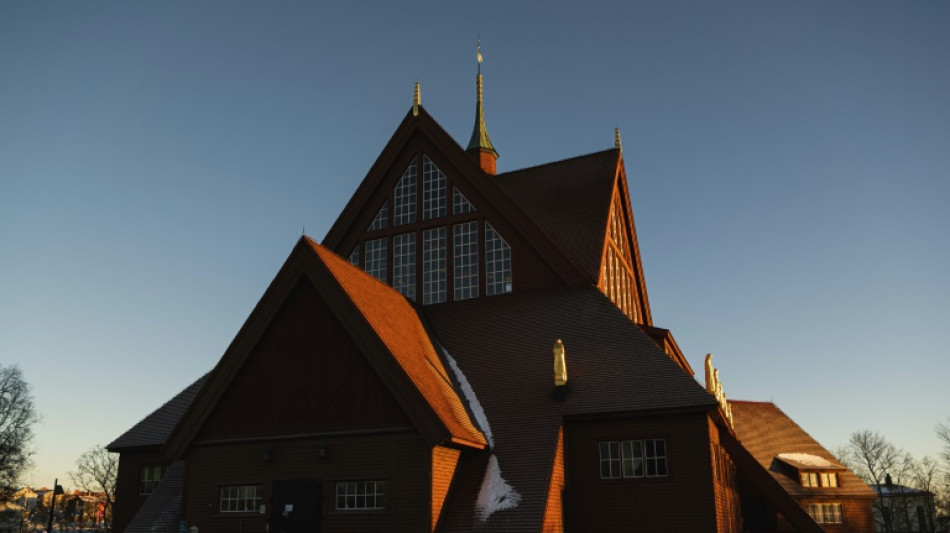
Historic Swedish church being moved as giant mine casts growing shadow / Photo: Jonathan NACKSTRAND - AFP

 Geri Halliwell-Horner Embraces Queen Camilla at Commonwealth Writing Competition

 Meta Quest 3 and 3S Gain Access to Over 150 3D Movies

 Sarah Bajada Shares Message on Pregnancy Loss

 ALIX LASERS shareholders remove Michael Sobitsch as managing director in view of the circumstances

 Euroseas Q3 Net Profit Falls to $91.4 Million Amid Fleet Reduction

 Daily Horoscope November 20, 2026: Astrological Predictions for All Signs

 Tosca's 2026 Sustainability Report Makes the Case for Packaging as Critical Supply Chain Infrastructure

A historic red wooden church considered one of Sweden's most beautiful buildings is to be moved from its longtime home in the Arctic town of Kiruna next week as part of a campaign to expand Europe's biggest underground mine.
Kiruna Kyrka, a Swedish Lutheran church, dates from 1912. The 672 tonne, 40 metre (131 feet) high building will be moved five kilometres (three miles) on a lorry to the new Kiruna town on Tuesday and Wednesday.
The complex and costly logistical operation has generated widespread interest, with more than 10,000 people expected to line the streets of the town of 18,000.
King Carl XVI Gustaf will be among those in town following the move. Swedish television will broadcast the entire journey live -- a new iteration of the "Slow TV" trend -- with 30 cameras set up along the route, it said.
Kiruna's entire town centre is being moved because of the giant mine that dominates the region.
As the LKAB iron ore mine's operations have progressed ever deeper over the years, the stability of the ground under Kiruna has weakened, increasing the risk of collapse in some parts.
- Unique event -
The town's relocation process began almost two decades ago and is expected to continue for years to come. The new town centre was officially inaugurated in September 2022.
The relocation of the church alone is expected to cost 500 million kronor ($52 million) and is being paid for by LKAB.
Designed by Swedish architect Gustaf Wickman, the imposing structure is a mix of influences and includes designs inspired by the region's indigenous Sami people on the pews.
The neo-Gothic exterior features slanting roofs and windows on each side, while its dark interior has elements of national romanticism as well as an Art Nouveau altarpiece painted by Sweden's Prince Eugen (1865-1947), a pastel landscape inspired by his trips to Toscana and western Sweden.
The church is one of 23 cultural buildings relocated in the Kiruna move. LKAB has called next week's relocation "a unique event in world history".
The structure has been "thoroughly examined ahead of the move to protect its cultural assets in the best possible way, to ensure that the altarpiece and organ in particular are moved with care," the company said.
The roads on the route have been widened, a process that took a year according to LKAB, and the ground around the church's current location has been dug out.
"The church is sitting on a beam system, then two rows of trailers were brought in," LKAB project manager Stefan Holmblad Johansson told AFP.
The move is expected to take on the air of a street party, with LKAB treating crowds to snacks, refreshments and live entertainment.
L.E.Campos--PC