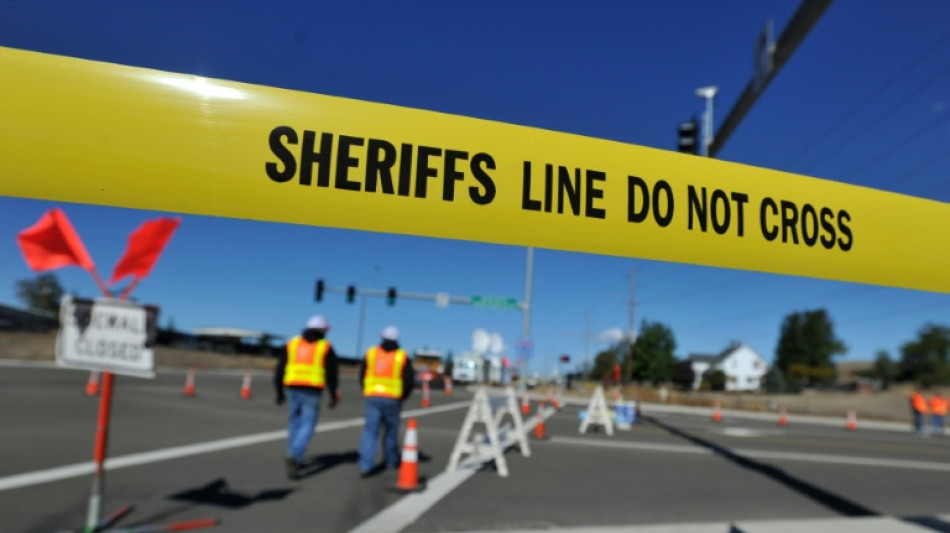
What is swatting? Shooting hoaxes target campuses across US / Photo: Josh Edelson - AFP

 'Act before it's too late': Tokyo residents fight for more trees

 'Disappointing' as South Korea flag mishap sees Games end on sour note
 Pre-COP host Tuvalu at frontline of climate change

 Hungary's dwindling paprika producers battle to save signature spice

 Cornell president vows review in wake of alleged student gang rape
 Latvian partial election results suggest pro-European choice
 In Egypt's Sinai, Gazan builds school for children displaced by war

 Trump tariffs a mixed bag for US auto industry

 Yemen government forces say struck Houthi targets

 Music links past, present for Pedro Pascal's cellist in 'Behemoth!'

 ALEX BODI ȘI AMBASADORUL REPUBLICII SUDANUL DE SUD, GUM DOMINIC MATIOK, DISCUTĂ LA BERLIN DESPRE POSIBILITATEA ÎNFIINȚĂRII UNUI CONSULAT ONORIFIC LA BUCUREȘTI

 Dodgers step up World Series three-peat bid with 5-3 win over Braves

 Spain break down Czechs as England outclass Croatia in Nations League

 Yamal on target as Spain hold off Czech Republic

 Latvian exit polls suggest pro-European choice

 Lula, Bolsonaro wrap up campaigns ahead of knife-edge election

 Tuchel hails 'complete' England after Croatia demolition

 Fury to invite Trump to lead ring walk before Joshua showdown

 Fashion industry in 'precarious moment', says Vivienne Westwood supremo

 Seventh heaven for England in Nations League rout of Croatia

 Storms, flooding cause chaos on Greek holiday island of Crete

 #IAmJaneDoe: online support campaign in US university rape case

 Brazil shine on Selecao's first visit to India

 Zverev sets up Djokovic quarter-final at China Open, Rybakina out
 Happier at home, Bordeaux hammer Lyon in Top 14

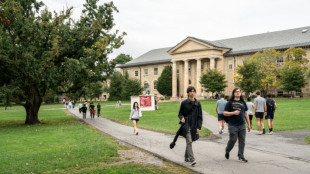
Students at the University of South Carolina were sent into panic when they received an active shooter alert and police rushed to the library.
The university had fielded two separate calls on Sunday that included sounds of gunfire.
But the reports turned out to be false, part of a wave of so-called "swatting" hoaxes that have targeted American universities as students returned to campuses for fall classes.
Similarly baseless reports hit Villanova University and the University of Tennessee-Chattanooga last week, and at least seven more schools on Monday, according to campus alerts and school and police statements.
West Virginia University responded to yet another hoax Tuesday morning.
Experts warn that swatting -- deliberately phoning in a false emergency to trigger a law enforcement response -- traumatizes students, depletes security resources and risks desensitizing Americans to alerts in a country where mass shootings are a legitimate threat.
"It plays on our fears because bad things really do happen," said former police chief John DeCarlo, a criminal justice professor at the University of New Haven.
"They can trigger, with just one call, lockdowns, mobilizations, closings of buildings and a lot of media coverage."
The FBI told AFP it is aware of the recent incidents targeting colleges and is "seeing an increase in swatting events across the country."
The agency said it has received thousands of swatting reports since creating a database for law enforcement agencies to log incidents in 2023, adding that the practice "drains law enforcement resources, costs thousands of dollars, and, most importantly, puts innocent people at risk."
- Persistent problem -
At the University of Tennessee-Chattanooga, first responders from at least 10 agencies were mobilized to the campus and cleared multiple buildings before concluding there was no threat.
The University of South Carolina said two students received minor injuries in the rush out of its library.
A third was falsely branded as a gunman after social media users and Congresswoman Nancy Mace shared footage of him carrying an umbrella that resembled a firearm.
Swatting began in gamer and hacker communities and has been wielded against judges, election officials and lawmakers in recent years.
Schools are "especially vulnerable" due to their visibility and student populations, DeCarlo said.
Keven Hendricks, a cybercrime expert, told AFP perpetrators are frequently linked to extremist groups and ideologies and are often juveniles who are emboldened when they are not caught.
"A lot of swatters do it simply because they can."
Experts called for stronger laws to combat the problem, as well as investments in technologies to identify callers who conceal their voices or IP addresses.
"It is, in reality, a form of domestic terrorism that's very easy to get away with because we don't have the wherewithal to investigate or prosecute it well," DeCarlo said.
"It seems to be running away unbridled."
L.Carrico--PC