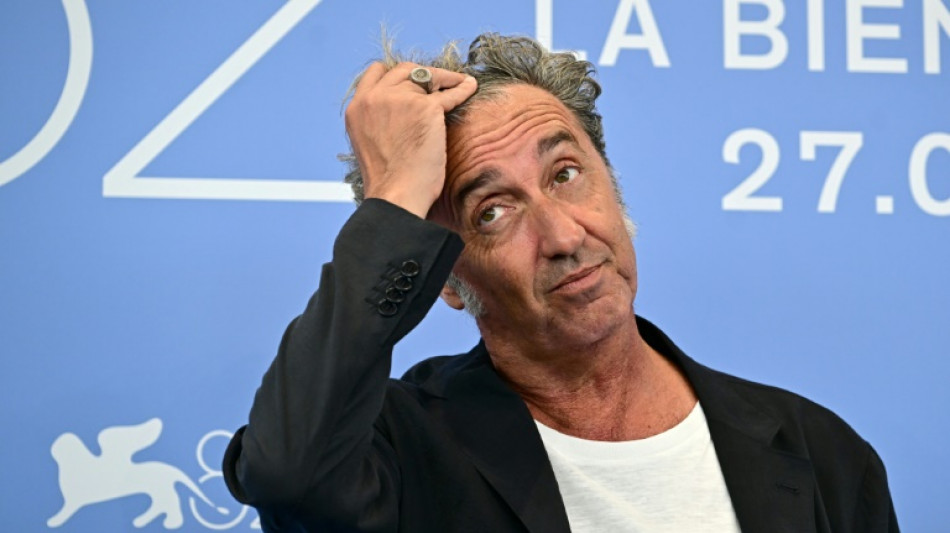
Italy's Sorrentino embraces doubt in euthanasia film at Venice / Photo: Tiziana FABI - AFP

 'Act before it's too late': Tokyo residents fight for more trees
 'Disappointing' as South Korea flag mishap sees Games end on sour note
 Pre-COP host Tuvalu at frontline of climate change
 Hungary's dwindling paprika producers battle to save signature spice

 Cornell president vows review in wake of alleged student gang rape
 Latvian partial election results suggest pro-European choice

 In Egypt's Sinai, Gazan builds school for children displaced by war
 Trump tariffs a mixed bag for US auto industry
 Yemen government forces say struck Houthi targets
 Music links past, present for Pedro Pascal's cellist in 'Behemoth!'
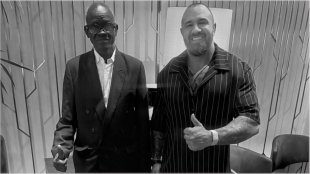 ALEX BODI ȘI AMBASADORUL REPUBLICII SUDANUL DE SUD, GUM DOMINIC MATIOK, DISCUTĂ LA BERLIN DESPRE POSIBILITATEA ÎNFIINȚĂRII UNUI CONSULAT ONORIFIC LA BUCUREȘTI
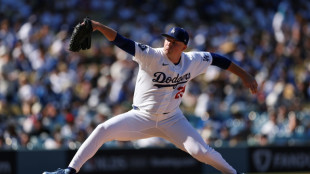 Dodgers step up World Series three-peat bid with 5-3 win over Braves

 Spain break down Czechs as England outclass Croatia in Nations League

 Yamal on target as Spain hold off Czech Republic

 Latvian exit polls suggest pro-European choice

 Lula, Bolsonaro wrap up campaigns ahead of knife-edge election

 Tuchel hails 'complete' England after Croatia demolition

 Fury to invite Trump to lead ring walk before Joshua showdown

 Fashion industry in 'precarious moment', says Vivienne Westwood supremo

 Seventh heaven for England in Nations League rout of Croatia

 Storms, flooding cause chaos on Greek holiday island of Crete

 #IAmJaneDoe: online support campaign in US university rape case

 Brazil shine on Selecao's first visit to India

 Zverev sets up Djokovic quarter-final at China Open, Rybakina out

 Happier at home, Bordeaux hammer Lyon in Top 14

Italian director Paolo Sorrentino hopes his latest film premiering Wednesday in Venice will bring attention to the controversial topic of euthanasia -- while encouraging those in power to reject the need for certainty and embrace doubt.
"La Grazia", about an Italian president grappling with indecision over whether to sign a euthanasia bill into law, is the latest from the Naples-born director, best known to non-Italian audiences for "The Great Beauty", winner of the best foreign film Oscar in 2014.
"Dwelling on doubt and then allowing that doubt to mature into a decision is something that is increasingly rare," Sorrentino told journalists, hours before his film was to kick off the 10-day Venice Film Festival.
"I wanted to portray a politician who embodies a lofty idea of politics as I believe it should be and as it too often is not," he said, adding that too many today are in a "constant search for certainty".
Sorrentino's 11th film is the second euthanasia-themed film to play at Venice since last year, when Spanish director Pedro Almodovar won the coveted Golden Lion for his "The Room Next Door".
But "La Grazia" is miles apart in tone and scope, with the topic of euthanasia used to explore one man's self-reckoning as he approaches the end of his life and career.
Still, asked in a press conference whether he hoped the film could influence the debate over euthanasia, Sorrentino replied: "I think cinema can try."
"I can only hope that a film, in this case my film, can bring attention back to a topic that I take for granted but which is fundamental, that of euthanasia. So I hope so."
- Moral consequences -
Part love story, part legal drama, part provocation to Italy's political elite, Sorrentino's film is about finding the courage to act despite uncertainty.
A current-day, fictionalised president, Mariano de Santis (played by Sorrentino regular Toni Servillo) is months away from the end of his presidential term but under pressure from his lawyer daughter (Anna Ferzetti) to sign an end-of-life bill that will make euthanasia legal.
Although the measured and reflective Catholic widower has quelled many a political crisis in the past, he is stymied by his inability to make a decision either on the euthanasia bill or on two clemency requests on behalf of convicted murderers that are rife with moral consequences.
"For years, I've thought moral dilemmas were a formidable narrative engine, more so than any other narrative tool usually used in cinema," Sorrentino said. "From there came the idea of centring the film on a president of the republic."
De Santis' indecision is fuelled by demons from the past about his deceased wife, the love story weaving throughout the film that provides its emotional grounding.
Sorrentino's latest film is highly topical, both politically and socially, in Catholic Italy where there is no national right-to-die law but there is a hot debate on a regional level over whether to legalise medically assisted suicide.
Moviegoers in Italy will also notice obvious echoes of the current inhabitants of the country's presidential Quirinale Palace -- Italian President Sergio Mattarella, a widower, and his daughter Laura, a lawyer, who is a constant companion of her father.
Despite its serious subject matter, the film is peppered with deliciously surreal touches and quirky cameos that are a signature of Sorrentino.
The film also at times evokes famous moments from "The Great Beauty", such as Servillo staring deep into the camera at the film's start, or the film's pulsing rap and techno soundtrack.
M.A.Vaz--PC