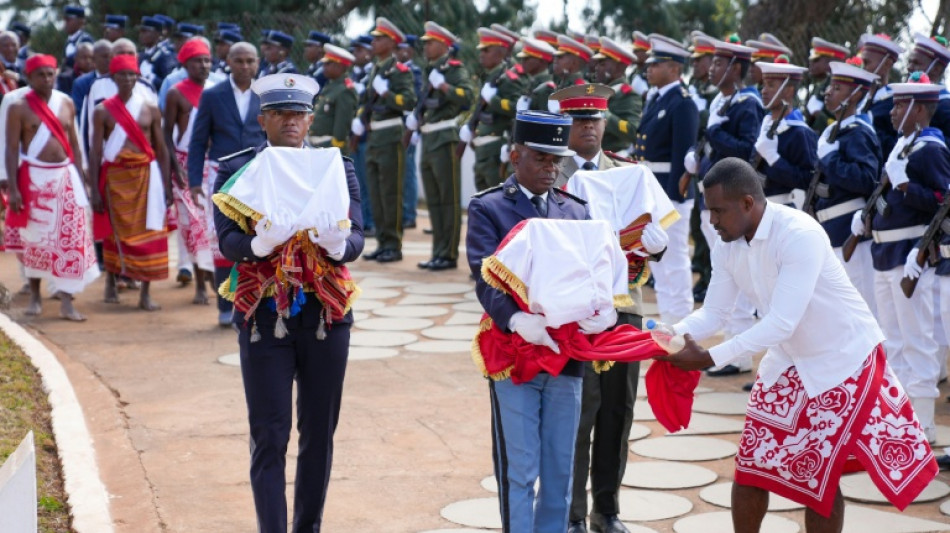
Madagascar receives skull of king beheaded by France / Photo: Mamyrael - AFP

 KFF Health News Readers Weigh In on Healthcare Policy, Ethics, and Workforce Shortages

 16-Year-Old Founder Targets 'Cost Per Kill' With AI Missile Startup

 Elon Musk Promises Steering-Wheel-Free Tesla Model Y Amid Cybercab Sales Launch

 Tosca's 2026 Sustainability Report Makes the Case for Packaging as Critical Supply Chain Infrastructure

 Eisai's Dayvigo Shows Year-Long Efficacy Without Tolerance Ahead of Korean Launch

 Ozlo Sleepbuds Drop $40 Ahead of Black Friday for Noise-Masking Sleep Aid
Madagascar marked at a ceremony Tuesday the return from France of the skulls of three men killed by French troops 128 years ago, including one believed to be that of a decapitated king.
France handed over the skulls in Paris on August 27, in the first such restitution since it passed a law in 2023 facilitating the return of human remains seized during its colonial conquests.
They are believed to belong to King Toera of the Sakalava people, who was beheaded by French troops in 1897, and two of his warriors.
The remains arrived in Madagascar late Monday and were received at the airport by members of the Sakalava group dressed in traditional robes.
Held in three boxes draped with the flag of the Indian Ocean nation, they were driven through the capital Antananarivo to the city's mausoleum Tuesday, where they were welcomed by President Andry Rajoelina and a gathering of government and Sakalava dignitaries.
"If we want to move forward, we must know our past, our history," Rajoelina told the gathering.
"We are proud to have had a king and his soldiers who protected the nation," he said, praising a people who rose against French colonial troops "with courage and daring".
King Toera's great-grandson, the newly enthroned Sakalava king Georges Harea Kamamy, sprinkled water from the sacred Tsiribihina River to welcome home his ancestor's remains.
"We Sakalava are relieved. Today is a day of joy," Kamamy said.
He however regretted that the skulls were handed to Madagascar's government instead of the royal family.
- Reunited with skeleton -
The skulls will take a four-day, 800-kilometre (500-mile) journey by road to the west coast area of Menabe, where they are expected to be buried later this week.
The skull believed to be the king's will rejoin the rest of his skeleton in a tomb in Ambiky, where he was killed in 1897.
"It is a source of pride and immense inner peace that my ancestor is back among us," a royal descendant and leader of the second Sakalava clan, Joe Kamamy, told AFP.
He hinted at disagreements within the royal family about the final resting place of the artefact.
"I have only one regret: that the skulls are not kept in Mitsinjo (in the centre-west), with the relics of the other (Sakalava) kings," he said.
Following the 1897 Ambiky massacre, the skulls were taken to France as trophies.
They were kept in Paris's national history museum alongside hundreds of other remains from Madagascar, which declared independence in 1960 after more than 60 years of French colonial rule.
France has in recent years sent back various artefacts plundered during its imperial campaigns.
Yet each return required special legislation, until parliament adopted the 2023 law simplifying the repatriation of human remains.
L.Mesquita--PC