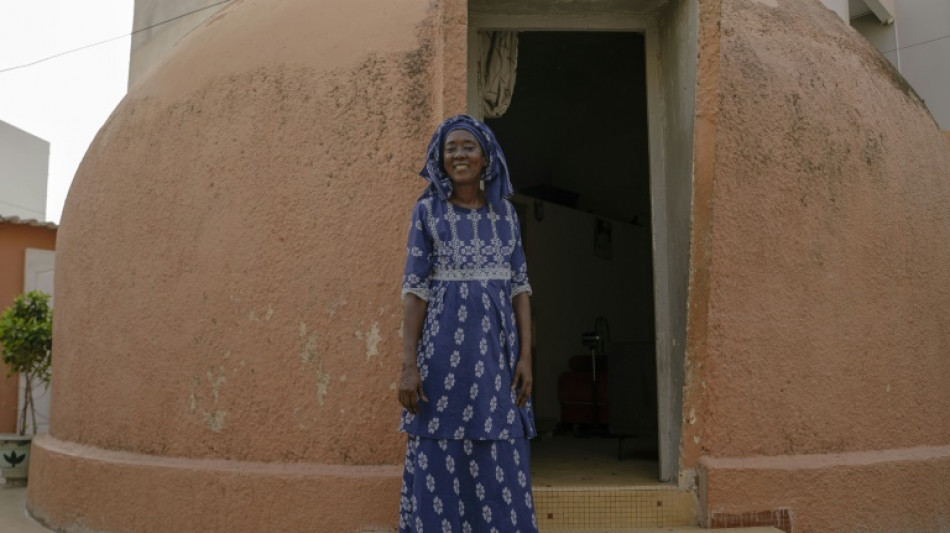
In Senegal, the last of Dakar's 'bubble homes' at risk / Photo: Carmen Abd Ali - AFP

 'Act before it's too late': Tokyo residents fight for more trees

 'Disappointing' as South Korea flag mishap sees Games end on sour note

 Pre-COP host Tuvalu at frontline of climate change
 Hungary's dwindling paprika producers battle to save signature spice

 Cornell president vows review in wake of alleged student gang rape

 Latvian partial election results suggest pro-European choice

 In Egypt's Sinai, Gazan builds school for children displaced by war

 Trump tariffs a mixed bag for US auto industry

 Yemen government forces say struck Houthi targets

 Music links past, present for Pedro Pascal's cellist in 'Behemoth!'

 ALEX BODI ȘI AMBASADORUL REPUBLICII SUDANUL DE SUD, GUM DOMINIC MATIOK, DISCUTĂ LA BERLIN DESPRE POSIBILITATEA ÎNFIINȚĂRII UNUI CONSULAT ONORIFIC LA BUCUREȘTI

 Dodgers step up World Series three-peat bid with 5-3 win over Braves

 Spain break down Czechs as England outclass Croatia in Nations League

 Yamal on target as Spain hold off Czech Republic

 Latvian exit polls suggest pro-European choice

 Lula, Bolsonaro wrap up campaigns ahead of knife-edge election

 Tuchel hails 'complete' England after Croatia demolition

 Fury to invite Trump to lead ring walk before Joshua showdown

 Fashion industry in 'precarious moment', says Vivienne Westwood supremo

 Seventh heaven for England in Nations League rout of Croatia

 Storms, flooding cause chaos on Greek holiday island of Crete

 #IAmJaneDoe: online support campaign in US university rape case

 Brazil shine on Selecao's first visit to India

 Zverev sets up Djokovic quarter-final at China Open, Rybakina out
 Happier at home, Bordeaux hammer Lyon in Top 14

Marieme Ndiaye emerged from her igloo-shaped home in Senegal's capital, its 1950s space-age aesthetic in sharp contrast with the boxy, multi-storey apartments being built nearby.
The little concrete house is a head-turner, seemingly better suited for a sci-fi movie than the average Dakar residential block where it is located.
In the 1950s, around 1,200 of the tidy little homes were built in several neighbourhoods across Dakar to alleviate a post-World War II housing crunch.
The dwellings were made by inflating a giant balloon and spraying it with a concrete solution called gunite, before then deflating the balloon.
Row after row of the light-coloured domes, which could be constructed in just 48 hours, quickly sprung from the brown Sahelian landscape.
Designed by a California architect; implemented by French colonial authorities; lived in by Senegalese -- the dwellings saw only lukewarm success.
Senegal's traditionally non-nuclear, multi-generational families began outgrowing the homes' small, circular confines quickly.
In addition, the land beneath them soon became more valuable than the odd little bubbles themselves.
These days, only around 100 are estimated to remain, according to Dakar architect Carole Diop, with the majority having fallen victim to rampant urban development.
"When I was little, we only had balloons," Ndiaye said, referring to the area where she grew up and lives today in Dakar's central Zone B neighbourhood.
Without historical societies or architectural organisations campaigning to preserve the homes, the remaining residents have become the little igloos' principal protectors.
"Now we're in the middle of destroying the balloons, of transforming," Ndiaye told AFP.
"For me, it's sentimental," said the 65-year-old retiree, who is the reason her dome house is still standing. "My younger brothers want to tear down the ballon and build," she said.
The balloon homes are being preserved by residents for a variety of reasons, Diop told AFP.
But "unfortunately, many families who had the means ended up demolishing the balloon to build a building", she added.
- 'Very atypical' -
Many of those remaining have been transformed to better fit Senegalese life and no longer exist as solitary bubbles.
With an average diameter of just six metres (20 feet), a standard bubble house like Ndiaye's would have consisted of a bedroom, living room and bathroom, according to Diop.
"Many families adapted and found ways to meet the need for expansion", such as building an attachment, she said.
Ndiaye's house, first bought by her father in the 1950s, is now enveloped inside her family's larger compound, where she lives with about half a dozen relatives spanning multiple generations.
The bubble house is in the middle of a square courtyard, with other rooms along the courtyard walls.
While the bubble homes can become warm in the direct sun, even with a vent on top, Ndiaye said hers was comfortable.
A 10-minute walk away, Sekouna Yansane recently built a large house next to the bubble home his father bought in the 1950s, incorporating it as a room jutting off one side.
Describing himself as artistic, he was loath to allow the little dome to fall into developers' hands.
"It's very atypical, I love it," the 65-year-old said. "It reminds me of when I went to Mongolia, the yurts."
Four years ago he began constructing the larger home, while his next-door neighbours tore their bubble house down.
Along the street, a towering and decidedly non-descript apartment building looms where bubble houses no doubt once stood.
"Why destroy them? They are things we should keep," Yansane said, adding that a good house always has "character".
- In 100 years -
American architect Wallace Neff, who invented the bubble house, was best known for his Spanish colonial revival homes and residences for major Hollywood stars like Judy Garland and Groucho Marx.
Yet, he believed the bubble homes, which were constructed in several countries, were his most significant contribution to architecture.
Asked whether she thought the homes would still exist in 100 years, Diop voiced doubts.
"At the pace at which the city is densifying and evolving, I think unfortunately in 100 years there will be no more ballons," she said, but expressed hope that if classified or transformed for preservation, some might survive.
Yansane was slightly more positive.
"I'm in favour of preserving things," he said, adding: "In 100 years, this house, if it still exists, it's going to be something extraordinary."
T.Batista--PC