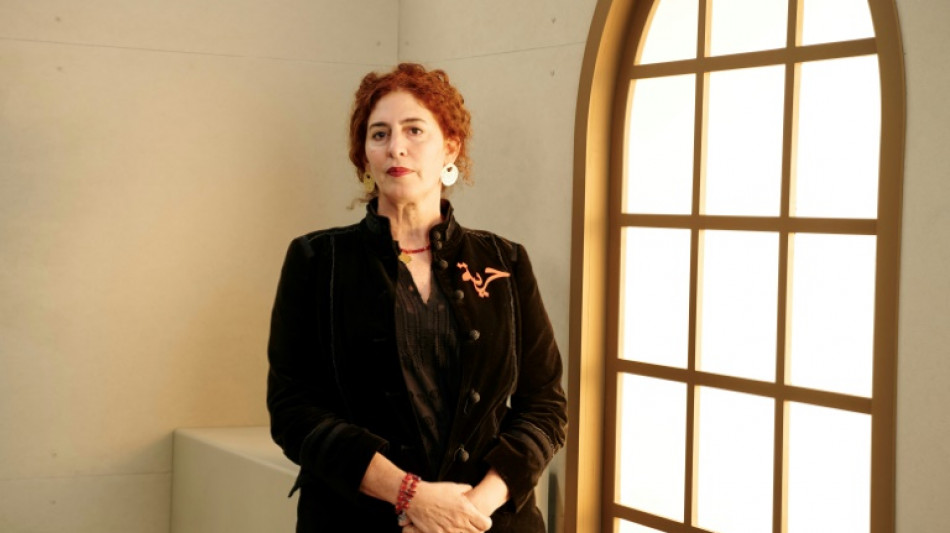
'Palestine 36' shines light on Arab revolt against British rule / Photo: Gareth Cattermole - GETTY IMAGES NORTH AMERICA/AFP

 Latvian partial election results suggest pro-European choice

 In Egypt's Sinai, Gazan builds school for children displaced by war

 Trump tariffs a mixed bag for US auto industry

 Yemen government forces say struck Houthi targets

 Music links past, present for Pedro Pascal's cellist in 'Behemoth!'

 ALEX BODI ȘI AMBASADORUL REPUBLICII SUDANUL DE SUD, GUM DOMINIC MATIOK, DISCUTĂ LA BERLIN DESPRE POSIBILITATEA ÎNFIINȚĂRII UNUI CONSULAT ONORIFIC LA BUCUREȘTI

 Dodgers step up World Series three-peat bid with 5-3 win over Braves

 Spain break down Czechs as England outclass Croatia in Nations League

 Yamal on target as Spain hold off Czech Republic

 Latvian exit polls suggest pro-European choice
 Lula, Bolsonaro wrap up campaigns ahead of knife-edge election

 Tuchel hails 'complete' England after Croatia demolition

 Fury to invite Trump to lead ring walk before Joshua showdown

 Fashion industry in 'precarious moment', says Vivienne Westwood supremo

 Seventh heaven for England in Nations League rout of Croatia

 Storms, flooding cause chaos on Greek holiday island of Crete

 #IAmJaneDoe: online support campaign in US university rape case

 Brazil shine on Selecao's first visit to India

 Zverev sets up Djokovic quarter-final at China Open, Rybakina out
 Happier at home, Bordeaux hammer Lyon in Top 14

 Lula, Bolsonaro in final push for votes ahead of knife-edge election

 Boisterous fashion week barnstorms 'sleepy' Nigerian capital

 UAE investigators say flydubai co-pilot was planning 'terrorist act'
 Rahul smacks century in India v Windies ODI

 Daryz seeks to join exclusive club of dual Arc winners
In "Palestine 36," director Annemarie Jacir recounts a year of Arab revolt against British colonial rule that she says is crucial to understanding current events in the Middle East.
"You can't understand where we are today without understanding 1936," Jacir told AFP a day after the film's world premiere at the Toronto International Film Festival.
The Palestinian filmmaker, who lives in the Israeli city of Haifa, was motivated to make the film, in part, to redress a lack of awareness about the consequences of British policies during the so-called mandate period, before Israel's creation in 1948.
"I wanted to really point the finger at the British," she said.
The film features a mostly Arabic-speaking cast, including Hiam Abbass from HBO's "Succession," and Jeremy Irons as a British high commissioner unsettled by rising violence and protests against the colonial administration.
With Jewish immigration from Europe increasing and Palestinian villagers concerned about further loss of land, Arab support for armed revolt against the British surges.
The film details the brutal crackdown launched to contain the violence.
Villagers are beaten, people are arrested en masse while soldiers torch homes after searching them for weapons.
They are tactics Jacir said Israel's army learned from the British and have used since against Palestinians living under occupation.
But Jacir -- who was born in Bethlehem in the Israeli-occupied West Bank -- told AFP a key goal of the film was to shine a spotlight on the British colonial practice of divide and rule, which was used across the empire.
The narrative in "Palestine 36" builds toward the publication of the Peel Commission's report, a British inquiry into the causes of Arab and Jewish unrest in Palestine.
The commission recommended Palestine be partitioned -- with separate areas for Jews and Arabs -- a finding that influenced the United Nations-backed partition plan that coincided with Israel's creation.
"It was a British policy: first, we'll bring (Arabs and Jews) together," Jacir said.
Then "we separate... It was a tactic of control," she added.
Jacir said the reception for the film at Friday's world premiere was overwhelming.
"Yesterday was crazy," she told AFP, an outpouring of support likely tied to widespread outrage over the conflict in Gaza.
She voiced hope that the film could foster broader awareness about the lasting impacts of the British mandate period in Palestine.
"I'm shocked how many people have told me when I tell them about the film, they were like, 'the British were in Palestine?'"
British rule, she said, was "decisive."
G.M.Castelo--PC