Salvaged shipwreck porcelain gets new life in Malaysia / Photo: Mohd RASFAN - AFP

 'Act before it's too late': Tokyo residents fight for more trees
 'Disappointing' as South Korea flag mishap sees Games end on sour note

 Pre-COP host Tuvalu at frontline of climate change

 Hungary's dwindling paprika producers battle to save signature spice

 Cornell president vows review in wake of alleged student gang rape

 Latvian partial election results suggest pro-European choice

 In Egypt's Sinai, Gazan builds school for children displaced by war

 Trump tariffs a mixed bag for US auto industry

 Yemen government forces say struck Houthi targets

 Music links past, present for Pedro Pascal's cellist in 'Behemoth!'

 ALEX BODI ȘI AMBASADORUL REPUBLICII SUDANUL DE SUD, GUM DOMINIC MATIOK, DISCUTĂ LA BERLIN DESPRE POSIBILITATEA ÎNFIINȚĂRII UNUI CONSULAT ONORIFIC LA BUCUREȘTI

 Dodgers step up World Series three-peat bid with 5-3 win over Braves

 Spain break down Czechs as England outclass Croatia in Nations League

 Yamal on target as Spain hold off Czech Republic

 Latvian exit polls suggest pro-European choice

 Lula, Bolsonaro wrap up campaigns ahead of knife-edge election

 Tuchel hails 'complete' England after Croatia demolition

 Fury to invite Trump to lead ring walk before Joshua showdown

 Fashion industry in 'precarious moment', says Vivienne Westwood supremo

 Seventh heaven for England in Nations League rout of Croatia

 Storms, flooding cause chaos on Greek holiday island of Crete

 #IAmJaneDoe: online support campaign in US university rape case

 Brazil shine on Selecao's first visit to India

 Zverev sets up Djokovic quarter-final at China Open, Rybakina out

 Happier at home, Bordeaux hammer Lyon in Top 14

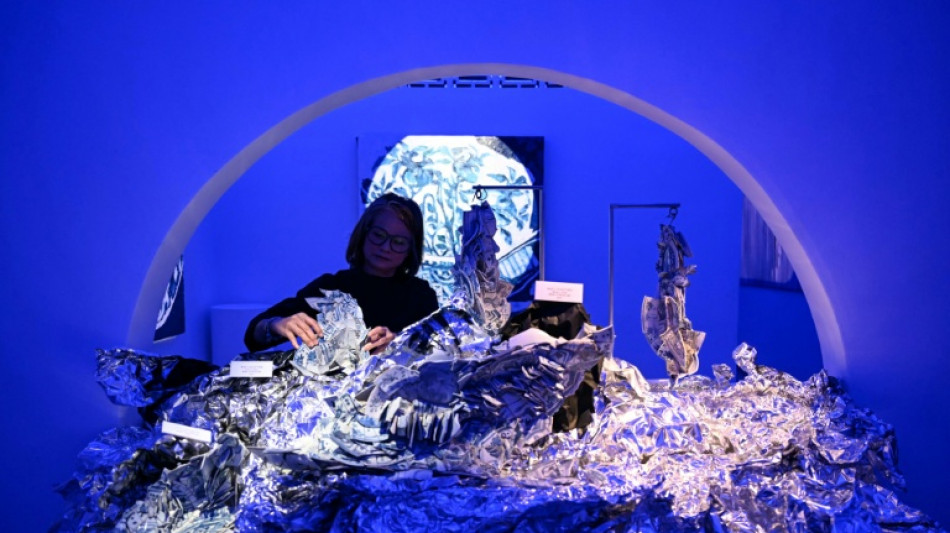
Chinese porcelain shards salvaged from a famous shipwreck are being reimagined in Malaysia, hundreds of years after the Portuguese vessel is said to have sunk in battle.
The smashed 17th-century crockery was almost consigned to the scrap heap before Malaysian artist Alice Chang saw the potential to transform the shattered plates and cups.
After chancing upon a social media post selling the porcelain fragments, the 57-year-old bought about 50 kilograms (110 pounds) for more than 10,000 ringgit ($2,370).
Her recent solo exhibition "Me, Then Blue" at her studio in Ampang, a suburb of the capital Kuala Lumpur, turned the porcelain into sculptures representing submerged dreamscapes.
Her materials are fragments of a once-great cargo of blue-and-white pottery made in Jingdezhen, China's renowned porcelain capital.
The cargo was carried by a Portuguese merchant vessel that sank around 1625, likely due to a battle off Malaysia's coast.
It was discovered in 1998 after pottery appeared in fishermen's nets, with the vessel then named the Wanli after the Ming Dynasty emperor who ruled when the ship sank.
It was hailed as one of the most significant maritime finds in Southeast Asia and is now recognised under UNESCO's Silk Roads Programme.
But while intact porcelain pieces were preserved in museums, Chang said the broken shards were "cast aside as useless".
"The 400 years of broken porcelain tell a story of our past and a look into our future. If nobody wanted them, they would be thrown away, and that is such a waste," said Chang.
She used the shards to create the "ambience of this exhibition like it's immersed in the deep blue sea", Chang told AFP.
"This is part of Malaysia's history... its maritime legacy often goes unrecognised, and this discovery felt like a forgotten chapter waiting to be told," she said.
- 'Beauty in brokenness' -
At the heart of Chang's exhibition stood 11 sculptures, adorned with salvaged shards, accompanied by 20 oil paintings.
Working with the broken porcelain pieces was "deeply personal" for Chang, a second-generation Malaysian with Chinese roots who often felt culturally unmoored.
"Through the Wanli shipwreck and working with the pieces, I feel reconnected... I have been told I'm not very Chinese because I'm married to an Italian. So I'm neither here nor there," she chuckled.
"This project reconnected me to my Chinese roots. I actually travelled to China to search and understand my culture."
Some of her sculptures evoked ornate vases while others resembled cascading waves, with mirrors beneath them mimicking the glimmering seabed.
They show "the beauty in brokenness", Chang said.
"Depending on your perspective, you can turn brokenness into something beautiful."
E.Paulino--PC