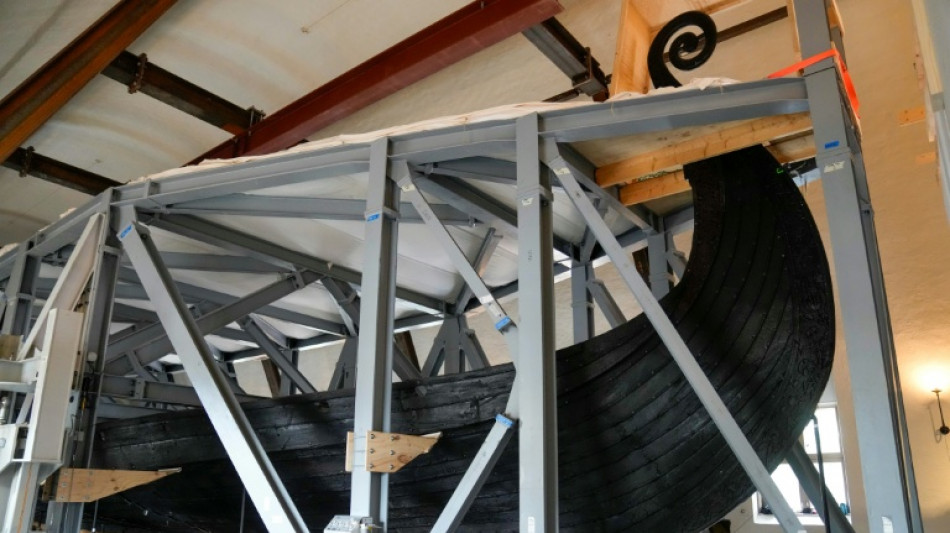
Viking ships make final high-risk voyage to new Oslo home / Photo: Fredrik Varfjell - NTB/AFP/File

 Latvian partial election results suggest pro-European choice

 In Egypt's Sinai, Gazan builds school for children displaced by war

 Trump tariffs a mixed bag for US auto industry

 Yemen government forces say struck Houthi targets

 Music links past, present for Pedro Pascal's cellist in 'Behemoth!'

 ALEX BODI ȘI AMBASADORUL REPUBLICII SUDANUL DE SUD, GUM DOMINIC MATIOK, DISCUTĂ LA BERLIN DESPRE POSIBILITATEA ÎNFIINȚĂRII UNUI CONSULAT ONORIFIC LA BUCUREȘTI

 Dodgers step up World Series three-peat bid with 5-3 win over Braves

 Spain break down Czechs as England outclass Croatia in Nations League

 Yamal on target as Spain hold off Czech Republic

 Latvian exit polls suggest pro-European choice

 Lula, Bolsonaro wrap up campaigns ahead of knife-edge election

 Tuchel hails 'complete' England after Croatia demolition

 Fury to invite Trump to lead ring walk before Joshua showdown

 Fashion industry in 'precarious moment', says Vivienne Westwood supremo

 Seventh heaven for England in Nations League rout of Croatia

 Storms, flooding cause chaos on Greek holiday island of Crete

 #IAmJaneDoe: online support campaign in US university rape case

 Brazil shine on Selecao's first visit to India

 Zverev sets up Djokovic quarter-final at China Open, Rybakina out

 Happier at home, Bordeaux hammer Lyon in Top 14

 Lula, Bolsonaro in final push for votes ahead of knife-edge election

 Boisterous fashion week barnstorms 'sleepy' Nigerian capital

 UAE investigators say flydubai co-pilot was planning 'terrorist act'

 Rahul smacks century in India v Windies ODI

 Daryz seeks to join exclusive club of dual Arc winners

Three 1,200-year-old Viking ships that have stood the test of time are embarking on their final and possibly riskiest journey to their new forever home in Norway.
The first to relocate is the Oseberg, which on Wednesday slowly began making its way from its current location in the old Viking Ship Museum to a newly built addition that will house the national treasures in optimal conditions.
The extremely fragile oak hull inched forward so slowly its movement was almost undetectable to the human eye, the structure encased in a heavy protective steel rig.
The hundred-metre journey was expected to take over 10 hours, with the ship hanging from a crane moving on a track high above the ground.
"It's almost like it's sailing in the air," museum director Aud Tonnesseen said, visibly exhilarated as she watched the slowly-approaching spiralling serpent's head that rises up from the ship's stern.
"There is something deeply moving when you think that these ships -- with their long history and all the voyages they have undertaken -- will embark on their final journey," she said.
Named after the places where they were discovered, the Oseberg, Gokstad and Tune -- all believed to have been built between 820 and 910 -- have been housed in a cross-shaped building considered too small and unsuitable to conserve them properly.
"They've been subjected to humidity, vibrations ... Over time, the strain became so intense that they started showing signs that they would eventually collapse onto their supports," Tonnessen said.
A decision was therefore taken to move them to a new climate-controlled facility, built as an extension to the old museum, which should make it possible to maintain the ships in their current condition for at least another century.
The relocation process is perilous.
"We have to complete this operation without causing any further damage to the ships, but we know that each handling is harmful to them," said curator David Hauer, who has been planning the project for years.
"These are clinker hulls (featuring partially overlapping planks) that are 1,200 years old. At the slightest deformation, they split between the rivets, the wood cracks," he explained.
- Endless precautions -
Endless precautions have been taken to prevent any breakage or vibrations during the relocation. The ship is being moved very slowly, at a pace of 5.5 minutes per metre.
Among other things, an oil services company experienced in high-precision work -- such as positioning massive structures 300 metres below the sea with millimetre accuracy -- has been called in.
"But this is yet another level," Hauer said.
"The level of precision required, for example when it comes to vibrations, is the same as for electron microscopes in hospitals" which require extreme stability, he said.
"Except here, it involves lifting the electron microscope, moving it, and then setting it back down so you can use it again," he said.
If everything goes as planned, the Gokstad is scheduled to be relocated next during the autumn, and then finally the Tune in the summer of 2026.
All three ships were found in separate burial sites southwest and southeast of Oslo between 1867 and 1904, each one very distinct from the other.
Richly decorated with ornate carvings, Oseberg, the oldest of the three vessels, is considered the best preserved Viking ship in the world.
Gokstad is meanwhile the largest of the three, measuring 23 metres (75 feet) long and five metres wide and with space for 32 rowers.
Tune is much more decomposed than the other two and is believed to have been a particularly fast warship.
The new museum is set to open in 2027.
G.M.Castelo--PC