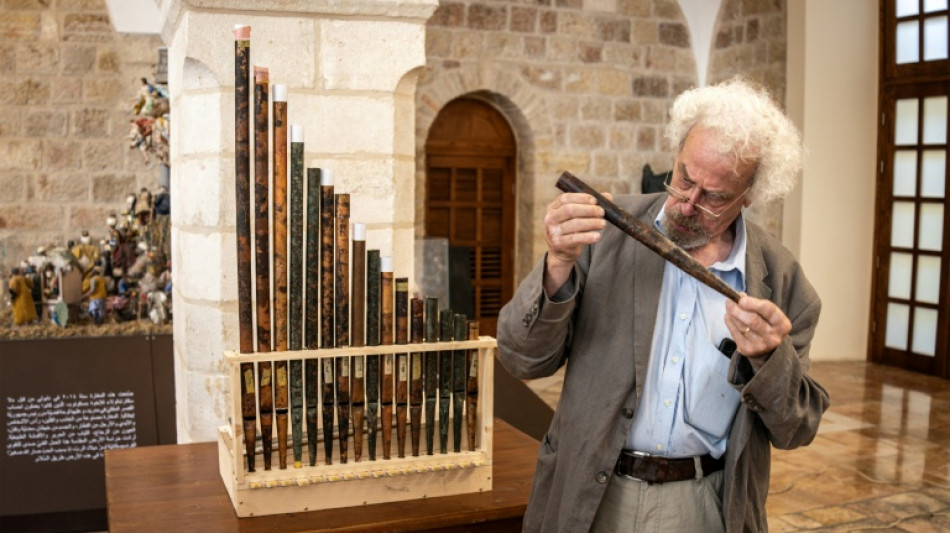
Silent for 800 years, medieval organ sings again in Jerusalem / Photo: JOHN WESSELS - AFP

 Latvian partial election results suggest pro-European choice

 In Egypt's Sinai, Gazan builds school for children displaced by war

 Trump tariffs a mixed bag for US auto industry

 Yemen government forces say struck Houthi targets

 Music links past, present for Pedro Pascal's cellist in 'Behemoth!'

 ALEX BODI ȘI AMBASADORUL REPUBLICII SUDANUL DE SUD, GUM DOMINIC MATIOK, DISCUTĂ LA BERLIN DESPRE POSIBILITATEA ÎNFIINȚĂRII UNUI CONSULAT ONORIFIC LA BUCUREȘTI

 Dodgers step up World Series three-peat bid with 5-3 win over Braves

 Spain break down Czechs as England outclass Croatia in Nations League

 Yamal on target as Spain hold off Czech Republic

 Latvian exit polls suggest pro-European choice

 Lula, Bolsonaro wrap up campaigns ahead of knife-edge election

 Tuchel hails 'complete' England after Croatia demolition

 Fury to invite Trump to lead ring walk before Joshua showdown

 Fashion industry in 'precarious moment', says Vivienne Westwood supremo

 Seventh heaven for England in Nations League rout of Croatia

 Storms, flooding cause chaos on Greek holiday island of Crete

 #IAmJaneDoe: online support campaign in US university rape case
 Brazil shine on Selecao's first visit to India

 Zverev sets up Djokovic quarter-final at China Open, Rybakina out

 Happier at home, Bordeaux hammer Lyon in Top 14

 Lula, Bolsonaro in final push for votes ahead of knife-edge election

 Boisterous fashion week barnstorms 'sleepy' Nigerian capital

 UAE investigators say flydubai co-pilot was planning 'terrorist act'

 Rahul smacks century in India v Windies ODI

 Daryz seeks to join exclusive club of dual Arc winners

The pipes of a medieval organ, buried for centuries and discovered near the Church of the Nativity in Bethlehem in the occupied West Bank, are once more filling a Jerusalem monastery with ancient melodies.
"This is a window into the past... we have the opportunity for the first time in modern history of listening to a medieval sound which is a thousand years old," said David Catalunya, a Spanish researcher who has worked for more than five years to bring the 11th-century instrument back to life.
"And it's not through a recreation or a hypothetical reconstruction, but it's really the original sound: the same vibration that the Crusaders heard at the Nativity Church," he told AFP.
Dating nearly as far back as the invention of the instrument itself, it was discovered in 1906 at the Biblical birthplace of Jesus Christ.
Catalunya pulls on small tabs to play the organ -- which he fondly refers to as a "miracle" -- expelling a formidable ringing from the otherwise modest wooden instrument.
Currently housed in the Monastery of Saint Saviour in Jerusalem's Old City, the instrument is set to be displayed in a museum of the Franciscan Custody of the Holy Land.
"It's like finding a living dinosaur, because it's something we knew existed but we only know from fossils, so there's very limited evidence," said Alvaro Torrente, a musicologist who participated in the restoration project.
"This is not a fossil, this is the real object and the real sound," he told AFP.
- Chance discovery -
It was discovered "almost by chance", according to Father Eugenio Alliata, a Franciscan archaeologist attached to the mission in charge of several holy sites, including the Church of the Nativity in Bethlehem.
During construction of a pilgrim hostel, a set of 222 copper pipes and a bell carillon were unearthed near the site.
It was seemingly buried with "utmost care", according to Catalunya, meaning researchers were able to reconstruct the instrument with painstaking care.
Koos van de Linde, one of the world's leading organ specialists who also consulted on the project, said that "the hope the Crusaders who buried these pieces had, that one day they would resound again, was not in vain.
"It was an immense honour to witness and participate in their resurrection," he continued.
To the experts, the instrument is unique not just for its complexity -- 18 pipes producing a single note -- or what Catalunya says is an "incredible state of preservation", but also its antiquity.
While the oldest organs studied by historians are from the 15th century, this one was built in the 11th century in France before being transported to Bethlehem by Crusaders in the 12th century, Catalunya said.
"The Christians of Europe brought to the Church of the Nativity in Bethlehem the most avant-garde musical instrument used at the time in liturgy: the organ, an instrument designed to become the emblem of sacred music," Torrente told AFP.
He hopes the discovery will spark more interest in what the research team simply calls the "Bethlehem organ", which Torrente says has not yet sung all its tunes.
P.Sousa--PC