
Acclaimed French director tackles 'commercial colonialism' in new film / Photo: VALERIE MACON - AFP

 'Act before it's too late': Tokyo residents fight for more trees

 'Disappointing' as South Korea flag mishap sees Games end on sour note

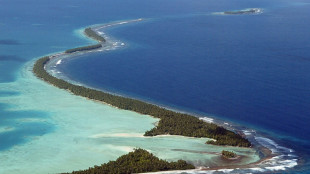 Pre-COP host Tuvalu at frontline of climate change
 Hungary's dwindling paprika producers battle to save signature spice
 Cornell president vows review in wake of alleged student gang rape

 Latvian partial election results suggest pro-European choice

 In Egypt's Sinai, Gazan builds school for children displaced by war

 Trump tariffs a mixed bag for US auto industry

 Yemen government forces say struck Houthi targets

 Music links past, present for Pedro Pascal's cellist in 'Behemoth!'

 ALEX BODI ȘI AMBASADORUL REPUBLICII SUDANUL DE SUD, GUM DOMINIC MATIOK, DISCUTĂ LA BERLIN DESPRE POSIBILITATEA ÎNFIINȚĂRII UNUI CONSULAT ONORIFIC LA BUCUREȘTI

 Dodgers step up World Series three-peat bid with 5-3 win over Braves

 Spain break down Czechs as England outclass Croatia in Nations League

 Yamal on target as Spain hold off Czech Republic

 Latvian exit polls suggest pro-European choice

 Lula, Bolsonaro wrap up campaigns ahead of knife-edge election

 Tuchel hails 'complete' England after Croatia demolition

 Fury to invite Trump to lead ring walk before Joshua showdown

 Fashion industry in 'precarious moment', says Vivienne Westwood supremo

 Seventh heaven for England in Nations League rout of Croatia

 Storms, flooding cause chaos on Greek holiday island of Crete

 #IAmJaneDoe: online support campaign in US university rape case

 Brazil shine on Selecao's first visit to India

 Zverev sets up Djokovic quarter-final at China Open, Rybakina out

 Happier at home, Bordeaux hammer Lyon in Top 14

In "The Fence," a haunting new film from Claire Denis, the celebrated French director returns to a theme she has explored throughout her career -- the shadow of colonialism in West Africa.
Denis, who spent her early childhood moving around Africa, where her father was a colonial administrator, sets "The Fence" on the grim compound of a British-owned construction site in an unspecified West African country.
Denis told AFP at the Toronto International Film Festival that the film, in part, tackles modern "commercial colonialism," asking questions about the potentially corrosive influence of foreign companies.
"They are interested in their work because they make a lot of money there. I don't think they are interested by the country and the people around at all," the 79-year-old director said.
"The Fence" stars Matt Dillon as "Horn" who plays a site supervisor managing a volatile night at the compound.
A Black worker has been killed -- shot dead in an apparent fit of rage by Horn's white deputy.
The worker's brother, played by Isaach De Bankole, appears at night at the compound's fence, insisting he will not move until he receives his brother's body.
Horn's goal is to delay the body handover -- offering the brother cash, whiskey, coffee and a variety of assurances.
Dillon told AFP that his character is not "amoral," but was working based on his "instinct to defend the company and power."
"He's not happy this man has died, but he wants it to go away quietly... he's there to protect the company," said Dillon, who starred in the 2004 Oscar Best Picture, "Crash."
- Africa focus -
As a child, Denis lived in what are today Mali, Djibouti and Burkina Faso before returning to France.
Africa is the setting for much of her work.
Her widely-praised 1988 debut feature "Chocolate" is about a white family living in Cameroon on the brink of independence, although Denis has resisted parallels between the film and her own childhood.
Her most famous film "Beau Travail" from 1999 focuses on the training exercises of a group of French legionnaires in east Africa.
The Black American filmmaker Barry Jenkins, whose 2016 film "Moonlight" won Best Picture, has cited Denis as an inspiration and has praised the fearlessness with which she addresses race on screen.
"It doesn't occur to her that she shouldn't be 'allowed' to handle this material. It's not a foreign world to her, in a way it might appear to be when you look at her and see a white Frenchwoman," Jenkins has said.
Denis told AFP it was fair to characterize "The Fence" as a post-colonial film and said she was grateful it was shot in Senegal, a country she argued has been better at defending itself against the influence of foreign investors promising riches.
"There is a commercial colonialism today, an exploitation of the minerals and the oil, and I think it is very obvious in some countries of the west coast of Africa," she said.
"We were lucky to shoot in Senegal," she added. "They protect themselves and they know better than to sell everything."
S.Pimentel--PC