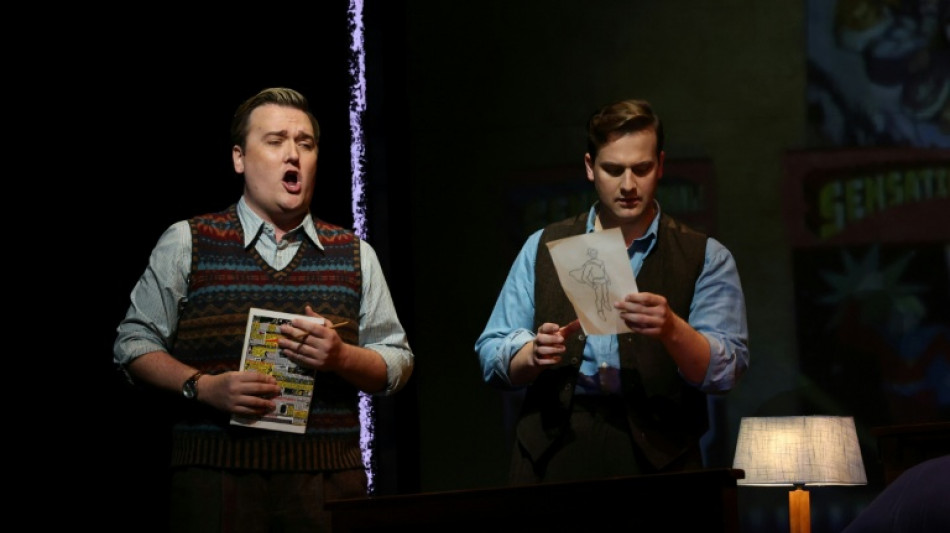
In New York, an anti-fascist superhero rises -- at the Met / Photo: TIMOTHY A. CLARY - AFP

 Latvian partial election results suggest pro-European choice

 In Egypt's Sinai, Gazan builds school for children displaced by war
 Trump tariffs a mixed bag for US auto industry
 Yemen government forces say struck Houthi targets
 Music links past, present for Pedro Pascal's cellist in 'Behemoth!'

 ALEX BODI ȘI AMBASADORUL REPUBLICII SUDANUL DE SUD, GUM DOMINIC MATIOK, DISCUTĂ LA BERLIN DESPRE POSIBILITATEA ÎNFIINȚĂRII UNUI CONSULAT ONORIFIC LA BUCUREȘTI
 Dodgers step up World Series three-peat bid with 5-3 win over Braves
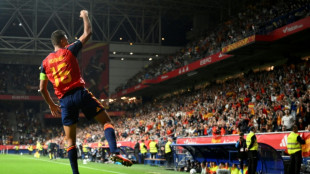 Spain break down Czechs as England outclass Croatia in Nations League

 Yamal on target as Spain hold off Czech Republic

 Latvian exit polls suggest pro-European choice

 Lula, Bolsonaro wrap up campaigns ahead of knife-edge election

 Tuchel hails 'complete' England after Croatia demolition

 Fury to invite Trump to lead ring walk before Joshua showdown

 Fashion industry in 'precarious moment', says Vivienne Westwood supremo

 Seventh heaven for England in Nations League rout of Croatia
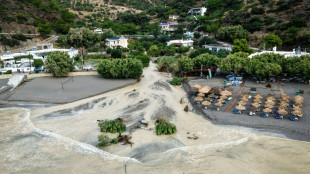 Storms, flooding cause chaos on Greek holiday island of Crete

 #IAmJaneDoe: online support campaign in US university rape case
 Brazil shine on Selecao's first visit to India
 Zverev sets up Djokovic quarter-final at China Open, Rybakina out

 Happier at home, Bordeaux hammer Lyon in Top 14

 Lula, Bolsonaro in final push for votes ahead of knife-edge election

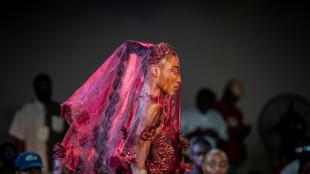 Boisterous fashion week barnstorms 'sleepy' Nigerian capital

 UAE investigators say flydubai co-pilot was planning 'terrorist act'
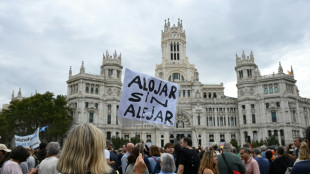
 Rahul smacks century in India v Windies ODI

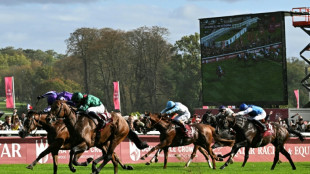 Daryz seeks to join exclusive club of dual Arc winners
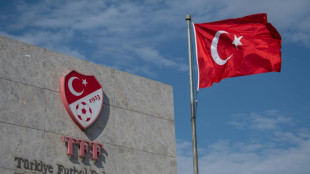
The Statue of Liberty makes a cameo in the Metropolitan Opera's season opener, invoking a time when New York stood as a beacon of hope for Jews desperately fleeing Nazism.
The image from "The Amazing Adventures of Kavalier & Clay" -- which kicks off the Met's 2025-26 cycle on Sunday -- resonates at a time when President Donald Trump's government is cracking down on the media and immigration.
The opera tells the fictitious tale of Joe Kavalier's escape from Nazi-occupied Prague in 1939 to Brooklyn, where he joins forces with cousin Sam Clay to try to raise funds to attempt to save Kavalier's family.
Their money-making venture? A comic strip featuring an superhero called "The Escapist," who fights fascists.
Tenor Miles Mykkanen, who plays Clay, calls the work "a 21st century opera with stories that we want to hear nowadays and stories that affect our lives, which I don't think we can say about a lot of the standard repertoire."
- 'Never done with fascism' -
The ambitious piece, based on a Pulitzer Prize-winning novel published in 2000 by Michael Chabon, alternates in music and sets between Prague, Brooklyn and the fantastic world of The Escapist.
The meditation on love, loss, family and the necessity of art comes on the heels of other recent Met productions that have sought to reinvent the medium.
The world of professional boxing, a magical realist universe evocative of Gabriel Garcia Marquez, the debate over the death penalty in American and the ravages of the AIDS era have all been handled on the Met's stage.
But "Kavalier & Clay" represents the first work in the Met's 142-year history that revolves around a comic book superhero -- a pop culture mainstay that may provide an entry point for those who may not usually try opera.
Chabon's book was the first time "a big serious art form like the novel had taken comic books so seriously," said composer Mason Bates.
"We still embrace superheroes because we are never done with fascism and authoritarianism," he said.
"We long for the simplicity of a good guy to fight back."
- 'The stuff of opera' -
With a huge symphonic burst, the opera starts in the ominous fog of Nazi-occupied Prague at night before shifting to Clay's Brooklyn brownstone and his bustling office.
The novel was published at more than 650 pages, necessitating a heavy streamlining by librettist Gene Scheer.
Choruses and dancers come and go in a quickfire staging that includes frequent jolts of animation beamed to a busy stage.
Some moments link worlds, as when Kavalier reads a letter from his mother, who is shown as he imagines her in Prague.
New York is "the city of freedom and hope," she tells her son, who is played by baritone Andrzej Filonczyk, before the tone shifts.
"I want you to forget us," she adds, leaving a crestfallen Kavalier as Prague inevitably darkens further.
Bates, who is known for works that combine symphonic and electronic music, said he immediately thought "Kavalier & Clay" would work as opera, a medium of "storytelling on a grand scale" he said.
"You've got desperation, passion, art, Nazis and superheroes," he said. "Mix all that together. That's the stuff of opera."
Bates pitched the idea to Met General Manager Peter Gelb, who greenlighted the commission in 2018.
For director Bartlett Sher, the opera is landing at a moment when the rise of fascism in World War II and the response of artists to that calamity feels particularly resonant.
People go to theater and opera "to learn from our own history who we are," said Sher.
He said he is especially moved when characters "talk about what it means to be an immigrant fleeing a country politically and the refuge you seek in the United States."
That allows the audience to "think to ourselves, 'Well, is that who we are?'" Sher added.
E.Ramalho--PC