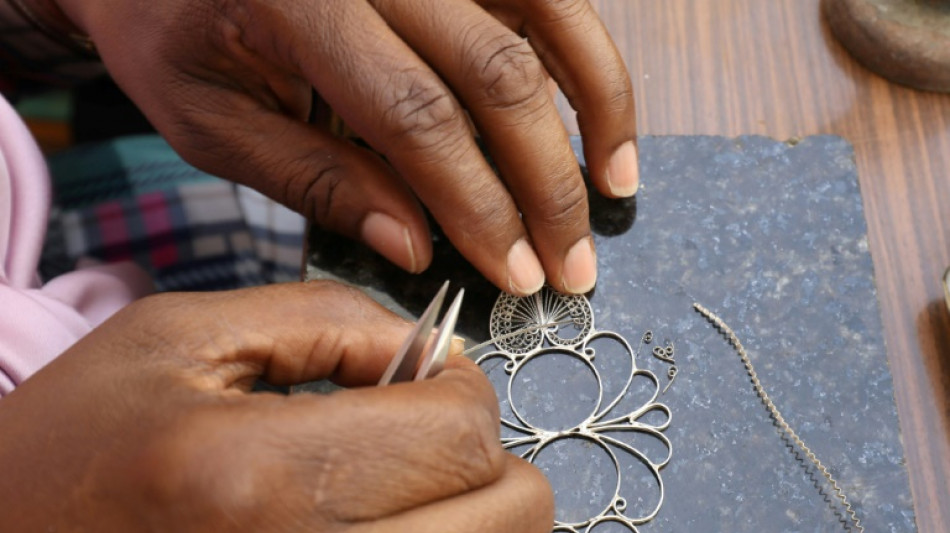
Libya traditional jewellery hangs on by silver thread / Photo: Mahmud Turkia - AFP

 Zverev thrashes Shang to set up Djokovic quarter-final at China Open

 Turkey football ref chief jailed pending trial for graft

 North Korea says test of intermediate-range strategic missile included use of AI

 Rampant Sayers leads Hong Kong to third men's rugby gold in a row

 Ethiopia's Tigray rebels abandon regional capital as govt advances

 Bulgaria's Tsar Samuel returns 'home' after 1,000 years

 'Glad it's over': Kim powers to Games gold and military exemption

 After 11 World Cups, football finally comes home for one Indian fan

 Marc Marquez wins sprint at Japan MotoGP, Martin grabs pole

 Alcaraz fends off Arnaldi to reach Japan Open quarters

 Antonelli tops times in final practice at Bahrain GP

 Gauff digs deep to beat Osorio in China Open second round

 Fresh protests to hit Spain after housing measures defeated

 'He's here with me': Japan cycle queen dedicates gold to late brother

 Japan Olympic chief says 'lot more' athletes at Games than expected

 Asian carmakers besting US rivals at home, China poised to strike

 Widgets & Web Offers All-Inclusive Investor Relations Websites for Public Companies, IPOs and SPACs

 Adams named new US captain to 2030 World Cup

 China a better influence in Latin America than US: poll

 Judge pauses construction of border project in Texas national park

 Belgium's De Bruyne fires double to sink Turkey, France held by Italy

 US jobs data boosts stocks as oil prices dip

 US Supreme Court to hear high-stakes climate case

 Trump expected to name intel chief Clayton as AI czar: reports

 Argentina unveils passports-for-investment scheme

In Tripoli's Old City, young Libyans weave delicate patterns with threads of silver and gold to create traditional filigree jewellery -- reviving an art almost lost through decades of dictatorship and war.
Abdelmajid Zeglam is just 12 years old, but his minutely detailed creations are already selling fast in the streets around a Roman-era archway dedicated to emperor Marcus Aurelius.
"I hesitated at first for fear of failing because I'm young, but my mum encouraged me," Zeglam said.
He is the youngest of 20 or so students, around half of them female, studying at the Libyan Academy for Traditional Gold and Silver Crafts, in a building that once served as a French consulate to the Ottoman Empire.
Trainees learn about precious metal alloys before studying the art of filigree, in which beads and threads of the precious materials are woven into intricate designs then soldered together to create jewellery.
"I love it," Zeglam said. "I want to become a petroleum engineer in the mornings and a jeweller in the afternoons."
Mohamed al-Miloudi, a 22-year-old civil engineering student in a baseball cap, said he had not missed a class since signing up in September.
"It's a hobby, but I'd like to make it into my trade," he said.
The institute's founder, Abdelnasser Aboughress, said filigree jewellery was an ancient tradition in the North African country.
"Craftsmen in the medina of Tripoli were trained by Jewish masters and later by Arabs, at the prestigious School of Arts and Trades" founded in the late 19th century, he said.
- Secret jewellers -
But generations of tradition were abruptly halted after Moamer Kadhafi took power in a 1969 coup.
The capricious ruler scrapped the constitution and established his "jamahiriya" -- a medley of socialism, Arab nationalism and tribal patronage.
He also scrapped the private sector, seizing companies and confiscating their assets.
Overnight, self-employed artisans lost everything: their workshops, their livelihoods and their students.
"The state reduced Libyan crafts to nothing and forced a generation of young apprentices, who should have taken up the baton, to instead leave the traditional crafts and join the army" or become civil servants, said Aboughress.
The 55-year-old was born just a few streets away in the medina, and despite Kadhafi's ban, he took up the craft at the age of 15.
Along with his father, for decades he worked in secret on jewellery for trusted clients.
Now, he hopes to pass the craft on to younger generations, as well as fighting back against a tide of "lower-quality jewellery imported from Egypt and China (which) has flooded the market".
Aboughress is working on a project to document and preserve as much of this cultural heritage as possible.
- 'People with passion' -
Student Fatima Boussoua hit out at the practice of selling old Libyan silver jewellery at cheap prices to be exported then melted down.
"It's part of Libya's artisanal heritage that's disappearing!" she said.
A dentist in her 40s who also teaches at the University of Tripoli, Boussoua has been training at the centre for the past year, hoping to master the craft.
"We should be training artists to preserve our heritage," she said. "All it needs is people with passion."
While becoming a true expert takes years of training, Aboughress's students are already producing works for sale online or at the centre itself.
That said, he admits the project needs financial help to buy the expensive raw materials -- as well as "moral support".
He hopes that with enough resources, he will one day be able to set up a string of other workshops across Libya.
"It's time to bring this craft back to life," he said.
T.Resende--PC