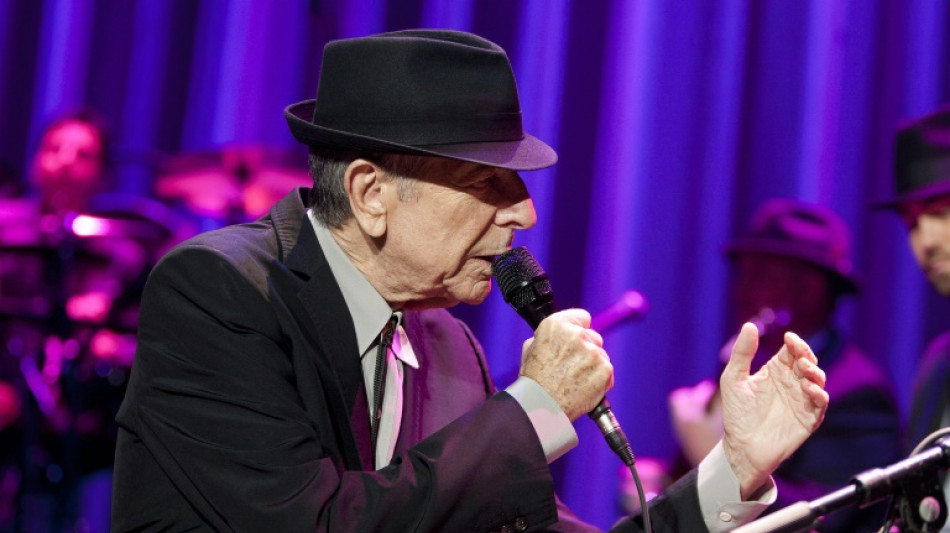
'Hallelujah', a dud turned classic song, the focus of new Cohen doc / Photo: Mike Lawrie - GETTY IMAGES/AFP

 Zverev thrashes Shang to set up Djokovic quarter-final at China Open

 Turkey football ref chief jailed pending trial for graft

 North Korea says test of intermediate-range strategic missile included use of AI

 Rampant Sayers leads Hong Kong to third men's rugby gold in a row

 Ethiopia's Tigray rebels abandon regional capital as govt advances

 Bulgaria's Tsar Samuel returns 'home' after 1,000 years

 'Glad it's over': Kim powers to Games gold and military exemption

 After 11 World Cups, football finally comes home for one Indian fan

 Marc Marquez wins sprint at Japan MotoGP, Martin grabs pole

 Alcaraz fends off Arnaldi to reach Japan Open quarters

 Antonelli tops times in final practice at Bahrain GP

 Gauff digs deep to beat Osorio in China Open second round

 Fresh protests to hit Spain after housing measures defeated

 'He's here with me': Japan cycle queen dedicates gold to late brother

 Japan Olympic chief says 'lot more' athletes at Games than expected

 Asian carmakers besting US rivals at home, China poised to strike

 Widgets & Web Offers All-Inclusive Investor Relations Websites for Public Companies, IPOs and SPACs

 Adams named new US captain to 2030 World Cup

 China a better influence in Latin America than US: poll

 Judge pauses construction of border project in Texas national park

 Belgium's De Bruyne fires double to sink Turkey, France held by Italy

 US jobs data boosts stocks as oil prices dip

 US Supreme Court to hear high-stakes climate case

 Trump expected to name intel chief Clayton as AI czar: reports

 Argentina unveils passports-for-investment scheme

Leonard Cohen's song "Hallelujah" pretty much flopped when it came out nearly 40 years ago.
Today, it enjoys cult status and has been performed by everyone from Bob Dylan to Jeff Buckley and Bon Jovi -- even appearing in animated hit "Shrek" -- in a unique evolution detailed in a new documentary film.
The tune rich in religious and erotic references by the Canadian poet, who died in 2016, has made the rounds.
In 2008, a gospel version of the song was performed by Alexandra Burke on the British TV talent show "The X Factor."
That year the song placed 1st, 2nd and 36th in the British music charts: the versions by Burke, Buckley and the original by Cohen himself.
"I do not know of any other song with that trajectory," said music journalist Alan Light, who wrote a book on the song called "The Holy or the Broken," published in 2012.
- 'Snowball is rolling' -
"This song took 10 years, 20 years, going through all these different versions, around these different corners and then it gains this momentum. The snowball is rolling, and it gets bigger and bigger and bigger," Light told AFP.
He spoke in New York at a showing of the new documentary "Hallelujah: Leonard Cohen, a Journey, a Song," for which was an adviser and producer.
The film shows that, at first, the work was destined for obscurity.
A practicing Jew who eventually retired to a Buddhist monastery, poet-turned-singer Cohen took years to write the spiritual and image-rich lines of the song, which evokes King David, his music and his temptations.
Cohen left out dozens of the verses he had written.
The Columbia record label refused to release "Various Positions," the LP that included "Hallelujah," in the United States. It did come out in Europe, among other the places.
Competition was stiff that year, and slow, poetic songs were not crowding the top of the charts.
"It's 1984. It's boom time in the music business. This is the year of 'Born in the USA,' and 'Like a Virgin' and 'Purple Rain,'" Light said, referring to huge hits by Bruce Springsteen, Madonna, and Prince.
A few years later, Dylan lifted the song out of the darkness with a blues version.
Then John Cale, one of the founders of The Velvet Underground, covered it in 1991, followed by Buckley's in 1994.
- Bono apologizes -
The documentary shows how "Hallelujah" became a feature of popular culture, with new generations discovering it in the first "Shrek" movie in 2001 and in "Sing" in 2016.
In 2010, the Canadian singer K.D. Lang belted it out at the Winter Olympics in Vancouver. And 11 years later "Hallelujah" was performed again at a tribute to victims of the coronavirus pandemic, with President Joe Biden in attendance on the eve of his swearing in.
Light says the song has a beautiful melody and but also lyrics open to interpretation.
"If to you it's a religious song, that's there. If to you, it's a heartbreak song, great, that's there. You can do that," Light said.
"There's no wrong way to do it," he added, noting a ukelele version by US musician Jake Shimabukuro.
Not all agree, however.
In an interview for his book on "Hallelujah," Light recalled how U2 frontman Bono apologized for a 1995 trip-hop version of the song he recorded, in which he talked his way through the lyrics, rather than sang.
T.Vitorino--PC