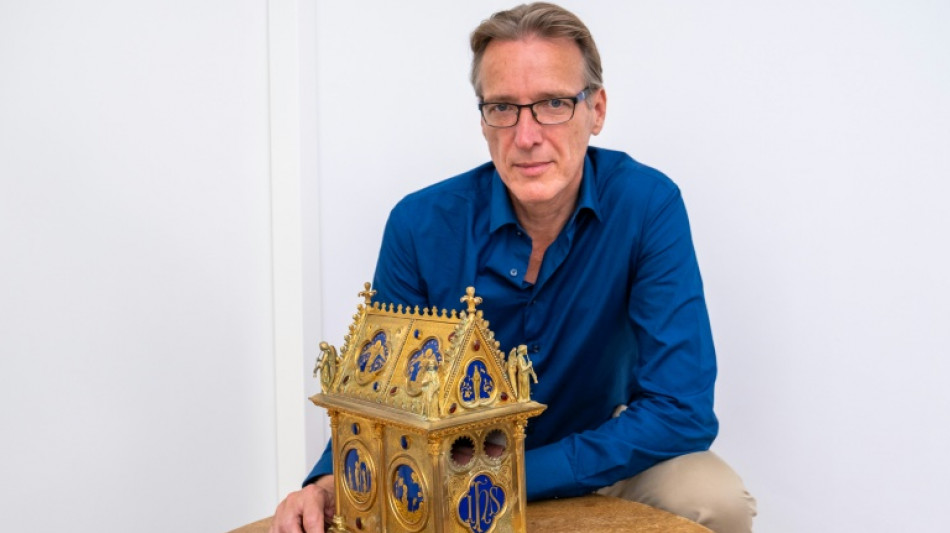
The Dutch art detective who says he recovered the 'Blood of Christ' relic / Photo: Jeremy AUDOUARD - AFP

 Zverev thrashes Shang to set up Djokovic quarter-final at China Open

 Turkey football ref chief jailed pending trial for graft

 North Korea says test of intermediate-range strategic missile included use of AI

 Rampant Sayers leads Hong Kong to third men's rugby gold in a row

 Ethiopia's Tigray rebels abandon regional capital as govt advances

 Bulgaria's Tsar Samuel returns 'home' after 1,000 years

 'Glad it's over': Kim powers to Games gold and military exemption

 After 11 World Cups, football finally comes home for one Indian fan

 Marc Marquez wins sprint at Japan MotoGP, Martin grabs pole

 Alcaraz fends off Arnaldi to reach Japan Open quarters

 Antonelli tops times in final practice at Bahrain GP

 Gauff digs deep to beat Osorio in China Open second round

 Fresh protests to hit Spain after housing measures defeated

 'He's here with me': Japan cycle queen dedicates gold to late brother

 Japan Olympic chief says 'lot more' athletes at Games than expected

 Asian carmakers besting US rivals at home, China poised to strike

 Widgets & Web Offers All-Inclusive Investor Relations Websites for Public Companies, IPOs and SPACs

 Adams named new US captain to 2030 World Cup

 China a better influence in Latin America than US: poll

 Judge pauses construction of border project in Texas national park

 Belgium's De Bruyne fires double to sink Turkey, France held by Italy

 US jobs data boosts stocks as oil prices dip

 US Supreme Court to hear high-stakes climate case

 Trump expected to name intel chief Clayton as AI czar: reports

 Argentina unveils passports-for-investment scheme

It was 10:30 pm on a Friday when Arthur Brand got the delivery he was nervously expecting.
His doorbell rang, and when he opened the door no one was there. Instead, a cardboard box was waiting for him at the door in the dark.
In that box he said was one of the most sacred artefacts ever stolen from the Catholic Church: the "Precious Blood of Christ" relic.
"(My) heart was beating in (my) chest," the Dutch art detective told AFP in an interview about the recovery of the stolen treasure.
Brand is dubbed the "Indiana Jones of the Art World" for his remarkable recoveries of stolen art, including the "Hitler's Horses" bronze statues, a Picasso painting and a ring that once belonged to Oscar Wilde.
At 52, he is one of the most famous art sleuths in the world, trusted by both thieves and police for his unprecedented access to the criminal trade in stolen art.
But getting his hands on the "Precious Blood of Christ" relic was a particularly special experience for him.
"As a Catholic myself, this is about as close to Jesus and the legend of the Holy Grail you can get."
"It was a religious experience," he said.
- 'Massive shock' -
When he opened the box, he discovered what he hoped he would: the relic perfectly intact.
The ornate container, about 30 centimetres (11 inches) high, has two metal bulbs inside and is said to hold drops of Jesus' blood collected in the Holy Grail during the crucifixion.
It is held in a heavily gilded copper box with encrusted precious stones and depictions of Christ on the cross and other saints.
The holy relic is believed to date back to the death of Christ and has been a source of worship for Catholic pilgrims for more than 1,000 years.
It was held by the Fecamp Abbey in France's Normandy region until the night of June 1-2, when it was stolen, just two weeks before the annual "Mass of the Precious Blood" celebration.
"The thief most likely got inside by being locked in after hours and made off with the artefact," Brand said.
"It was a massive shock that this famous piece, this legendary piece was stolen," he told AFP in his home, the relic on display nearby.
- 'The real thing' -
The relic and its copper box were not the only objects waiting in the cardboard package on Brand's doorstep on that fateful July evening.
There were several copper liturgical plates, depictions of saints and an ornate goblet, which were also stolen from the abbey in June.
Brand carefully showed AFP the ornate and heavy copper box with a miniature roof and four angels on its corners, called a reliquary.
AFP could not independently verify the authenticity of the objects, and they have not yet been examined by police or experts. The abbey could not immediately be reached for comment.
But Brand is certain about their authenticity.
"I have no doubt in my mind that it is the real thing. Religious objects are almost impossible to forge."
The sacred relic will be handed to Dutch law enforcement once they receive a request for mutual assistance from France, Dutch police said Tuesday.
Once Dutch police receive the object, they will investigate the authenticity of the object and try to identify the thief.
"After the investigation, our conclusions and the relic will be returned to the French police," Dutch national police spokesman Dennis Janus told AFP.
- 'A curse' -
Brand said his involvement in the case started a few days after the theft, when he received a protected email from an anonymous writer, claiming to have the stolen loot in their possession.
"This person was approaching me on behalf of another, at whose home the stolen relics were being stored," said Brand.
But "to have the ultimate relic, the blood of Jesus in your home, stolen, that's a curse," he said.
"When they realised what it was, that you in fact cannot sell it, they knew they had to get rid of it."
Brand showed AFP an email written in Dutch in which the person asked him to take back the stolen property, as it was too risky to return it to the abbey itself.
Brand was told that the stolen artefact would be delivered to his home, but no date or time was given.
"I was virtually a prisoner in my own home for a week. I could not leave," he said, laughing.
Finally the objects turned up, delivered by an anonymous sender.
Asked why the thieves would return the stolen art to Brand, he said "it would be too dangerous to involve the police".
"These people know my reputation and that the most important thing is to return this to the church. Hopefully it will stand for another thousand years," Brand said.
O.Gaspar--PC