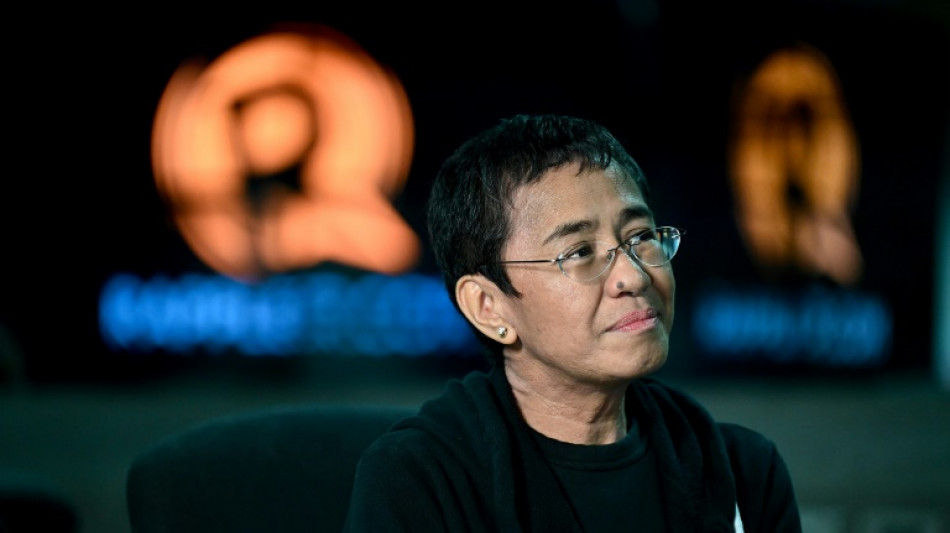
Defiant Philippine Nobel laureate Ressa fights for her freedom / Photo: JAM STA ROSA - AFP

 Zverev thrashes Shang to set up Djokovic quarter-final at China Open

 Turkey football ref chief jailed pending trial for graft
 North Korea says test of intermediate-range strategic missile included use of AI
 Rampant Sayers leads Hong Kong to third men's rugby gold in a row

 Ethiopia's Tigray rebels abandon regional capital as govt advances

 Bulgaria's Tsar Samuel returns 'home' after 1,000 years
 'Glad it's over': Kim powers to Games gold and military exemption

 After 11 World Cups, football finally comes home for one Indian fan
 Marc Marquez wins sprint at Japan MotoGP, Martin grabs pole
 Alcaraz fends off Arnaldi to reach Japan Open quarters
 Antonelli tops times in final practice at Bahrain GP
 Gauff digs deep to beat Osorio in China Open second round
 Fresh protests to hit Spain after housing measures defeated

 'He's here with me': Japan cycle queen dedicates gold to late brother
 Japan Olympic chief says 'lot more' athletes at Games than expected
 Asian carmakers besting US rivals at home, China poised to strike

 Widgets & Web Offers All-Inclusive Investor Relations Websites for Public Companies, IPOs and SPACs

 Adams named new US captain to 2030 World Cup
 China a better influence in Latin America than US: poll
 Judge pauses construction of border project in Texas national park

 Belgium's De Bruyne fires double to sink Turkey, France held by Italy
 US jobs data boosts stocks as oil prices dip

 US Supreme Court to hear high-stakes climate case
 Trump expected to name intel chief Clayton as AI czar: reports
 Argentina unveils passports-for-investment scheme

Less than a year after winning the Nobel Peace Prize for her efforts to protect free speech, Philippine journalist Maria Ressa is fighting to stay out of jail while her news site Rappler faces possible closure.
But the spirited veteran reporter -- a vocal critic of former president Rodrigo Duterte and his deadly drug war -- refuses to be cowed into silence.
"This is a newsroom that's been under attack for six years and we've prepared ourselves," Ressa, 58, told AFP this week at Rappler's office in suburban Manila.
"We will not voluntarily give up our rights."
Rappler, which Ressa co-founded a decade ago, had to battle for survival under Duterte as his government accused it of violating a constitutional ban on foreign ownership, as well as tax evasion.
Days before Duterte's term ended on June 30, the company received a shutdown order from the Philippine Securities and Exchange Commission (SEC).
Less than two weeks later, Ressa lost an appeal against a 2020 conviction for cyber libel, putting her one step closer to serving up to nearly seven years behind bars.
Drawing on decades of experience working as a journalist across Asia, including in conflict zones, Ressa said she had to be "ready for anything".
"This is something I do as a person, whatever it is I'm most afraid of, I think about the worst-case scenario and then I plan it out," said the former CNN correspondent, who is on bail.
Ressa is facing seven court cases, including the cyber libel conviction, while Rappler faces eight.
Their lawyers describe the cases as "state-sponsored legal harassment".
Trouble for Ressa and Rappler started in 2016 when Duterte came to power and launched a drug war in which more than 6,200 people died in police anti-narcotics operations, official data show.
Rights groups estimate tens of thousands were killed.
Rappler was among the domestic and foreign media outlets that published shocking images of the killings and questioned the crackdown's legal basis.
Local broadcaster ABS-CBN -- also critical of Duterte -- lost its free-to-air licence, while Ressa and Rappler endured what press freedom advocates say was a grinding series of criminal charges, probes and online attacks.
Duterte's government said previously it had nothing to do with any of the cases against Ressa.
After the SEC shutdown order, Ressa said the online harassment increased "exponentially" and has continued since the son and namesake of former Philippine dictator Ferdinand Marcos succeeded Duterte.
"This was the largest spike for sure. It hasn't stopped, it's been pretty much non-stop," said Ressa.
"The attacks are always connected to a defence of the Marcos administration."
- 'Make or break' -
Ressa became a journalist in 1986, the same year that the elder Marcos was ousted in a popular revolt and his family chased into exile in the United States.
Ferdinand Marcos Jr won the May 9 presidential polls by a landslide, completing a remarkable comeback for the clan, helped by relentless online whitewashing of their past and powerful alliances with rival elite families.
Ressa said she was hopeful Marcos Jr would rule differently to his father, who presided over human rights abuses, corruption and the shuttering of independent media.
But the pattern in the past three weeks, including the social media attacks, "bodes ill for press freedom and for Filipino journalists", she said.
"It hasn't been magnanimity in victory," said Ressa.
"This is not one or two people not being nice -- these are concerted information operations."
Some of her colleagues at Rappler, where the average age of staff, including reporters, is about 25, have also been targeted.
As Ressa and the company fight to have the SEC and cyber libel decisions overturned, their future is uncertain.
She had hoped that winning the Nobel Peace Prize in October, which she shared with Russian journalist Dmitry Muratov, would shield her and other journalists in the Philippines.
While Marcos Jr has given few clues about his views on Rappler and the broader issue of freedom of speech, activists fear he could make the situation worse.
Ressa said the outcome of the cases against her and Rappler could have broader implications for Filipinos and their rights.
She points to the controversial cyber libel law, which she has been accused of violating. It was introduced in 2012 and applied to an article published by Rappler months before the law took effect.
"This is make or break," Ressa said.
"What's at stake goes beyond my freedom or Rappler. It really will determine where this country will go."
J.V.Jacinto--PC