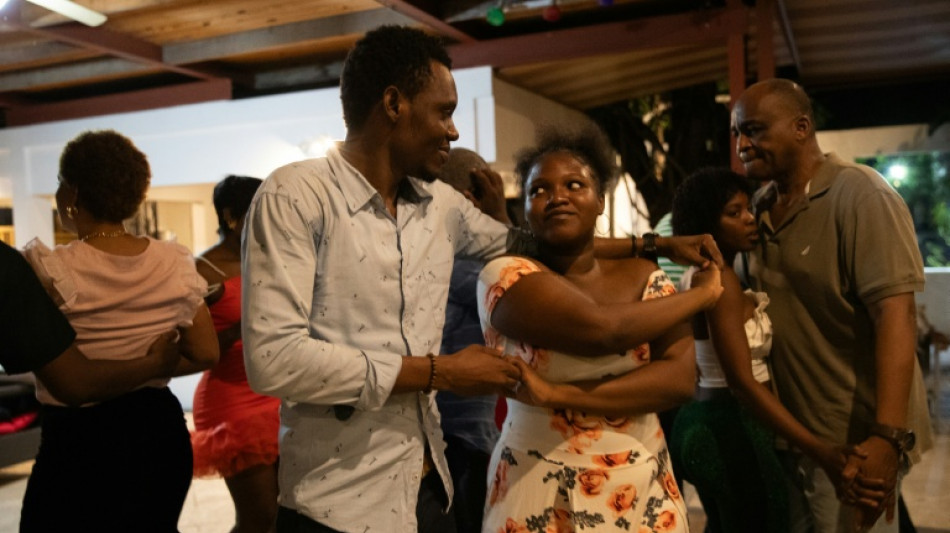
Haitians dance with joy over UNESCO musical listing / Photo: Clarens SIFFROY - AFP

 Tuchel hails 'complete' England after Croatia demolition

 Fury to invite Trump to lead ring walk before Joshua showdown

 Fashion industry in 'precarious moment', says Vivienne Westwood supremo

 Seventh heaven for England in Nations League rout of Croatia

 Storms, flooding cause chaos on Greek holiday island of Crete

 #IAmJaneDoe: online support campaign in US university rape case

 Brazil shine on Selecao's first visit to India

 Zverev sets up Djokovic quarter-final at China Open, Rybakina out
 Happier at home, Bordeaux hammer Lyon in Top 14
 Lula, Bolsonaro in final push for votes ahead of knife-edge election

 Boisterous fashion week barnstorms 'sleepy' Nigerian capital

 UAE investigators say flydubai co-pilot was planning 'terrorist act'

 Rahul smacks century in India v Windies ODI

 Daryz seeks to join exclusive club of dual Arc winners

 Russia warns diplomats to leave Kyiv over new strikes threat

 Olympic champ Zheng rebukes rowdy home crowd at China Open

 World No.1 Sinner pulls out of Shanghai Masters to delay return

 Red Bull's Verstappen grabs pole position for Bahrain GP

 India beat Pakistan in blockbuster as golfer Kim wins 'crazy' gold

 India beat arch-rivals Pakistan to win Asian Games cricket gold

 Ethiopia's Tigray rebels abandon regional capital as govt advances: journalist

 Tom Kim powers to Games gold and exemption from military service

 Split loyalties for Indian football fans at Brazil friendly

 India-Pakistan blockbuster brings cricket fever to Japan baseball field

 Wong waiting on Rafa after winning Asian Games tennis gold

From the bars of the capital Port-au-Prince to Haiti's most remote villages and its worldwide diaspora, people listen and dance to the sensual rhythms of compas.
This musical source of pride among Haitians -- known as konpa or kompa in Creole -- is expected to be added by UNESCO to its Intangible Cultural Heritage list on Wednesday.
"Today, compas is the main artistic (and) musical representation of Haiti abroad," said Frantz Duval, the director of Ticket, the country's leading cultural magazine.
The anticipated listing is a boost of national pride for Haiti -- along with the Caribbean nation's recent qualification for the 2026 football World Cup -- and comes against a backdrop of entrenched poverty and instability driven by gang violence.
Compas "resists crises because everyone listens to it and dances to it even during times of crisis," Duval said. "If we can't dance or organize shows in Port-au-Prince, we do it in the regions. Otherwise, we do it in Haitian communities abroad."
Both a musical genre and a dance style, "compas is a defining creation of the Haitian people," according to the official nomination document submitted to Paris-based UNESCO.
The compas "transcends social classes, forging a unique characteristic within Haitian identity," it said.
"Deeply rooted in Haitian society, the compas is an essential element of festive and ritual life, playing a key role in significant moments for individuals, families, and communities."
The genre typically blends percussion, guitars, and keyboard instruments, with syncopated drumming that drives the rhythm.
- Nation's 'collective memory' -
At any time on a given day in Haiti, this merengue-style music can be heard in restaurants with dance floors, buses, public squares, and on the radio.
It's hard for Haitians to resist the rhythms of compas, or not to nod their heads or dance a few steps while listening to a song.
On TikTok, videos tagged with #kompa (spelled in various ways) reach hundreds of thousands of viewers, and often feature couples dancing sensually.
Compas "is the collective memory of the nation," Emmelie Prophete, Haiti's former culture minister, who worked on the UNESCO application, told AFP.
"We are delighted with this inscription on the list," she said. "This recognition comes at a time when we need to talk about Haiti in a way other than its political and security issues."
Haiti, the poorest country in the Americas, in recent years has been gripped by political instability and violence from gangs, which control a large part of the capital.
- Crossing borders -
The musical genre's birth dates back to a concert held in July 1955 in Port-au-Prince by Nemours Jean-Baptiste, a renowned Haitian saxophonist.
With roots in Africa and France, the former colonial power, compas also draws inspiration "from Cuban and Dominican songs that Haitians listened to on shortwave stations broadcasting from the island of Cuba and neighboring Dominican Republic," musician Yves Joseph, who is popularly known as Fanfan Tibot, told AFP.
His band, Tabou Combo, is famous for having exported compas far beyond Port-au-Prince. He recalled that "New York City," a track released in 1975, was successful in the Caribbean and in France.
"This led us to change our strategy, to sing in English and Spanish in order to win over more fans. Since then, other musical groups have helped compas continue to cross borders," he said.
"This rhythm represents Haiti very well internationally, and I hope it will endure," said Duval, who is also the editor-in-chief of the Haitian daily Le Nouvelliste.
S.Caetano--PC