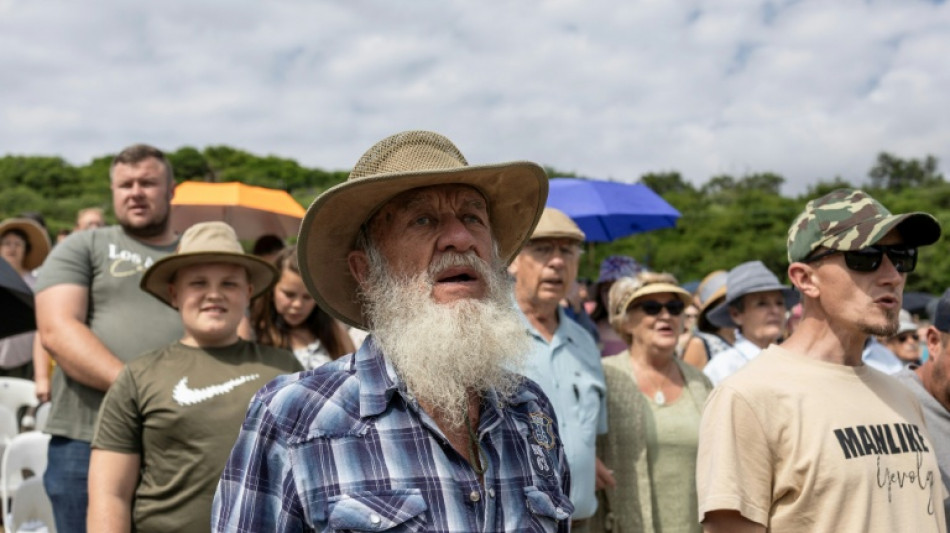
Afrikaners mark pilgrimage day, resonating with their US backers / Photo: Wikus de Wet - AFP

 Tuchel hails 'complete' England after Croatia demolition

 Fury to invite Trump to lead ring walk before Joshua showdown

 Fashion industry in 'precarious moment', says Vivienne Westwood supremo

 Seventh heaven for England in Nations League rout of Croatia

 Storms, flooding cause chaos on Greek holiday island of Crete

 #IAmJaneDoe: online support campaign in US university rape case
 Brazil shine on Selecao's first visit to India

 Zverev sets up Djokovic quarter-final at China Open, Rybakina out

 Happier at home, Bordeaux hammer Lyon in Top 14

 Lula, Bolsonaro in final push for votes ahead of knife-edge election

 Boisterous fashion week barnstorms 'sleepy' Nigerian capital

 UAE investigators say flydubai co-pilot was planning 'terrorist act'

 Rahul smacks century in India v Windies ODI

 Daryz seeks to join exclusive club of dual Arc winners

 Russia warns diplomats to leave Kyiv over new strikes threat

 Olympic champ Zheng rebukes rowdy home crowd at China Open

 World No.1 Sinner pulls out of Shanghai Masters to delay return

 Red Bull's Verstappen grabs pole position for Bahrain GP

 India beat Pakistan in blockbuster as golfer Kim wins 'crazy' gold

 India beat arch-rivals Pakistan to win Asian Games cricket gold

 Ethiopia's Tigray rebels abandon regional capital as govt advances: journalist
 Tom Kim powers to Games gold and exemption from military service

 Split loyalties for Indian football fans at Brazil friendly

 India-Pakistan blockbuster brings cricket fever to Japan baseball field

 Wong waiting on Rafa after winning Asian Games tennis gold
Thousands of Afrikaners, descendants of the first European settlers in South Africa, celebrated on Tuesday the "Day of the Vow" -- a founding myth with values shared by US President Donald Trump's administration, which has offered the group protection.
On a hill overlooking the capital Pretoria, an announcer boasted that some 37,000 Afrikaners had gathered at the Voortrekker Monument, commemorating the migration of Dutch-speaking settlers.
The crowd included men dressed in short-sleeved shirts and khaki shorts and women wearing traditional Voortrekker dresses, similar to that of their pioneer ancestors.
"We just decided to come today because it felt like the right thing to do: to come and enjoy this important day in our language," mechanic Johan Reid, 24, told AFP, on his first pilgrimage accompanied by his fiance.
"It's a hard time now to be an Afrikaner with the politics that's going on in South Africa -- you know what Donald Trump is saying."
US Vice President JD Vance was due to visit the monument during last month's G20 summit before Trump decided to boycott the event, claiming Afrikaners were "being killed and massacred".
Sticking to that position despite evidence to the contrary, Washington blocked South Africa from participating in the G20's first technical meetings under its leadership Monday and Tuesday.
- Treks and destiny -
Eighteenth century Dutch-speaking settlers migrated in what is known as the Great Trek from the British Cape Colony across modern day South Africa -- a journey in their mind similar to the conquest of the American West under the mythos of "Manifest Destiny".
Descendants of those settlers -- who now speak Afrikaans, a language descended from Dutch -- every year still celebrate a 1838 victory over indigenous Zulu people at the Battle of Blood River, fulfilling the mythical vow.
"We made a promise with God. If he saves us during that war with the Zulus, then we will commemorate this year, this day every year. So that's what we do," said Rudolf Brits, 61, who had made the two-hour drive from Sasolburg in the Free State.
The date has remained a public holiday since the end of apartheid, but was renamed as the Day of Reconciliation in 1995 following the election of Nelson Mandela.
"The underlying ethos between Manifest Destiny and the Great Trek are similar: descendants of colonists who felt sure of their claim to the land -— all the land —- despite the presence of people already living there," Laura Mitchell, a University of California Irvine history professor specialising in South Africa and the Dutch East India Company, told AFP.
The comparison extends to the initial settlers. Huguenots went to South Africa to flee persecution in Europe while the pilgrims who sailed to the United States on the Mayflower left for the same reasons.
- Migratory waves -
They "are all sort of part of the same wave of migration," Joel Cabrita, director of the Center for African Studies at Stanford University, told AFP. "There (was) a global Anglo-Saxon chauvinism in this period. this idea that white people are somehow closer to God."
Those parallel migration myths are now being rekindled with Trump's MAGA movement's interest in South Africa.
"I think it's about whiteness. It's about places around the world where white right-wing American nationalists can see evidence of whiteness under siege, whiteness under attack," Cabrita said.
She also noted that hundreds of American mercenaries fought in Rhodesia, now Zimbabwe, to defend white minority rule in the 1960s and 70s.
"Today it's South Africa, but 50 years ago Rhodesia was the kind of cause celebre," Cabrita said.
At the monument in Pretoria, Reid, the mechanic, accused South African President Cyril Ramaphosa of denying the murders of white farmers, a claim echoed by Trump.
"I've had family that was in farm murders. My uncle's mother was murdered on a farm," Reid said.
Twelve people -- not all white -- were killed in rural areas in South Africa between July and September this year, according to the latest police statistics, compared to nearly 5,800 homicides country-wide.
The insistence of some white South Africans and Americans to still believe in massive racial targetting stems from their fear of losing cultural identity, Mitchelle said.
"The fear looks bigger than the actual risks," she said.
X.Matos--PC