World's oldest cave art discovered in Indonesia / Photo: Maxime AUBERT - GRIFFITH UNIVERSITY/AFP

 #IAmJaneDoe: online support campaign in US university rape case

 Brazil shine on Selecao's first visit to India

 Zverev sets up Djokovic quarter-final at China Open, Rybakina out
 Happier at home, Bordeaux hammer Lyon in Top 14

 Lula, Bolsonaro in final push for votes ahead of knife-edge election

 Boisterous fashion week barnstorms 'sleepy' Nigerian capital

 UAE investigators say flydubai co-pilot was planning 'terrorist act'

 Rahul smacks century in India v Windies ODI

 Daryz seeks to join exclusive club of dual Arc winners

 Russia warns diplomats to leave Kyiv over new strikes threat

 Olympic champ Zheng rebukes rowdy home crowd at China Open

 World No.1 Sinner pulls out of Shanghai Masters to delay return

 Red Bull's Verstappen grabs pole position for Bahrain GP

 India beat Pakistan in blockbuster as golfer Kim wins 'crazy' gold

 India beat arch-rivals Pakistan to win Asian Games cricket gold

 Ethiopia's Tigray rebels abandon regional capital as govt advances: journalist

 Tom Kim powers to Games gold and exemption from military service

 Split loyalties for Indian football fans at Brazil friendly

 India-Pakistan blockbuster brings cricket fever to Japan baseball field

 Wong waiting on Rafa after winning Asian Games tennis gold

 With Russia next door and rising costs, Latvia goes to the polls

 Penalty hero rues empty seats as Games hosts Japan win football gold

 North Korea fires ballistic missile after Seoul's apology demand

 US regulator finds Boeing 737 MAX software bug 'not a safety concern'

 Ohtani 'managing' injuries as Dodgers launch MLB post-season

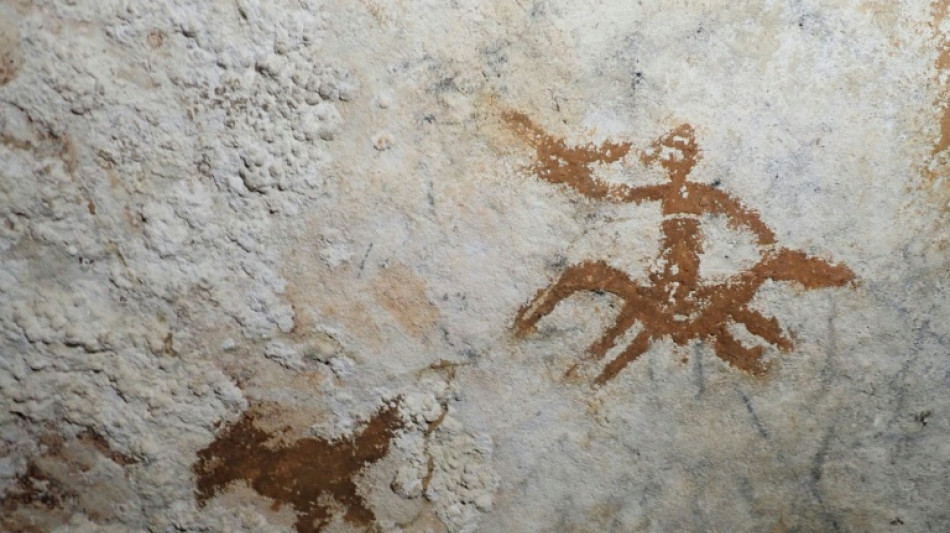
A red stencil of a hand pressed against the wall of an Indonesian cave is the oldest rock art ever discovered, scientists said Wednesday, and sheds light on how humans first migrated to Australia.
The cave art dates back at least 67,800 years, according to research published in the journal Nature by a team of Indonesian and Australian archaeologists.
"We have been working in Indonesia for a long time," study co-author Maxime Aubert of Australia's Griffith University told AFP.
This time they ventured to caves on the island of Muna in the Sulawesi province on the advice of Indonesian archaeologist Adhi Agus Oktaviana, the study's lead author.
There they found "handprints in negative, stencilled, probably using red ochre," Aubert said.
The fingers of one of the hands were "retouched to become pointed like claws -- a style of painting only seen in Sulawesi," the Canadian archaeologist added.
To determine the art's age, the team took five-millimetre samples from "cave popcorn", which are small clusters of calcite that form on the walls of limestone caves.
Then they zapped the layers of rock with a laser to measure how the uranium decayed over time, compared to a more stable radioactive element called thorium.
This "very precise" technique gave the scientists a clear minimum age for the painting, Aubert explained.
At 67,800 years old, the Indonesian stencil is more than a thousand years older than other hand stencils found in a Spanish cave which has been attributed to Neanderthals. However the dating of that cave art "has been controversial," the study cautioned.
The new discovery is also more than 15,000 years older than previous art found in the Sulawesi region by the same team.
The scientists also established that the Muna caves had been used for rock art many times over a long period.
Some of the ancient art was even painted over up to 35,000 later, Aubert said.
- A fork in the road -
Beyond setting a new record, the art also offers clues for a long-running historical mystery.
Scientists have been divided about how Homo sapiens first journeyed from Asia to Australia.
They could have taken the northern route, travelling by boat through Indonesia islands including Sulawesi to Papua New Guinea.
These ancient humans could then have walked the rest of the way -- at the time, Papua New Guinea and Australia were both part of a supercontinent called Sahul.
Or the migrants could have taken the southern route, travelling through the islands of Sumatra, Java and Bali before heading for Timor. Then a boat ride was required to finally make it to Australia.
"These paintings provide the first evidence that modern humans were on these Indonesian islands at that time," Aubert said.
The discovery also "reinforces the idea that people arrived in Australia via Papua, perhaps around 65,000 years ago", he said.
But it could not be ruled that other people were also making their way to Australia via the southern route at the same time, he added.
The researchers also said that the paintings were very likely created by people closely linked to the ancestors of Indigenous Australians.
A.Silveira--PC