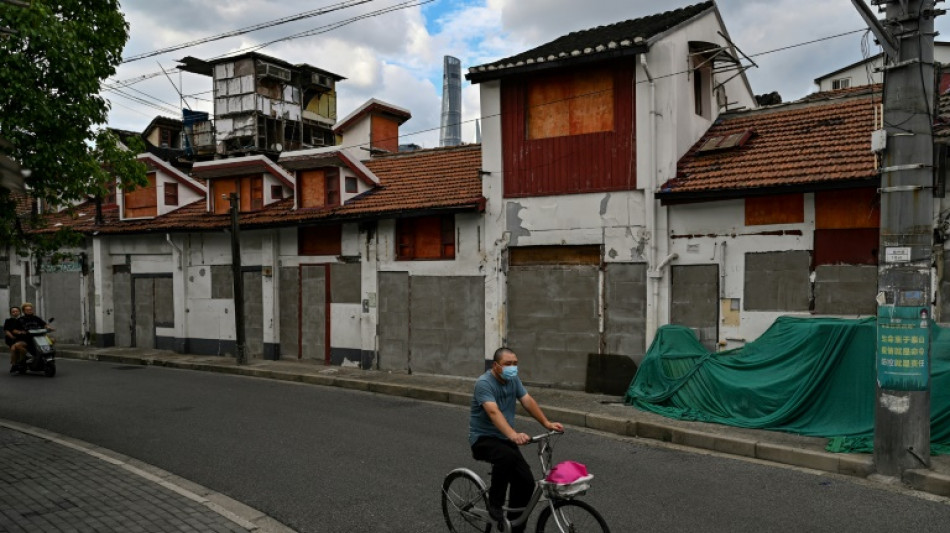
Demolition looms for historic Shanghai neighbourhood / Photo: Hector RETAMAL - AFP

 Zverev thrashes Shang to set up Djokovic quarter-final at China Open

 Turkey football ref chief jailed pending trial for graft
 North Korea says test of intermediate-range strategic missile included use of AI

 Rampant Sayers leads Hong Kong to third men's rugby gold in a row

 Ethiopia's Tigray rebels abandon regional capital as govt advances

 Bulgaria's Tsar Samuel returns 'home' after 1,000 years

 'Glad it's over': Kim powers to Games gold and military exemption

 After 11 World Cups, football finally comes home for one Indian fan

 Marc Marquez wins sprint at Japan MotoGP, Martin grabs pole

 Alcaraz fends off Arnaldi to reach Japan Open quarters

 Antonelli tops times in final practice at Bahrain GP

 Gauff digs deep to beat Osorio in China Open second round

 Fresh protests to hit Spain after housing measures defeated

 'He's here with me': Japan cycle queen dedicates gold to late brother

 Japan Olympic chief says 'lot more' athletes at Games than expected

 Asian carmakers besting US rivals at home, China poised to strike

 Widgets & Web Offers All-Inclusive Investor Relations Websites for Public Companies, IPOs and SPACs

 Adams named new US captain to 2030 World Cup

 China a better influence in Latin America than US: poll

 Judge pauses construction of border project in Texas national park

 Belgium's De Bruyne fires double to sink Turkey, France held by Italy

 US jobs data boosts stocks as oil prices dip

 US Supreme Court to hear high-stakes climate case

 Trump expected to name intel chief Clayton as AI czar: reports

 Argentina unveils passports-for-investment scheme

Bricked-up doorways, crumbling facades and a small group of defiant locals: one of Shanghai's oldest neighbourhoods is barely clinging to life as the city presses ahead with demolition and redevelopment plans.
Laoximen or "old West Gate" -- named for its position in Shanghai's 16th-century defensive walls -- was once the city's cultural centre.
Built around the site of a Confucian temple, the mostly two- and three-storey buildings of stone and wood are an anachronism at the heart of Shanghai's gleaming commercial district.
Thousands of residents -- a mix of old Shanghai families and migrant workers drawn to the low rent -- were ordered to leave their homes at the end of 2017, though some have clung to the ageing buildings for years after the deadline.
Yang, who declined to give his full name, is one of the last residents who has resisted compensation from the government and held onto his home in Laoximen, a damp labyrinth of long corridors stacked with old furniture and household appliances.
"This piece of land was bought by my grandfather," Yang, whose family has lived in the area since before the Communist Party took power in 1949, told AFP.
Most of his neighbours have agreed to leave, but Yang is holding out for what he says is compensation that would match "the value of the house".
- Compensation -
According to the local government, Laoximen residents can receive as much as 20,000 yuan ($2,962) per square metre, with bonus payments for moving out early.
But the average pre-owned apartment in Shanghai currently costs more than 55,000 yuan per square metre, according to property company Anjuke.
The final demolition was apparently delayed by the pandemic, but diggers have resumed their work after Shanghai emerged from lockdown earlier this year.
Where locals once dined at popular restaurants, large red-and-white signs on the walls urge cooperation with redevelopment plans.
"Open, fair and just: promote the renovation of the old city," one reads.
Doors and windows have been sealed with cement blocks in the winding streets, pockmarked with piles of old chairs, boards and doors.
A short walk from Shanghai's swanky Bund riverside, Laoximen is one of thousands of ageing neighbourhoods in China where residents have been relocated and the land has been taken back by the government in the name of redevelopment and progress.
Many of the homes in the neighbourhood predated modern building standards, and lack heating or central plumbing.
Residents are typically offered new apartments or a sum of money to give up their homes, though some redevelopment projects have caused public anger and violent confrontations in parts of the country.
Replacing Laoximen's once densely packed alleyways with larger, higher-end developments could also help the city achieve its goal of capping its population at 25 million by 2035.
Authorities announced the goal in 2017 as part of a campaign to curb "big city diseases" including congestion and housing shortages.
- 'Public interest' -
Wu Weigang, a retiree who grew up in the area with his extended family, has especially fond memories of celebrating Chinese New Year in Laoximen as a child.
"Everyone set off fireworks and hung up rabbit-shaped lanterns during the lantern festival," he said.
Wu, who now lives two hours away in a temporary apartment in Qingpu district, occasionally returns to Laoximen to revisit his old haunts and check in with neighbours.
Most of the buildings in Laoximen were built in the 20th century in the "shikumen" style of rowhouses arranged along branching lanes.
Antique dealers have been waiting outside family homes to buy up heirlooms in recent months, as families clear out their last belongings.
When night falls, the yellow glow of the streetlights envelops the enclave's near-empty alleys, while the Oriental Pearl Tower glows in the distance.
Shanghai authorities say the area will be redeveloped to meet "the needs of public interest."
Wu hopes some of the old neighborhood's charm will survive the redevelopment intact.
"They told me my home was being preserved," Wu told AFP. "If it weren't here, I wouldn't come to see it, otherwise I would be so sad."
R.Veloso--PC