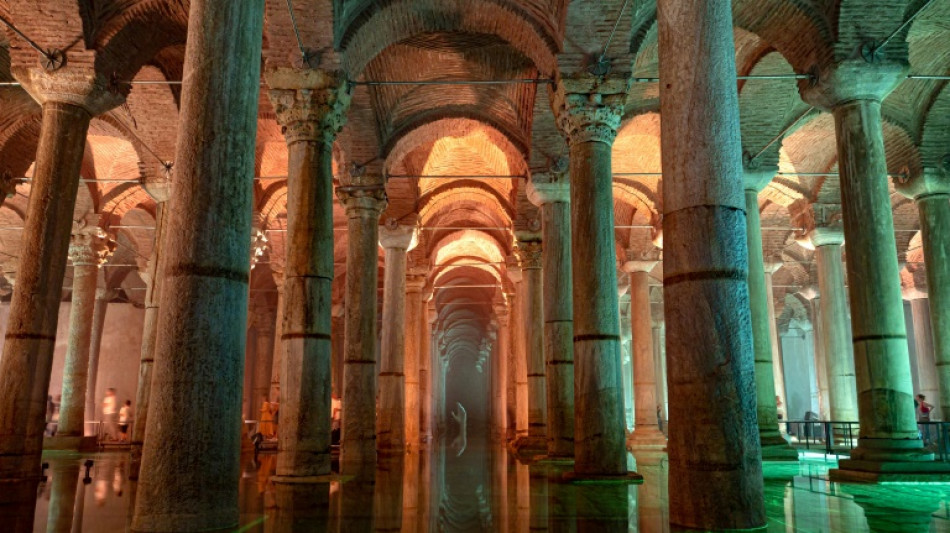
Mystical water underworld of past empires reopens in Istanbul / Photo: Yasin AKGUL - AFP

 Zverev thrashes Shang to set up Djokovic quarter-final at China Open

 Turkey football ref chief jailed pending trial for graft

 North Korea says test of intermediate-range strategic missile included use of AI

 Rampant Sayers leads Hong Kong to third men's rugby gold in a row

 Ethiopia's Tigray rebels abandon regional capital as govt advances

 Bulgaria's Tsar Samuel returns 'home' after 1,000 years

 'Glad it's over': Kim powers to Games gold and military exemption

 After 11 World Cups, football finally comes home for one Indian fan

 Marc Marquez wins sprint at Japan MotoGP, Martin grabs pole

 Alcaraz fends off Arnaldi to reach Japan Open quarters

 Antonelli tops times in final practice at Bahrain GP

 Gauff digs deep to beat Osorio in China Open second round

 Fresh protests to hit Spain after housing measures defeated

 'He's here with me': Japan cycle queen dedicates gold to late brother

 Japan Olympic chief says 'lot more' athletes at Games than expected

 Asian carmakers besting US rivals at home, China poised to strike

 Widgets & Web Offers All-Inclusive Investor Relations Websites for Public Companies, IPOs and SPACs

 Adams named new US captain to 2030 World Cup

 China a better influence in Latin America than US: poll

 Judge pauses construction of border project in Texas national park

 Belgium's De Bruyne fires double to sink Turkey, France held by Italy

 US jobs data boosts stocks as oil prices dip

 US Supreme Court to hear high-stakes climate case

 Trump expected to name intel chief Clayton as AI czar: reports

 Argentina unveils passports-for-investment scheme

Justinian the Great would have been proud.
The Basilica Cistern he built for the capital of his Eastern Roman Empire in modern-day Istanbul has reopened after a five-year makeover that has transformed the water storage site into a refreshingly cool haven of underground sound and light.
Built in AD 542 near the Hagia Sophia mosque -- then a cathedral -- the basilica was once part of a network of more than 100 cisterns begun by the Romans and completed by the Byzantines and Ottomans to supply the city and its palaces with running water.
Known in Turkey as Yerebatan Sarnici ("the cistern buried underground"), its rows of water-steeped columns gained fame on the silver screen when they featured in a scene from the 1963 James Bond film "From Russia With Love".
But the city had to partially close the site for restoration in 2017 over fears the basilica could crumble if the slightest tremor of an earthquake were to jolt Istanbul.
It has been completely shut since the coronavirus pandemic in 2020, allowing workers to strengthen and clean up the 138-metre by 65-metre (453-foot by 213-foot) water palace, said Aysen Kaya, deputy head of the municipality's heritage department.
Steel rods were stretched across the cornices of the 336 columns holding up the subterranean ceiling, arranged in 12 rows of 28.
The pink brick walls have also been cleared of traces of past, less elegant renovation efforts.
"By scraping off the added layers of cement, we brought the bricks up to date," said Kaya. She pointed to two pipes exposed by the latest work: one which brought water to the Hagia Sophia, and another to a palace that stood before the sultans built the Topkapi harem next door.
The Basilica Cistern could store nearly 80,000 litres (21,000 gallons) of water, which cascaded down aqueducts from mountains 19 kilometres to the north.
The feat helped protect the Byzantines from summer drought.
- Upside-down Medusa -
The renovation also includes a lower footbridge above the water, bringing tourists within half a metre of its surface. And with improved lighting, the floor is now visible for the first time.
Beyond the structural changes, the basilica has been infused with a mystical, almost spiritual feel with coloured lights that shift people's perspectives and reveal new details.
A famous Medusa head that adorns two of the corner pillars -- carved, in accordance with legend, upside down so as not to turn people who lock gazes with it to stone -- now looks even more vivid and terrifying.
At the heart of the 1,500-year-old structure, a triumph of the art and techniques of its time, modern works have been inserted for extra effect, such as a grasping hand emerging from the water.
A translucent jellyfish artwork seems to almost dance between the columns, lit up by the rainbow of colours illuminating the dark hall with a gentle glow.
"We wanted a light installation that takes nothing away from the mystical atmosphere of the place," Kaya said.
The queue of tourists snaking its way to the cistern's entrance under the hot Istanbul sun is a testament to the restoration's success.
"Absolutely incredible. I mean, totally unique," said 40-year-old British visitor Nick Alatti, struggling to express his amazement in words.
"I've never seen a place like this before, ever. And it will live with me for a very long time."
E.Paulino--PC