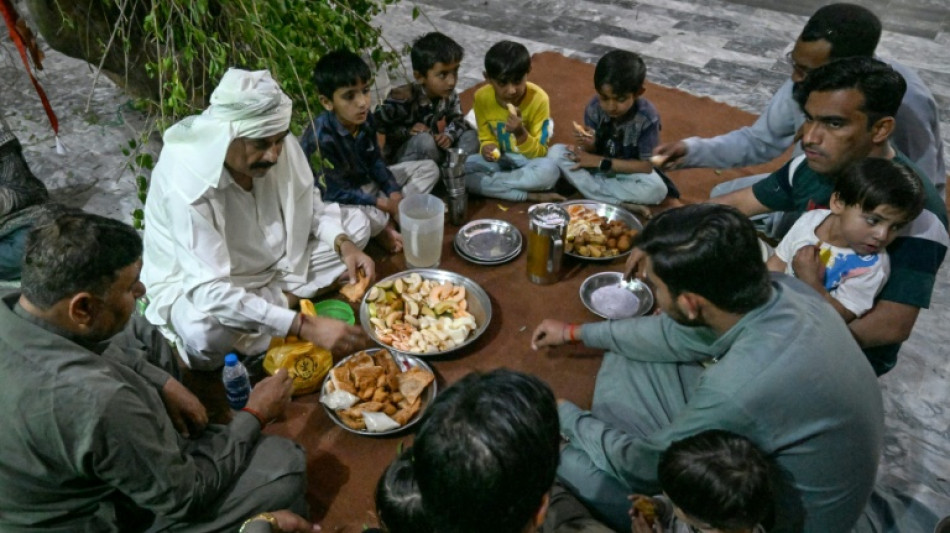
In southeast Pakistan, Ramadan brings Hindus and Muslims closer / Photo: Rizwan TABASSUM - AFP

 World No.1 Sinner pulls out of Shanghai Masters to delay return

 Red Bull's Verstappen grabs pole position for Bahrain GP

 India beat Pakistan in blockbuster as golfer Kim wins 'crazy' gold

 India beat arch-rivals Pakistan to win Asian Games cricket gold

 Ethiopia's Tigray rebels abandon regional capital as govt advances: journalist

 Tom Kim powers to Games gold and exemption from military service

 Split loyalties for Indian football fans at Brazil friendly

 India-Pakistan blockbuster brings cricket fever to Japan baseball field

 Wong waiting on Rafa after winning Asian Games tennis gold

 With Russia next door and rising costs, Latvia goes to the polls

 Penalty hero rues empty seats as Games hosts Japan win football gold

 North Korea fires ballistic missile after Seoul's apology demand

 US regulator finds Boeing 737 MAX software bug 'not a safety concern'

 Ohtani 'managing' injuries as Dodgers launch MLB post-season

 Botched US execution leaves murderer unconscious on ventilator: lawyers

 Cornell rape case exposes sexual violence at US colleges

 France held by Italy in Zidane's homecoming after Olise stunner

 Ethiopian pro-government militia claims Tigray airport as regional tensions spike

 Ohtani shaking off injuries as Dodgers launch MLB post-season

 Sea levels to rise in California as coastal wave surges up west coast

 New rallies urged in France as protests disrupt over 730 schools

 Djokovic survives China Open scare, Sabalenka starts strong

 King Charles to evoke colonial 'darkest days' on Caribbean tour

 Tesla shares jump after global car sales top estimates

 DR Congo Ebola outbreak killed more than 4,000: official figures

Partab Shivani, a Hindu in Muslim-majority Pakistan, has fasted on and off during Ramadan for years, but this time is different as he practices abstinence for the entire holy month.
Every year, he and his friends in the southeastern city of Mithi arrange iftar, when Muslims break their daily fast, to foster peace and solidarity between the two religions.
"I believe we need to promote interfaith harmony. First, we are humans -- religions came later," Shivani, a 48-year-old social activist, told AFP, adding that he also reads the teachings of the Buddha.
"His message is about peace and ending war. Peace can spread through solidarity and by standing with one another. Distance only widens the gap between people," he added.
Ninety-six percent of Pakistan's 240 million people are Muslim. Just two percent are Hindu, most of them living in rural areas of Sindh province where Mithi is located.
In Mithi itself, most of the 60,000 inhabitants are Hindu.
Many of the city's Hindus also observe Ramadan and iftar has become a social gathering where people from both faiths happily participate.
"This has been a wonderful tradition of ours for a very long time," said Mir Muhammad Buledi, a 51-year-old Muslim friend who attended Shivani's iftar gathering.
"It is a beautiful example of harmony between the two communities."
- 'Like brothers' -
Discrimination against minorities runs deep in Pakistan.
Following the end of British rule in South Asia in 1947, the subcontinent was partitioned into mainly Hindu India and Muslim-majority Pakistan.
That triggered widespread religious bloodshed in which hundreds of thousands were killed and millions displaced.
According to the Human Rights Commission of Pakistan, freedom of religion or belief is under constant threat, with religiously motivated violence and discrimination increasing yearly.
State authorities, often using religious unrest for political gain, have failed to address the crisis, the independent non-profit says.
But such tensions are absent in Mithi.
"I am a Hindu but I keep all the fasts during this month," said Sushil Malani, a local politician. "I feel happy standing with my Muslim brothers.
"We celebrate Eid together as well. This tradition in the region is very old."
Restaurants and tea stalls are closed across Pakistan during Ramadan.
Ramesh Kumar, a 52-year-old Hindu man who sells sweets and savoury items outside a Muslim shrine, keeps his push cart covered and closed until iftar.
"There is no discrimination among us if someone is Muslim or Hindu. I have been seeing this since my childhood that we all live together like brothers," he said.
- Muslim shrine, Hindu caretaker -
Locals say Mithi's peaceful religious coexistence can be traced to its remote location, emerging from the sand dunes of the Tharparkar desert, which borders the modern Indian state of Rajasthan.
Cows -- considered sacred in Hinduism -- roam freely in Mithi city, as they do in neighbouring India.
At two Sufi Muslim shrines in the middle of the city, Hindu families arrange meals, bringing fruit, meals and juices for their Muslim neighbours to break their fasts.
"We respect Muslims," said Mohan Lal Malhi, a Hindu caretaker of one of the shrines.
Mohan said his parents and elders taught him to respect people regardless of religion or colour, and the traditions pass from one generation to the next.
Local residents said both communities consider their social relationships more important than their religious identity.
"You will see a (Sikh) gurdwara, a mosque, and a shrine standing side by side here," Mohan said. "The atmosphere of this area teaches humanity."
T.Batista--PC