Tunisia library races to preserve rich polyglot press archive / Photo: Fethi Belaid - AFP

 How Britain's mapmakers track climate change

 Australian delivery drivers win 'world-leading' pay rise

 Meta meets its own 'tobacco' moment in court

 Art or medicine? Japan's cosmetic tattoo artists in limbo

 Rybakina ousts Osaka to book Toronto semi-final against Gauff

 Colombia rescuers find woman alive as quake death toll passes 240

 Charges dropped against Bondi Beach attack hero

 Parched and desperate for rain, Kazakhstan turns to cloud-seeding

 The perfect storm that turbocharged Venezuela's twin quakes

 2.4 million girls banned from Afghan schools since Taliban return: UNESCO
 Colombians dig through rubble as quake death toll surpasses 240

 New Zealand's ruling party meets to decide PM Luxon's fate

 Total solar eclipse to spellbind Europe

 Jodar, Nakashima to make Masters semis debuts in Montreal

 Chilean veteran Sanchez signs with MLS club Montreal

 Cristiano Ronaldo marries long-term partner Georgina Rodriguez

 Oil prices higher, stocks mixed ahead of inflation report

 Jacobs into 100m final with eye on third title
 Eight-try New Zealand cruise to tour victory over Sharks

 Trump's secret plane swap triggers questions and confusion

 California calls Paramount's threat to leave state 'blackmail'

 PSG 'want to win everything', says Luis Enrique
 Barred from elections, Russia's anti-war party vows to fight on
 Jaissle states Newcastle ambition but urges patience

 NBA star Cooper Flagg trading card a slam dunk for lucky buyer
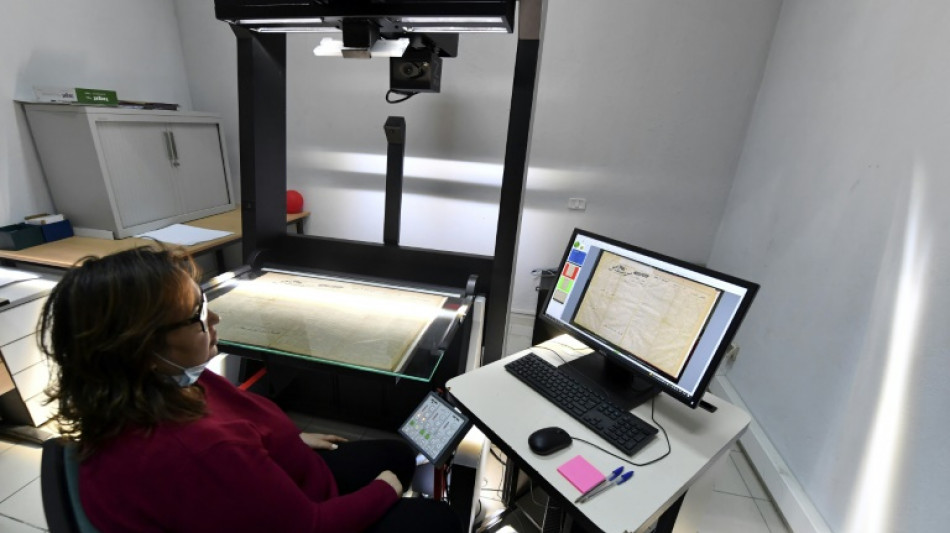
In the basement of the National Library of Tunis, conservator Hasna Gabsi combs through shelves of newspapers dating back to the mid-19th century to select the latest to digitise.
She picks out a yellowed copy of an Arabic-language newspaper printed in the 1880s, then walks to the sections containing French, Italian, Maltese and Spanish-language newspapers published in Tunisia.
"The archive is a witness to an important, historical culture," Gabsi said under the flickering neon lights.
The library's collection includes some 16,000 titles printed in Tunisia -- numbering hundreds of thousands of editions of newspapers and periodicals.
As part of a campaign to preserve the country's archives, the library staff have been working to digitise the documents.
Most of the newspapers are in Arabic, with the oldest from the mid-19th century when Tunisia was an Ottoman province.
After France occupied Tunisia in 1881, European settlers published periodicals in several languages, including French, Italian, Spanish and Maltese.
Some publications are even in Judeo-Arabic, a local Arabic dialect written in the Hebrew alphabet.
Gabsi selects a copy of Voix d'Israel, a Hebrew-language newspaper printed by Tunisia's Jewish community, which numbered around 100,000 when the country gained independence from France in 1956.
Further along the shelves, she picks out L'Unione, published in 1886 by an Italian community that would number some 130,000 by the middle of the following century.
Nearby, technicians use huge scanners to digitise the newspapers and other documents, which have been made available to the public online since May.
The library's director Raja Ben Slama has brought together a team of around 20 employees to accelerate the process.
She said the importance of preserving the newspapers was clear to her when she arrived in 2015.
"We are in a race against time with the elements against the deterioration of the periodicals," she said.
Some of them "can't be found anywhere else", she added.
Many of the publications have disappeared, particularly those published in Italian, Hebrew and Maltese.
Economic woes and tensions sparked by the Arab-Israeli conflict led to the departure of most of the country's Jewish community, while most Italians left in the years after independence.
For historian Abdessattar Amamou, the archives are rare in the region, reflecting the "mosaic" of different communities that were present in the North African country.
"At the dawn of independence, we were three million people -- but with that came a huge richness on the level of the press," Amamou added.
E.Paulino--PC