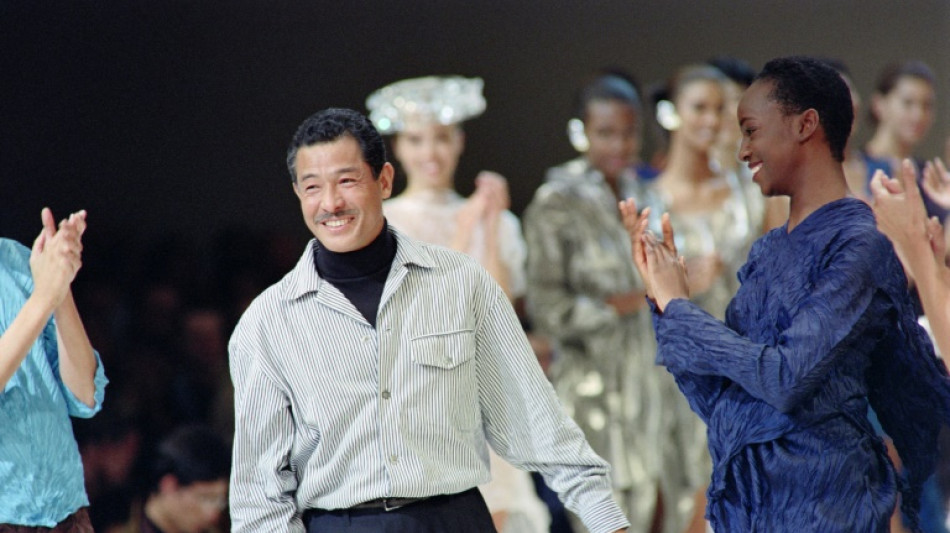
Issey Miyake: seamless innovator of avant-garde style / Photo: Pierre GUILLAUD - AFP

 Lula, Bolsonaro in final push for votes ahead of knife-edge election

 Boisterous fashion week barnstorms 'sleepy' Nigerian capital

 UAE investigators say flydubai co-pilot was planning 'terrorist act'

 Rahul smacks century in India v Windies ODI

 Daryz seeks to join exclusive club of dual Arc winners

 Russia warns diplomats to leave Kyiv over new strikes threat

 Olympic champ Zheng rebukes rowdy home crowd at China Open

 World No.1 Sinner pulls out of Shanghai Masters to delay return

 Red Bull's Verstappen grabs pole position for Bahrain GP

 India beat Pakistan in blockbuster as golfer Kim wins 'crazy' gold

 India beat arch-rivals Pakistan to win Asian Games cricket gold

 Ethiopia's Tigray rebels abandon regional capital as govt advances: journalist

 Tom Kim powers to Games gold and exemption from military service

 Split loyalties for Indian football fans at Brazil friendly

 India-Pakistan blockbuster brings cricket fever to Japan baseball field

 Wong waiting on Rafa after winning Asian Games tennis gold

 With Russia next door and rising costs, Latvia goes to the polls
 Penalty hero rues empty seats as Games hosts Japan win football gold

 North Korea fires ballistic missile after Seoul's apology demand

 US regulator finds Boeing 737 MAX software bug 'not a safety concern'

 Ohtani 'managing' injuries as Dodgers launch MLB post-season

 Botched US execution leaves murderer unconscious on ventilator: lawyers

 Cornell rape case exposes sexual violence at US colleges

 France held by Italy in Zidane's homecoming after Olise stunner

 Ethiopian pro-government militia claims Tigray airport as regional tensions spike

Fashion innovator Issey Miyake shook up Parisian style with his highly wearable avant-garde designs, saying he was driven to create clothes that "bring beauty and joy" after witnessing the horrors of Hiroshima.
Alongside Rei Kawakubo and Yohji Yamamoto, Miyake was part of a wave of young Japanese designers who made their mark in the French capital from the mid-1970s, following the lead of fashion greats Kenzo Takada and Hanae Mori.
Throughout his global career spanning more than half a century, he pioneered high-tech, comfortable clothing -- side-stepping the grandiosity of haute couture in favour of what he called simply "making things".
Among his inventions were the "Pleats Please" line, permanently pleated items which do not crease, refreshing an old-fashioned concept to exude fluidity and comfort.
The much-copied futuristic triangles of Miyake's geometric "Bao Bao" bag complemented countless chic outfits, and he made more than 100 black turtlenecks for Apple co-founder Steve Jobs.
Miyake also wowed runway audiences with his "A-POC (A Piece Of Cloth)" concept, using computer programming to cut whole garments with no seams.
"When I grow weary with where I'm going, or when I stumble, I'll return to the theme of 'A Piece of Cloth'," Miyake said in 2006 after winning the prestigious Kyoto Prize.
"From ancient times, in Greece or Africa, every culture has started (making clothes) from a single piece of cloth, or skin," he explained.
- Hiroshima survivor -
Born in Hiroshima in 1938, Miyake was just seven years old when the United States dropped an atomic bomb on the city in August 1945, obliterating everything he knew.
He survived the blast, which killed an estimated 140,000 people on impact and led to the end of World War II after the bombing of Nagasaki three days later.
Although the bombing left him with a lifelong limp, he rarely spoke of his trauma, once breaking his silence in a 2009 New York Times article calling for nuclear disarmament.
"When I close my eyes, I still see things no one should ever experience: a bright red light, the black cloud soon after, people running in every direction trying desperately to escape," he wrote.
"I remember it all. Within three years, my mother died from radiation exposure."
In the article, he urged Barack Obama to visit Hiroshima, a wish realised in 2016 when the then US president made a historic trip to the city.
"I have never chosen to share my memories or thoughts of that day. I have tried, albeit unsuccessfully, to put them behind me, preferring to think of things that can be created, not destroyed, and that bring beauty and joy," Miyake wrote.
- 'Open to everything' -
Having graduated from Tama Art University in Tokyo, Miyake moved to Paris in 1965, where he studied at the elite Ecole de la Chambre Syndicale de la Couture Parisienne.
As a cub designer he worked under Guy Laroche and Givenchy, but his outlook was also influenced by the huge student-led uprising of May 1968.
Seeing protests engulf the French capital made him realise "the world was moving beyond the needs of haute couture for the few and towards simple more universal elements such as jeans and T-shirts," Miyake told CNN in 2016.
He established the Miyake Design Studio in Tokyo in 1970, and soon afterwards opened his first Paris boutique.
By the 1980s, his career was in full swing as he experimented with materials from plastic to metal wire and even artisanal Japanese paper.
Teamwork was essential to Miyake, who preferred the anonymity of his research and development lab full of textile scientists and engineers to the bright lights of the catwalk.
"You always see things in a different way when you allow others to become part of a creative process," he told the New York Times.
He pulled back from designing his Paris collections at the turn of the century and has since given a series of talented young designers their big break.
But he continued to oversee the brand, and his obsession with technology endured -- with everything from fabrics to stitching explained in minute detail in the notes of every catwalk show.
Miyake is perhaps especially revered in France, whose former culture minister Jack Lang came to Tokyo in 2016 to award him the Legion of Honour at a major retrospective.
Lang, who still wears Miyake pieces he bought many years ago, described the designer in October 2021 as a "man of a deep humanity, open to everything".
"Issey Miyake is a researcher, a discoverer, a real inventor who conceived of and used new materials and textures the world had never seen," he told AFP.
V.Fontes--PC