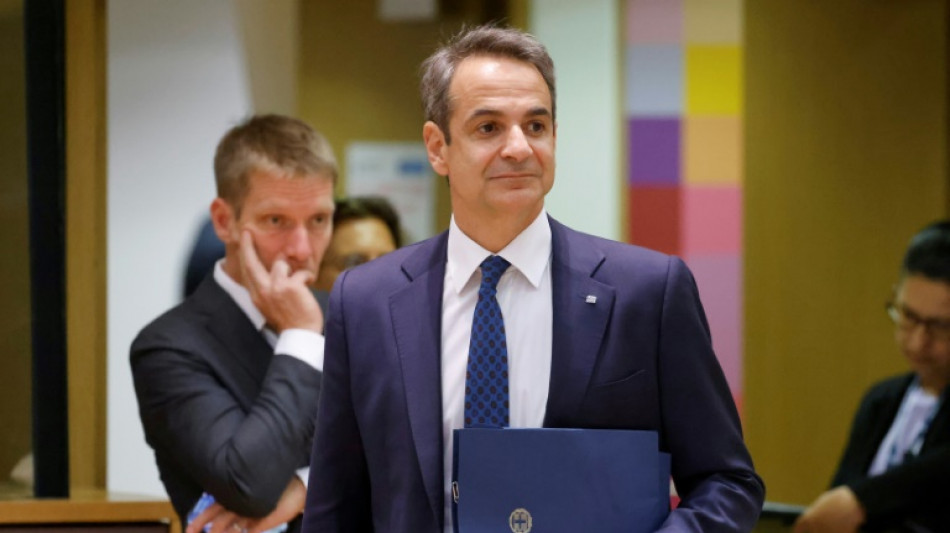
Greek phone-hacking scandal: investigative media's key role / Photo: Ludovic MARIN - AFP

 Lula, Bolsonaro in final push for votes ahead of knife-edge election

 Boisterous fashion week barnstorms 'sleepy' Nigerian capital

 UAE investigators say flydubai co-pilot was planning 'terrorist act'

 Rahul smacks century in India v Windies ODI

 Daryz seeks to join exclusive club of dual Arc winners

 Russia warns diplomats to leave Kyiv over new strikes threat

 Olympic champ Zheng rebukes rowdy home crowd at China Open

 World No.1 Sinner pulls out of Shanghai Masters to delay return

 Red Bull's Verstappen grabs pole position for Bahrain GP

 India beat Pakistan in blockbuster as golfer Kim wins 'crazy' gold

 India beat arch-rivals Pakistan to win Asian Games cricket gold

 Ethiopia's Tigray rebels abandon regional capital as govt advances: journalist

 Tom Kim powers to Games gold and exemption from military service

 Split loyalties for Indian football fans at Brazil friendly

 India-Pakistan blockbuster brings cricket fever to Japan baseball field

 Wong waiting on Rafa after winning Asian Games tennis gold

 With Russia next door and rising costs, Latvia goes to the polls

 Penalty hero rues empty seats as Games hosts Japan win football gold

 North Korea fires ballistic missile after Seoul's apology demand

 US regulator finds Boeing 737 MAX software bug 'not a safety concern'

 Ohtani 'managing' injuries as Dodgers launch MLB post-season

 Botched US execution leaves murderer unconscious on ventilator: lawyers

 Cornell rape case exposes sexual violence at US colleges

 France held by Italy in Zidane's homecoming after Olise stunner

 Ethiopian pro-government militia claims Tigray airport as regional tensions spike

Investigative journalism has emerged as a powerful force during Greece's phone-hacking scandal, rocking a government that tries to "control" the media landscape, experts say.
The long-rumbling "Predatorgate" affair reignited at the end of July when Nikos Androulakis, leader of the opposition Socialists, told journalists about the attempted surveillance of his mobile phone via spyware Predator, having filed a legal complaint.
The spyware can hack into a target's phone and access messages and conversations.
Greek Prime Minister Kyriakos Mitsotakis acknowledged last week that the intelligence service's surveillance had been "politically unacceptable", claiming he had not been informed.
He was speaking three days after two key members of his conservative government resigned over the matter.
Earlier this year two Greek journalists launched legal action, saying they had fallen prey to similar attacks on their phones.
Months-long probes by Greek investigative media have played a crucial part in shedding light on the phone-hacking.
Eliza Triantafyllou, a journalist with the Inside Story website, began investigating the case in January after the publication of two reports by the University of Toronto's Citizen Lab and Meta (Facebook) referring to a new spyware, Predator, with clients and targets in Greece.
"These reports went unnoticed by the (mainstream) Greek media at the time, though they revealed that the Greek government had probably bought Predator," she wrote in a recent article.
Last April, Inside Story published "the first confirmed case of Predator use in 2021 against a European citizen" -- Greek journalist Thanasis Koukakis, who specialises in reporting on corruption.
Online investigative news site Reporters United followed up by reporting that the journalist's phone was monitored by the Greek intelligence service, EYP, in 2020.
Stories first published online by investigative journalists are now making headlines in Greek newspapers.
The country's media landscape is marked by the connivance of traditional media groups with public authorities in line with political and financial interests.
The Reporters Without Borders (RSF) non-profit gives Greece the lowest press freedom rank in Europe.
RSF and the Media Freedom Rapid Response NGO have said the ruling party is "obsessed with controlling the message" and "minimising critical and dissenting voices".
But investigative outlets are "a hope for freedom of expression" in Greece, according to Katerina Batzeli, a member of the Pasok-Kinal central committee, former minister and MEP.
"These innovative media have taken risks and done an extraordinary job" she said.
Greek investigative media, including Inside Story, Solomon and Reporters United, have been on the rise in recent years, using subscriptions to promote "independent and analytical information".
With disinformation rife, "investigative media dare to control the power", said media analyst Georges Tzogopoulos.
He said investigative sites had played a "key role" and called for support through crowdfunding.
A.S.Diogo--PC