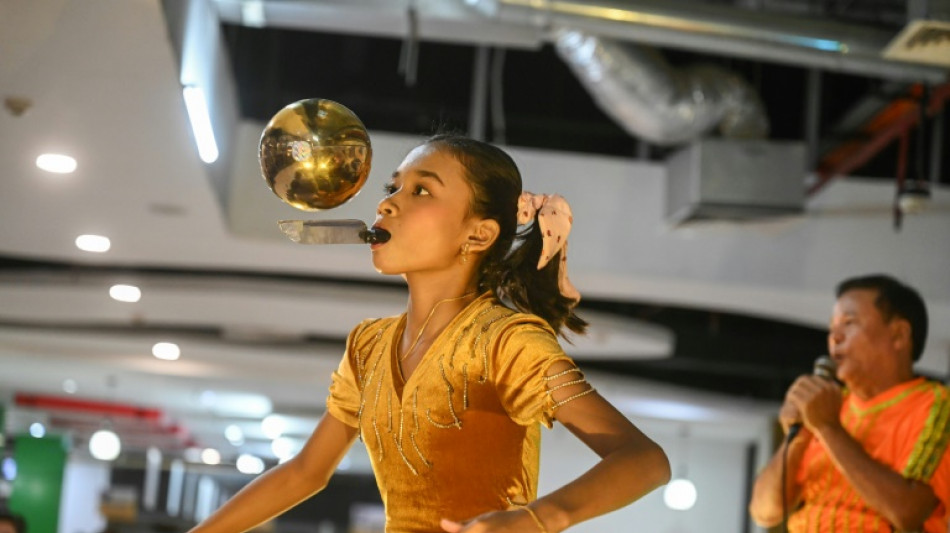
Myanmar grandfather on mission to revive juggling art / Photo: STR - AFP

 Lula, Bolsonaro in final push for votes ahead of knife-edge election
 Boisterous fashion week barnstorms 'sleepy' Nigerian capital

 UAE investigators say flydubai co-pilot was planning 'terrorist act'

 Rahul smacks century in India v Windies ODI

 Daryz seeks to join exclusive club of dual Arc winners

 Russia warns diplomats to leave Kyiv over new strikes threat

 Olympic champ Zheng rebukes rowdy home crowd at China Open

 World No.1 Sinner pulls out of Shanghai Masters to delay return

 Red Bull's Verstappen grabs pole position for Bahrain GP

 India beat Pakistan in blockbuster as golfer Kim wins 'crazy' gold

 India beat arch-rivals Pakistan to win Asian Games cricket gold

 Ethiopia's Tigray rebels abandon regional capital as govt advances: journalist

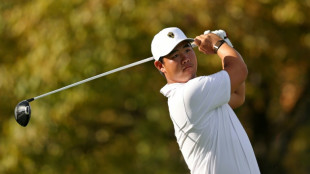 Tom Kim powers to Games gold and exemption from military service

 Split loyalties for Indian football fans at Brazil friendly

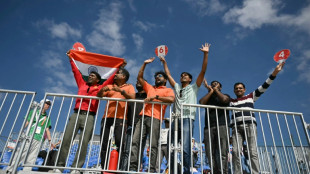 India-Pakistan blockbuster brings cricket fever to Japan baseball field

 Wong waiting on Rafa after winning Asian Games tennis gold

 With Russia next door and rising costs, Latvia goes to the polls

 Penalty hero rues empty seats as Games hosts Japan win football gold

 North Korea fires ballistic missile after Seoul's apology demand

 US regulator finds Boeing 737 MAX software bug 'not a safety concern'

 Ohtani 'managing' injuries as Dodgers launch MLB post-season

 Botched US execution leaves murderer unconscious on ventilator: lawyers
 Cornell rape case exposes sexual violence at US colleges

 France held by Italy in Zidane's homecoming after Olise stunner

 Ethiopian pro-government militia claims Tigray airport as regional tensions spike

Han Myint Mo kicks up a gold-coloured metal ball, pirouettes and catches it on the blade of a knife held in her teeth -- keeping up a Myanmar juggling tradition on the edge of extinction.
Her grandfather and trainer Ohn Myint watches on in their living room in the commercial hub of Yangon, throwing words of encouragement at her and, later in the routine, juggling bats.
At the dizzying peak of the performance, Han Myint Mo juggles as she balances on a mini see-saw, while a hula-hoop spins around her waist and the golden ball stays perched atop her head.
"It makes me happy and strong," the 12-year-old says after the routine, for which she trains three hours a day.
The art form is thought to have begun in the early 19th century when performers at the royal court began juggling balls made of blown, coloured glass -- known as "Ywal".
But unlike conventional juggling, performers move the grapefruit-sized globes around their bodies using only their feet, knees, shoulders and elbows.
Ohn Myint started practising with Ywal in his 40s, immersing himself in the intense meditation it requires, as a way to restore movement to his limbs after he suffered a stroke.
"We can't play when we are afraid, nervous or angry," says the spry 71-year-old after giving his own demonstration.
"Our mind has to be clear like glass."
The discipline required to master tricks puts many off studying the art, including his three children, he says.
He despaired of passing on his knowledge until his granddaughter Han Myint Mo asked him to teach her after she watched him practise.
- 'Eloquent feet' -
For previous generations, skill with the Ywal could be a ticket to travel and fame, with jugglers wowing crowds in Europe and North America.
"He starts to juggle two glass balls, such as we would hang on a Christmas tree in a way that would put to shame the most expert juggler," one San Francisco newspaper reported of a show in 1899.
"But all his work in throwing, catching and tossing is done with those eloquent feet."
For their shows in malls and schools around Yangon, Ohn Myint and Han Myint Mo add more conventional juggling tricks involving bats and hula hoops to draw in small crowds.
Their performances reach a far bigger audience online: one video of the duo training has been viewed more than 3 million times.
"When I see my practising videos are popular, I'm very happy," says Han Myint Mo.
"Sometimes when I'm practising some difficult tricks I fail many times. Then I feel depressed and have arguments with grandpa," he says.
"But he reassures me, we try again together and we manage."
Ohn Myint is also training a friend's granddaughter, who was inspired after watching him practise.
"I'm very glad to see my next generation playing Ywal," he says as the two girls practise in the living room.
Han Myint Mo says she is happy to carry his hopes.
"I want to be an outstanding Ywal master like my grandpa in the future," she says.
"I want to try to be better than him."
B.Godinho--PC