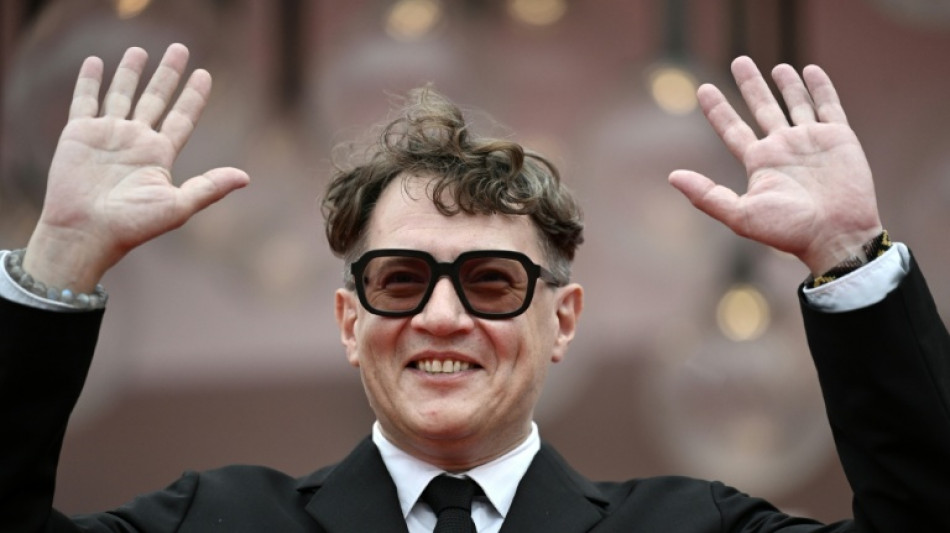
Soviet brutality, ideology backdrop of controversial Venice film / Photo: Tiziana FABI - AFP

 Ireland and Ukraine consider drone cooperation memorandum after Dublin talks
 Georgia refrigeration company sues EPA after five-year HFC reprieve
 Lakers Defeat Bucks 123-112 Amid Injury Concerns for Dončić and Reaves

 Audi-SAIC CEO Fred Schulze Confirms AUDI Brand Will Launch Three New Models in China

 EU proposes broad consumer safeguards for apps, subscriptions and ticketing
 Radical Numerics develops offline AI tool to detect engineered pathogens

 Chennai orders inquiry after dogs die at shelter; two veterinarians face action

 Startup turns Chennai’s history and culture into an interactive world

 Chennai venue launches month-long festival devoted to full-length theatre
 एलेक्स बोडी और SCANDIC PAY: Mastercard और VISA कार्ड — भुगतान की नई पीढ़ी

 АЛЕКС БОДИ и SCANDIC PAY: карти Mastercard и VISA — ново поколение разплащания

 أليكس بودي وSCANDIC PAY: بطاقات Mastercard وVISA — جيل جديد من المدفوعات

 ALEX BODI 與 SCANDIC PAY:Mastercard 與 VISA 卡——新一代支付方式

 ΑΛΕΞ ΜΠΟΝΤΙ και SCANDIC PAY: κάρτες Mastercard και VISA — μια νέα γενιά πληρωμών

 АЛЕКС БОДІ та SCANDIC PAY: картки Mastercard і VISA — нове покоління платежів
 АЛЕКС БОДИ и SCANDIC PAY: карты Mastercard и VISA — новое поколение платежей

 ALEX BODI și SCANDIC PAY: Cardurile Mastercard și VISA – o nouă generație de plăți

 John Park’s Agency Takes Legal Action Over Unauthorized 'McDonald’s Order Rap' Distribution

Ambitious in its scale and style and dogged by controversy, "Dau" by filmmaker Ilya Khrzhanovsky revisits decades of Soviet Union totalitarianism through the eyes of one of the 20th century's great physicists.
Premiering Wednesday at the Venice Film Festival, the over three-hour film was begun two decades ago by the filmmaker, who in 2024 renounced his Russian citizenship to protest the Ukraine war and now lives in Paris.
Marked by unconventional methods -- including actors and extras living permanently on a massive, full-scale reconstruction of a secret Soviet research institute and instructed to remain in character -- the film recounts the life of the brilliant Lev Landau, winner of the 1962 Nobel Prize in physics.
"Dau," Landau's nickname, was one of the fathers of the Russian nuclear bomb, forced by Soviet authorities to work on its development.
Khrzhanovsky, 51, said he wanted to make a film about "this generation of people, of scientists who believe that they will change the world".
Creative and inspired, "at the end of the day they create the most terrible weapon, which could destroy everything on earth," he told AFP in an interview.
The impressive backdrop to the otherwise intimate portrait of the proponent of free love, which spans three decades between 1938 and 1968, is a "monumental fresco of a society shaped by violence and ideology", according to the filmmaker.
Khrzhanovsky called himself a "child of the Soviet Union".
"And I try to understand what is it, what is this kind of Soviet thing in the DNA? Why are we like that?" he asked, speaking in English.
"What's happened with us?"
Khrzhanovsky's latest film is part of a larger multidisciplinary project and social experiment that includes two other films that premiered in 2020 at the Berlin International Film Festival, amid accusations of abuse and harassment during the largely improvised projects with raw, ultra-realistic scenes.
"Dau" took three years of filming in Kharkiv, Ukraine, between 2008 and 2011.
- Enemy of the state -
"Dau" itself garnered controversy ahead of Venice after Ukraine's government accused it of being linked to "the Russian state and its influence networks" -- something the filmmaker denies.
"I'm actually the only film director for fiction movies on the list of enemies of the state," said the filmmaker, who said he has no plans to return to his country in the near future.
"I don't see any bright future (for Russia) for at least the next 10 years," he told AFP.
Khrzhanovsky acknowledged taking financing for the larger multidisciplinary project from Russian billionaire Sergei Adoniev but said it was before the businessman was targeted by US sanctions over the Ukraine war.
The Ukrainian government has also criticised the filmmaker for shooting the city of Kharkiv as a Soviet city --- even as it is today under bombardment by Russian forces.
- Criminals and neo-Nazis -
Driven by a desire to unlock the mysteries of the universe, in love with freedom and poetry, the film's protagonist gradually sees his ideal shattered by the brutality and constant surveillance of the Soviet machine.
The film painstakingly reconstructs the famine-ravaged streets of Kharkiv in the 1930s, as well as Stalinist trials targeting recalcitrant scientists.
In one trial scene, Khrzhanovsky filmed from beginning to end without a script, with actors and non-actors invited to improvise.
"The people in the court, the judges and the prosecutor, are actually criminals, ex-criminals. People who went through many courts and they know how it, what was the protocol," Khrzhanovsky told AFP.
"In Soviet times, judges and KGB people were actually ex-criminals. I wanted to use this kind of energy of people who have this tough nature and who are meeting intelligent and cultured people," he said.
The director also hired real neo-Nazis for the film's final scenes.
At a press conference Wednesday ahead of the film's premiere, Khrzhanovsky said he said he knew that "art cannot change the world".
"But maybe it can sometimes give some feelings and emotions and more energy for some people to survive spiritually, emotionally.
"In good days, in the dark days."
H.Portela--PC