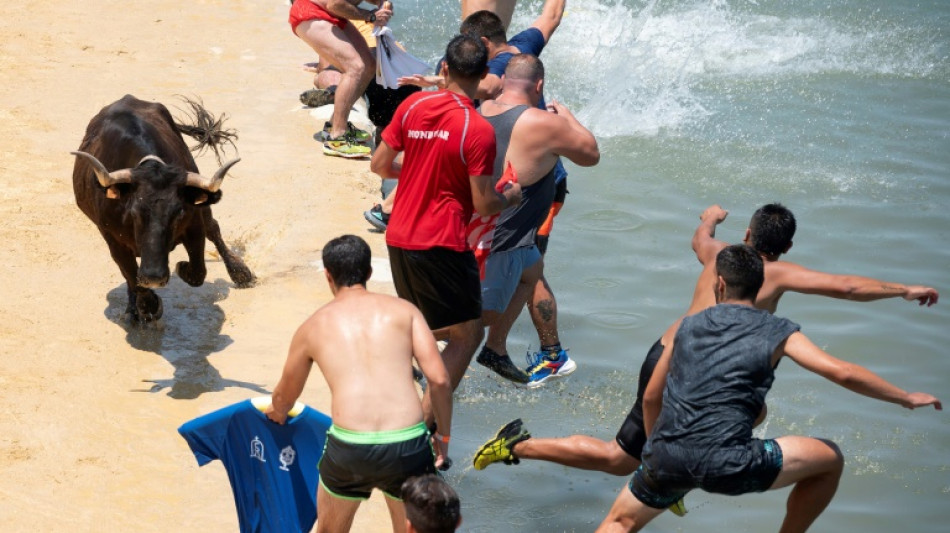
Debate flares over Spain bull-running fiestas as 10 die / Photo: Jose Jordan - AFP/File

 #IAmJaneDoe: online support campaign in US university rape case

 Brazil shine on Selecao's first visit to India

 Zverev sets up Djokovic quarter-final at China Open, Rybakina out
 Happier at home, Bordeaux hammer Lyon in Top 14

 Lula, Bolsonaro in final push for votes ahead of knife-edge election

 Boisterous fashion week barnstorms 'sleepy' Nigerian capital

 UAE investigators say flydubai co-pilot was planning 'terrorist act'
 Rahul smacks century in India v Windies ODI

 Daryz seeks to join exclusive club of dual Arc winners

 Russia warns diplomats to leave Kyiv over new strikes threat

 Olympic champ Zheng rebukes rowdy home crowd at China Open

 World No.1 Sinner pulls out of Shanghai Masters to delay return

 Red Bull's Verstappen grabs pole position for Bahrain GP

 India beat Pakistan in blockbuster as golfer Kim wins 'crazy' gold

 India beat arch-rivals Pakistan to win Asian Games cricket gold

 Ethiopia's Tigray rebels abandon regional capital as govt advances: journalist

 Tom Kim powers to Games gold and exemption from military service

 Split loyalties for Indian football fans at Brazil friendly

 India-Pakistan blockbuster brings cricket fever to Japan baseball field

 Wong waiting on Rafa after winning Asian Games tennis gold

 With Russia next door and rising costs, Latvia goes to the polls

 Penalty hero rues empty seats as Games hosts Japan win football gold

 North Korea fires ballistic missile after Seoul's apology demand

 US regulator finds Boeing 737 MAX software bug 'not a safety concern'

 Ohtani 'managing' injuries as Dodgers launch MLB post-season

Spain's controversial bull-running festivals have once again hit the headlines after a deadly summer in which at least 10 people lost their lives, exacerbating divisions over the centuries-old tradition.
Seven deaths occurred in the eastern Valencia region where the practice of releasing bulls into the streets for entertainment has sparked debate, with the other fatalities taking place in the regions of Madrid, Castilla y Leon and Navarra in the north.
This year's toll raises to more than 30 the total number of people who have been killed in Valencia's bull-running events since 2015.
This summer's victims, who died from injuries sustained while racing through the streets alongside a group of hefty bulls -- known as "bous al carrer" in Valencian -- were between the ages of 18 and 73.
Six of them were men and one was a woman -- a French woman who was the oldest victim.
They died after being gored or trampled by the bulls. Countless other people were injured, among them minors.
Bull-running events are a highlight of summer festivities across Spain, with the best known being the San Fermin festival in the northern city of Pamplona.
The idea is that a small group of bulls are let loose into a fenced-off area of the streets and hundreds of foolhardy thrill-seekers run alongside them for a few adrenaline-fuelled minutes, in a spectacle that draws thousands of spectators.
In Valencia and in southern parts of neighbouring Catalonia, such events are hugely popular and few are the villages that don't put on some sort of entertainment involving bulls barrelling through the streets.
There are also "bous a la mar" -- races to the seafront where at the end of the run, the participants vie to try and make the bulls fall into the water, most ending up there themselves.
- Political hot potato -
Experts are divided about when the practice of running the bulls began but Cuellar, a town some 150 kilometres (90 miles) north of Madrid, claims to have historical records dating back to the 13th century.
And although the exact origin of the tradition is unclear, it is thought to emerged out of the need to bring bulls from the countryside into the towns on market day when they would be be coralled through the streets with sticks.
Irrespective of how it began, it has become a political hot potato for the local authorities, which often sparks heated debate and can win or lose an election.
When the Socialists and their hard-left ally Podemos managed to take over Valencia's regional government in 2015, ousting the right-wing Popular Party, they were careful to steer well clear of the issue.
Podemos, which in Valencia is known as Compromis, is implacably opposed to any entertainment involving bulls.
"It's not a simple issue, whether you're debating or legislating... there are many sensitivities," Valencia's regional deputy leader Aitana Mas told reporters.
"At some point, it's a debate which we have to have," said Mas of the Compromis party, referring to a ban on all such activities.
"We're talking about seven lives this summer alone," she said, but adding it was also necessary to talk about "protecting animals".
But German Zaragoza, head of the region's Federation of Bull-Fighting Clubs which promotes bull-running events as the Spain's "most-traditional and authentic" fiestas, says any such move would face an uphill battle.
"They will have to take on Valencia's love for the 'bous al carrer'," he said.
"The right to access culture -- and all events featuring bulls are absolutely part of that -- is sacred within the constitution," he said in a statement.
"And neither the city councils nor the regions have the authority to ban or organise a referendum" on the fate of such events.
The right-wing Popular Party, which has a long history of supporting any bull-related festivities, pledged its support for such traditional events.
Those who question the validity of such fiestas "are attacking who we are and how we express our traditions and culture", said Marta Barrachina, a local PP leader in Valencia.
- Runners 'drunk or drugged up' -
But not all areas of Valencia feel the same, with towns like Sueca or Tavernes de la Valldigna refusing to issue permits for bull-running events this year.
And animal welfare associations have published a manifesto calling for a ban on change.org which describes bull-running events as "torture dressed up as culture and tradition" in which "abuse is more than evident".
Such spectacles often involve "these noble animals" being beaten with sticks, kicked, jerked around, insulted, humiliated and subjected to stress, it states.
And the runners "are often drunk or under the influence of drugs, with many also injured".
So far, the petition has garnered some 5,500 signatures.
P.Serra--PC