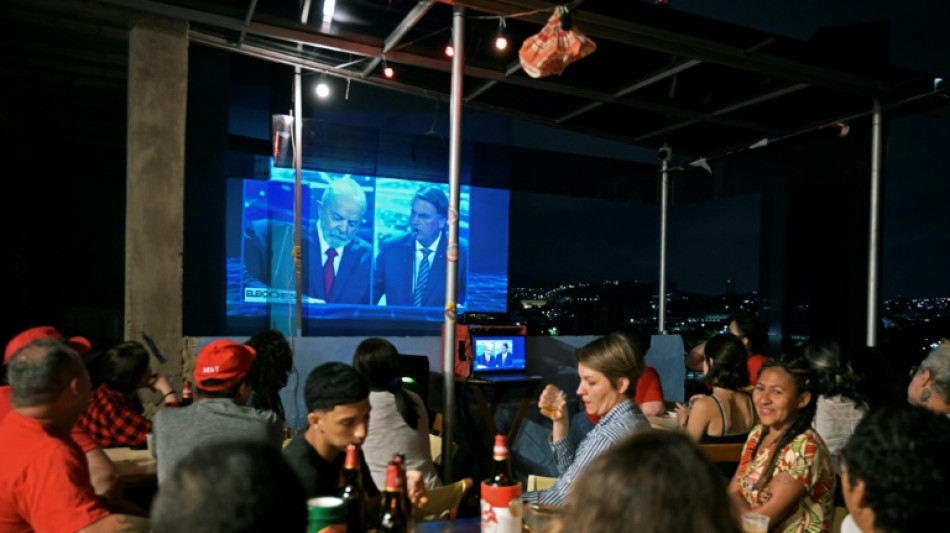
Prime-time lies: Brazil candidates take information wars to TV / Photo: CARL DE SOUZA - AFP

 Tuchel hails 'complete' England after Croatia demolition

 Fury to invite Trump to lead ring walk before Joshua showdown

 Fashion industry in 'precarious moment', says Vivienne Westwood supremo

 Seventh heaven for England in Nations League rout of Croatia

 Storms, flooding cause chaos on Greek holiday island of Crete

 #IAmJaneDoe: online support campaign in US university rape case

 Brazil shine on Selecao's first visit to India

 Zverev sets up Djokovic quarter-final at China Open, Rybakina out

 Happier at home, Bordeaux hammer Lyon in Top 14

 Lula, Bolsonaro in final push for votes ahead of knife-edge election

 Boisterous fashion week barnstorms 'sleepy' Nigerian capital

 UAE investigators say flydubai co-pilot was planning 'terrorist act'

 Rahul smacks century in India v Windies ODI

 Daryz seeks to join exclusive club of dual Arc winners

 Russia warns diplomats to leave Kyiv over new strikes threat

 Olympic champ Zheng rebukes rowdy home crowd at China Open

 World No.1 Sinner pulls out of Shanghai Masters to delay return

 Red Bull's Verstappen grabs pole position for Bahrain GP

 India beat Pakistan in blockbuster as golfer Kim wins 'crazy' gold

 India beat arch-rivals Pakistan to win Asian Games cricket gold

 Ethiopia's Tigray rebels abandon regional capital as govt advances: journalist

 Tom Kim powers to Games gold and exemption from military service

 Split loyalties for Indian football fans at Brazil friendly

 India-Pakistan blockbuster brings cricket fever to Japan baseball field
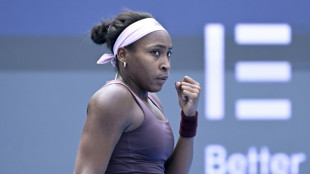
 Wong waiting on Rafa after winning Asian Games tennis gold
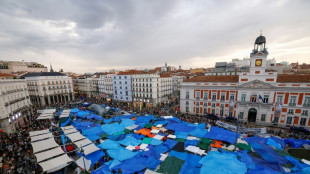
Disinformation on social networks has become routine as Brazil heads for deeply divisive elections, but it can gain traction and a broader audience when it comes straight from the candidates' mouths on national television.
The official start last month of the campaign for the October 2 elections means candidates have huge exposure on TV, including prime-time interviews, debates and daily ad spots paid for with public funds.
In practice, that has meant a flood of false narratives being beamed into Brazilian living rooms, whether it is incumbent President Jair Bolsonaro taking credit for the idea to create a mega-popular instant payments system known as "Pix" or front-runner Luiz Inacio Lula da Silva claiming he was absolved of all corruption charges against him, to cite just two examples.
In reality, Brazil's central bank started working on Pix in 2018, a year before the far-right incumbent took office. And Lula, the charismatic but tarnished leftist who led Brazil from 2003 to 2010, had his controversial convictions stemming from the "Car Wash" corruption scandal overturned on procedural grounds. He was not absolved.
"Campaigns are above all a war of narratives," and candidates often use distorted or outright false statements to sell themselves, says Amaro Grassi, a public policy expert at the Getulio Vargas Foundation.
There is nothing new about lies in politics.
But analysts warn TV is now giving broader reach to the disinformation that has been raging for months on social networks in Brazil.
"Television is still a mass medium" in Brazil, says Arthur Ituassu, associate professor of political communication at Pontifical Catholic University in Rio de Janeiro.
Unlike social media, Brazilian television -- where the vast majority of audience share is still concentrated among a handful of top networks, notably the dominant TV Globo -- reaches a broad population that is "not segmented by nature," he says.
- 'If it's on TV, it's true' -
"Television is still a space that reaches the general public, going well beyond the audience that is already firmly in one camp or the other," says Helena Martins, a communications professor at the Federal University of Ceara.
There is also a widely held belief that "if it's on TV, it's true," she adds.
The 2018 race that brought Bolsonaro to power was already awash in disinformation, especially on social media -- hugely powerful in a country that has more smart phones than people (an estimated 242 million, for 213 million inhabitants).
If anything, the campaign is arguably uglier this time around, given that the presidential race is highly polarized between the far-right incumbent and his leftist nemesis.
Amid those deep divisions, 85 percent of Brazilians say disinformation could influence the outcome of the election, according to a poll from the Ipec institute published on September 6.
At the same time, however, polls show there are relatively few voters left to persuade: 78 percent of voters say their minds are "completely" made up, found a poll from the Datafolha institute published last week.
The same poll found Lula had 45 percent of the vote, to 33 percent for Bolsonaro -- broadly in line with the institute's previous poll.
No other candidate was in double digits.
"There's a very high level of consolidation of voter intentions. That makes it difficult for any narrative to change the picture at this point," says Grassi.
That has not stopped the candidates from seeking to rile up their bases with truth-bending statements, hoping to persuade the odd undecided or third-candidate voter in the process.
Lula, for example, has repeatedly exaggerated his accomplishments on the economy.
Bolsonaro has meanwhile accused Lula of being anti-Evangelical and anti-agribusiness, two powerful groups that lean toward the incumbent.
"The idea is to reinforce those groups' rejection of Lula," says Grassi.
"Because in an election as polarized as this, it ends up being largely a battle of rejection."
A.S.Diogo--PC