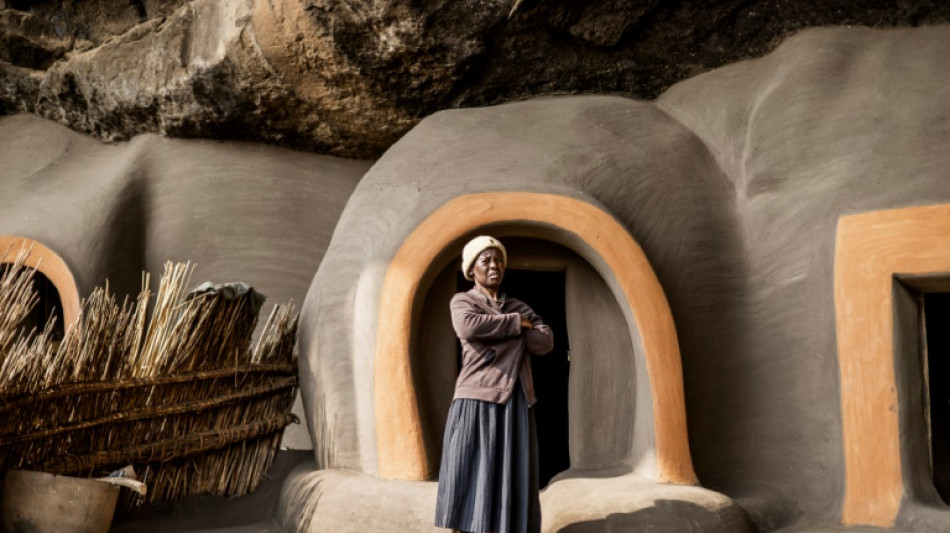
'Our home': Lesotho's last cave dwellers / Photo: Marco Longari - AFP

 Tuchel hails 'complete' England after Croatia demolition

 Fury to invite Trump to lead ring walk before Joshua showdown

 Fashion industry in 'precarious moment', says Vivienne Westwood supremo
 Seventh heaven for England in Nations League rout of Croatia

 Storms, flooding cause chaos on Greek holiday island of Crete

 #IAmJaneDoe: online support campaign in US university rape case

 Brazil shine on Selecao's first visit to India

 Zverev sets up Djokovic quarter-final at China Open, Rybakina out
 Happier at home, Bordeaux hammer Lyon in Top 14

 Lula, Bolsonaro in final push for votes ahead of knife-edge election

 Boisterous fashion week barnstorms 'sleepy' Nigerian capital

 UAE investigators say flydubai co-pilot was planning 'terrorist act'

 Rahul smacks century in India v Windies ODI

 Daryz seeks to join exclusive club of dual Arc winners

 Russia warns diplomats to leave Kyiv over new strikes threat

 Olympic champ Zheng rebukes rowdy home crowd at China Open

 World No.1 Sinner pulls out of Shanghai Masters to delay return
 Red Bull's Verstappen grabs pole position for Bahrain GP

 India beat Pakistan in blockbuster as golfer Kim wins 'crazy' gold

 India beat arch-rivals Pakistan to win Asian Games cricket gold

 Ethiopia's Tigray rebels abandon regional capital as govt advances: journalist

 Tom Kim powers to Games gold and exemption from military service

 Split loyalties for Indian football fans at Brazil friendly

 India-Pakistan blockbuster brings cricket fever to Japan baseball field

 Wong waiting on Rafa after winning Asian Games tennis gold
Inside a dimly-lit mud dwelling nestled within a rocky mountain in the southern African kingdom of Lesotho, Mamotonosi Ntefane, 67, dusts off an animal skin.
Her household is among a handful of families who still inhabit the Kome Caves, a heritage site in the north of the country, first occupied about 200 years ago by local tribes seeking shelter from conflict and cannibalism.
"Life is good, we grow our own vegetables, I can pray anytime I want," Ntefane, a rosary around her neck, tells AFP.
More than 1,800 metres above sea level, some 50 kilometres (30 miles) from the capital Maseru, the settlement is surrounded by barren pastures, where shepherds draped in long woollen blankets graze cattle in the morning mist.
Thin white smoke billows from outside the caves as "papa", a traditional corn porridge, boils in a black cast iron pot over a wood fire.
The cave is divided into several round houses propped against the basalt rock.
Open passages just high enough for a person to walk through serve as doorways. Walls and floors are made of a mix of mud and manure that require regular upkeep.
Inside are basic items including pots, plastic buckets to store water and a cowhide for a bed.
"There's no electricity and no fridge but this is our home, it's our history," says 44-year-old Kabelo Kome who is descended from the first people to settle the caves, after whom the place is named.
- Hideout -
The caves became a hideout for members of the Basia and Bataung tribes in the 19th century, when conflict and a severe drought ravaged the region.
Christian missionaries travelling the area at the time reported some groups resorted to cannibalism to survive, as livestock and grain reserves dwindled.
It was in this period that Lesotho emerged as a single entity, as the Sotho, the region's largest ethnic group, united to fight Zulu raiders and European settlers.
Today, most of the country's two million people live off subsistence farming.
Inhabitants of the Kome Caves grow corn, sorghum and beans and raise chickens and cattle.
The elderly receive a state allowance, while others make money showing their homes to tourists.
Some like Mamatsaseng Khutsoane, a 66-year-old former teacher, have moved to a nearby village with greater creature comforts.
"I come here to eat, or with my grandchildren," she says.
There is mobile phone coverage, but no fixed internet or running water.
"None of that here," scoffs Ntefane, as she stands outside her home, gazing at the mountains, while cow bells ring in the distance.
P.Queiroz--PC