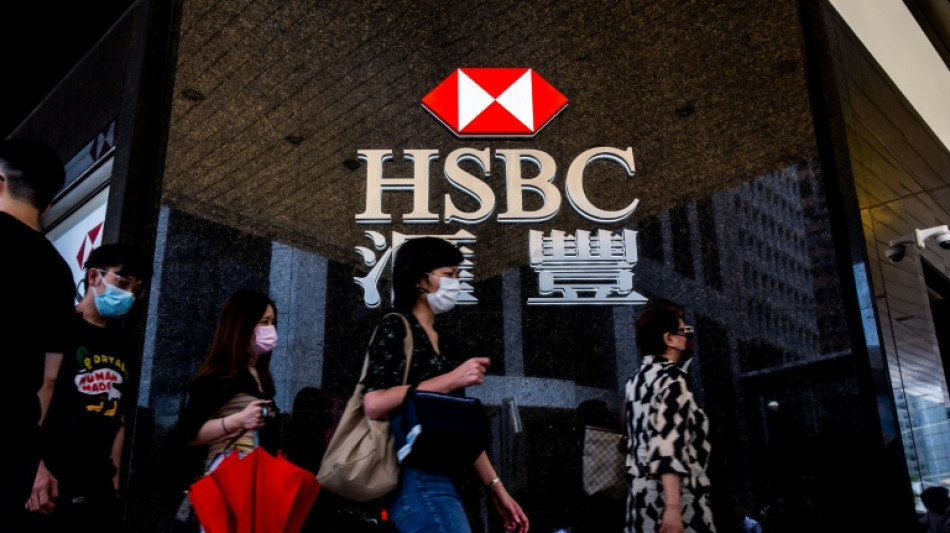
HSBC announces $1 bn share buyback as 2021 profits double

 Turkish Energy Minister Highlights Qatar as Key Partner for Regional and Global Energy Security

 London Museum Granted 24/7 License Ahead of November Opening

 Dana White Confirms Flight to Washington for Trump Meeting on Press Secretary Role

 Dengue Fever Expands Into High Himalayas as Climate Change Warms Nepal

 IoT Refrigerator Hacks Disrupt Blood Labs and Supermarkets Across Europe and US

 Post-election pressures complicate US and Israeli decisions on Iran

 UN members approve talks on treaty protocol against environmental crime

 Family-run West Sussex beach café prepares for first winter season

 CT scans reveal health and burial clues from Egypt’s Braided Lady mummy

 Oxford faces complaints over lecturer’s classroom attire

 Kyren Wilson and John Higgins reach International Championship snooker final
HSBC on Tuesday announced bumper 2021 profits and plans to repurchase shares worth up to $1.0 billion as the Asia-focused bank continues its recovery from the coronavirus pandemic and major restructuring.
The lender endured a tumultuous 2020 like the rest of the banking sector as the virus outbreak rocked the economy just as it embarked on a restructuring programme to slash 35,000 jobs to refocus on its most profitable areas in Asia and the Middle East.
The London-headquartered bank on Tuesday reported pre-tax profit of $18.9 billion in 2021, up $10.1 billion on the year before, helped by lower bad loans and operating expenses.
Profit after tax was up $8.6 billion to $14.7 billion. Fourth quarter profit before tax rose $1.3 billion to $2.7 billion.
In a boon for investors, the bank also announced plans for a $1.0 billion share buyback, adding to a $2.0 billion buyback announced late last year.
"We have good momentum coming into 2022 and are confident that we can continue to execute against our strategy," Chief Executive Officer Noel Quinn said in the statement.
"We also remain cognisant of the potential impact that further Covid-19- related uncertainty and continued inflation might have on us and our clients."
HSBC makes 90 percent of its profit in Asia, with China and Hong Kong the major drivers of growth.
Early last year it published a new strategy laying out plans to redouble its attempt to seize more of the region's market.
HSBC wants to seek out more fee-based income, especially via wealth management for Asia's increasingly affluent.
It is also hopeful of a significant boost to income thanks to the prospect of higher interest rates to fight surging global inflation.
However its reliance on China could also be a vulnerability. Both the mainland and Hong Kong are among the last few remaining places rigidly sticking to a zero-Covid strategy.
That strategy has crumbled in Hong Kong this year during a wave of infections forcing the reimposition of economically painful restrictions and a deepening of the financial hub's international isolation.
After strong growth for much of last year, China's recovery also slowed in the last quarter.
"As a result, we expect China's government to take action to ease monetary and fiscal policies, with the aim of shoring up growth," group chairman Mark Tucker said in the results note.
He also highlighted a number of global economic headwinds on the horizon including "supply chain bottlenecks", high energy, and food prices driving up inflation and tighter monetary policies from central banks.
G.M.Castelo--PC

