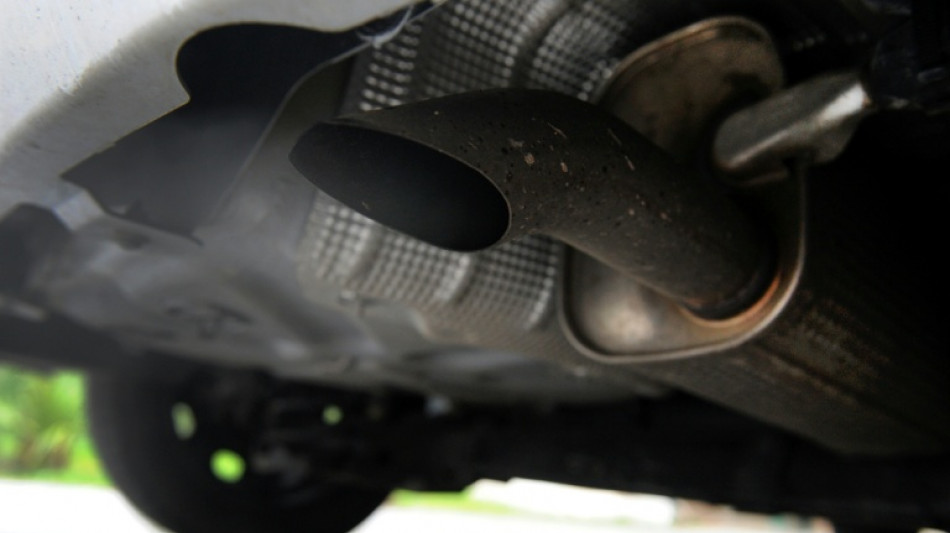
EU weakens 2035 combustion-engine ban to boost car industry / Photo: Fred TANNEAU - AFP

 Trump's beef policies irk Texas ranchers, testing their loyalty

 Nvidia, OpenAI CEOs to attend Xi dinner at White House

 Anthropic picks Accenture for in-house AI safety evaluation

 Balogun returns as Monaco beat Lens to continue strong Ligue 1 start

 'Pause' on overt repression in Venezuela, but reforms still needed: HRW

 Global stocks mixed as yen falls despite Bank of Japan rate hike

 Cuba hit with seventh major blackout of the year

 Murray out with concussion so Wentz will start for Vikings

 UN chief 'deeply regrets' US visa refusal to Abbas for annual meeting

 England quick Carse to face no charges over alleged nightclub assault

 Mancini brings nine newcomers into the first squad of his Italy comeback

 Czechs level Davis Cup tie against USA as South Korea eye Finals

 New France boss Zidane confirms Mbappe as captain after naming first squad

 California governor signs order to explore AI 'kill switch'

 Head leads run spree as Australia win Zimbabwe ODI series

 In-form Raphinha wants to finish career at Barcelona

 Warren Buffett steps down as Berkshire Hathaway chairman

 Carrick confident Man Utd can 'work through' tough time

 Mbappe ends Nike partnership to join Swiss brand On

 Liverpool boss Iraola puts Bournemouth love affair on hold

 'A disaster' if Man City do not win says Maresca after flawless start

 Kerry James Marshall: American 'blackness' painter celebrated in Europe

 Spain coach De la Fuente offers 'full support' to people of Ceuta

 Russia seizes assets of Nestle, French firms over West's Ukraine support

 England can build on World Cup 'spirit', says Tuchel

The EU on Tuesday walked back a 2035 ban on new petrol and diesel cars seen as a milestone in the fight against climate change, as the bloc pivots to bolstering its crisis-hit auto sector.
Under proposals slammed by green groups as an act of "self-sabotage", carmakers will have to cut exhaust emissions from new vehicles by 90 percent from 2021 levels -- down from an envisaged 100 percent.
This means that in practice automakers will still be able to sell a limited number of polluting vehicles -- from plug-in hybrids to diesel cars -- beyond 2035, provided the resulting emissions are "compensated" in various ways.
The EU's industry chief, Stephane Sejourne, insisted the bloc's green ambitions stood intact as he put forward a plan billed as a "lifeline" for Europe's auto industry.
"The European Commission has chosen an approach that is both pragmatic and consistent with its climate objectives," he told AFP.
The combustion-engine ban was hailed as a major win in the climate fight and a key tool to drive investments in electrification when adopted in 2023.
But carmakers and their backers have lobbied hard over the past year for Brussels to relax it, in the face of fierce competition from China and a slower-than-expected shift to electric vehicles (EVs).
Europe's biggest automaker Volkswagen welcomed the move as "pragmatic" and "economically sound", while German Chancellor Friedrich Merz said allowing for "more openness to technology and greater flexibility" was the right step.
Germany's leading auto industry group VDA however called the proposals "disastrous".
- 'Self-sabotage' -
Weakening the ban is the most striking result yet of a pro-business push that has seen the EU pare back a slew of environmental laws this year -- on the grounds they risk weighing on growth.
"This backward industrial policy is bad news for jobs, air quality, the climate, and would slow down the supply of affordable electric cars," said Greenpeace Germany's executive director, Martin Kaiser.
Post 2035, carmakers will have to compensate for planet-warning emissions spewed by combustion-engine vehicles through credits generated by the use of made-in-Europe, low-carbon steel and e-fuels and biofuels put on the market by energy firms.
Beset by announcements of job cuts and factory closures over the past year, Europe's auto industry -- which employs almost 14 million people and accounts for about seven percent of Europe's GDP -- had maintained that the 2035 goal was no longer realistic.
High upfront costs and the lack of adequate charging infrastructure in parts of the 27-nation union mean consumers have been slow to warm to EVs, producers say.
Just over 16 percent of new vehicles sold in the first nine months of 2025 run on batteries, according to industry figures.
Critics, including Spain, France and the Nordic countries, had warned that ditching the ban risked slowing the shift to electric, deterring investments.
While the French presidency called the EU's auto plan "balanced" overall, the country's environment minister slammed the "flexibility" granted for petrol and diesel cars, and said Paris hoped to stop it from becoming law.
"Every euro diverted into plug-in hybrids is a euro not spent on EVs while China races further ahead," said William Todts, director of the clean-transport advocacy group T&E.
"Weakening the CO2 standards for cars is an act of self-sabotage," added Linda Kalcher of Strategic Perspectives, a think tank.
- Green fleets -
The commission also unveiled a slew of additional measures to support the auto sector as part of a package that needs approval from the EU parliament and member states.
In the run-up to 2035, carmakers will benefit from "super credits" for small "affordable" electric cars made in the EU, in an accounting trick that would make reaching emission targets easier.
Brussels also proposed reducing the interim 2030 emission target for vans from 50 to 40 percent and allowing truck manufacturers more time to meet their own 2030 target, in line with a previous concession to automakers.
To boost EV sales, medium and large firms will be required to green their fleets, which currently account for about 60 percent of new car sales in Europe.
And the EU will provide 1.5 billion euros to support European battery producers through interest-free loans.
Road transport accounts for about 20 percent of total planet-warming emissions in Europe, and 61 percent of those come from cars' exhaust pipes, according to the EU.
E.Ramalho--PC