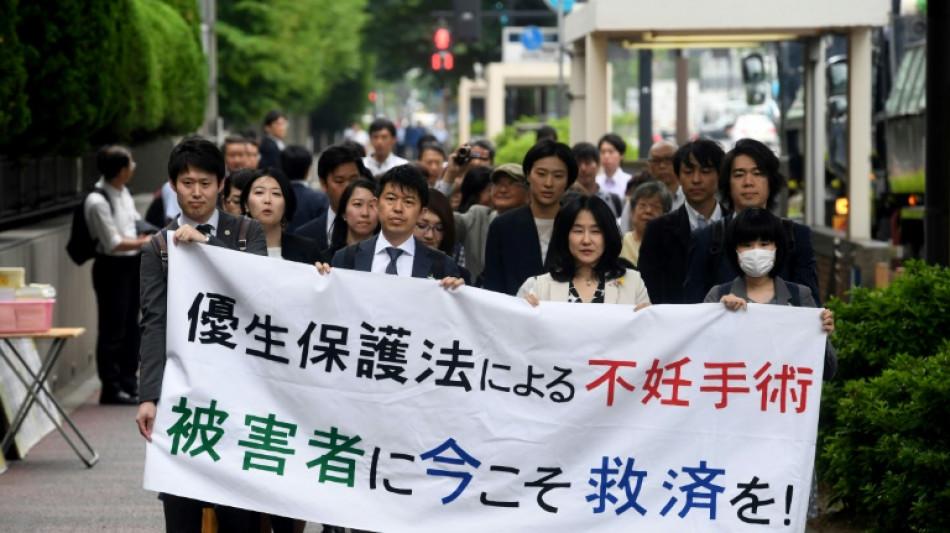
Campaigners slam Japan government forced sterilisation report / Photo: Toshifumi KITAMURA - AFP/File

 Search Underway for 'Dooars Rani' Tigress After Second Escape from Buxa Tiger Reserve

 IIM Indore Announces IPMAT 2027 Exam Date for April 24

 The Dilemma of Recording Live Music: Preserving Memories vs. Being Present

 ANC’s Renewal Rhetoric Fades as Voters Reject Party in 2026 Local Elections

 Foreign Investors Return to Indian Markets After 10-Month Selloff

 Honda CR-V and Toyota RAV4 Lead Canada’s Most Stolen Vehicles List for 2025
Japanese campaigners on Wednesday slammed a government report into the sterilisation of thousands under a eugenics law in place until 1996, saying it failed to take responsibility for the procedures.
The 1,400-page report submitted to parliament this week details how some 16,500 people -- including some as young as nine -- were sterilised without their consent under the law in force from 1948.
Around 8,500 more were sterilised after their consent was obtained, though campaigners have cast doubt on how freely agreement was given.
The law allowed doctors to sterilise people with heritable intellectual disabilities, to "prevent ... poor quality descendants".
In 2019, lawmakers passed legislation offering each victim government compensation of 3.2 million yen ($22,800) -- an amount campaigners called insufficient given the damage inflicted.
Lawmakers also commissioned the report made public this week, which Koji Niisato, a lawyer who has represented victims of the policy, said fell short.
It is "largely a compilation of what has been investigated and reported" which merely confirms "that it was an extremely terrible law," he told journalists Wednesday.
But "it lacks a summary of why this terrible law was enacted and existed for 48 years, and fails to mention why the government didn't take responsibility even after the law was amended," he said.
"That is extremely regrettable."
Victims of the sterilisation programme campaigned for decades seeking recognition of the harm they suffered and compensation.
They have also turned to the courts seeking relief, and last year three people were awarded damages in a landmark victory.
The Osaka High Court overturned a lower court decision, and ordered the national government to pay a combined 27.5 million yen ($200,000) to the elderly trio.
But earlier this month, a different high court rejected damages requests by plaintiffs, arguing a 20-year statute of limitations had passed.
The ruling "is a terrible verdict that doesn't consider why victims couldn't file lawsuits" sooner, plaintiff Junko Iizuka, 77, told reporters.
"As the government's responsibility is obvious, I want to see a quick solution," with more adequate compensation offered without the need for continued lawsuits, she said.
A.Silveira--PC