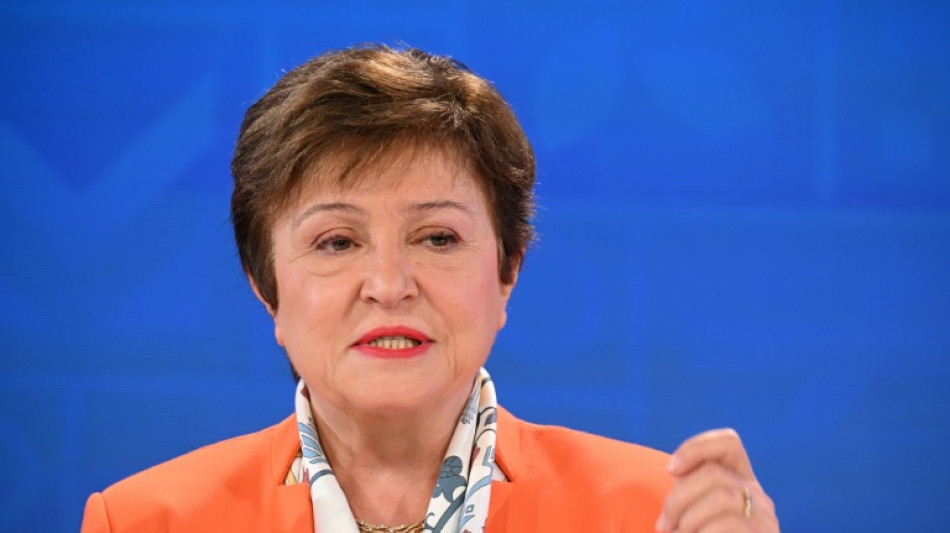
IMF, World Bank under pressure to boost climate change financing / Photo: Mandel NGAN - AFP/File

 In war-split Myanmar 'spirit consorts' commune across divide
 Leaders of Russia, China, Iran to attend summit in Kyrgyzstan
 Hovland and Gerard share lead at Tour Championship

 Maresca salutes 'unbelievable' Cherki after Man City star sinks Palace

 Marquinhos rescues last-gasp draw for PSG at Lille in Ligue 1

 ICE detains British far-right activist Milo Yiannopoulos in Louisiana

 Milo Yiannopoulos held by ICE after missing immigration hearing

 Six Flags closes X2 rollercoaster after reports of severe brain injuries

 Jury ends second day without verdict in Lindsay Clancy murder trial

 Artist says criticised Ronnie O'Sullivan mural is unfinished

 UAE grants Starlink 10-year satellite broadband licence

 US says Hormuz mines cleared as diplomacy and military deployments continue

 Nepal-Tibet flood toll reaches 584 as more than 2,400 remain missing

 Cherki makes his point to Maresca as Man City sparkle in Palace rout

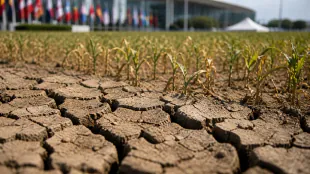 COP17 soil assessment links worsening land degradation to food and nutrition risks

 Medical AI paper predicts autonomous systems could outperform doctors in core clinical tasks by 2030

 REI Labor Day sale runs through September 7 with outdoor gear discounts

 Meta tests robots for cabling, server resets and maintenance inside data centers

 Nepal-Tibet flood rescue resumes after overflowing debris lake forces temporary withdrawal

 Extreme heat exposes vulnerabilities across Britain's rail network

 Dollar rallies after Fed chief lifts rate expectations

 Slumping Sabalenka 'confident' ahead of US Open three-peat bid

 Aston Villa seal swoop for Chelsea striker Jackson

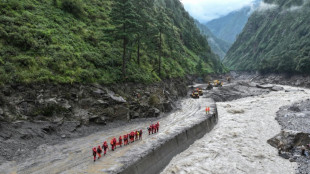 Number of missing in deadly Nepal, China floods jumps past 2,400

 Birmingham City Seek First Championship Win Against Wrexham
International Monetary Fund (IMF) and World Bank officials are joining dozens of economic leaders for a two-day summit in Paris, aiming to tackle the interlinked challenges of poverty alleviation and climate change.
The meetings, hosted by French President Emmanuel Macron, have been billed as an opportunity to refocus the global financial architecture to better address the vast scale of financing needed to meet the climate targets by the end of the decade.
The summit has also brought focus on the IMF and World Bank's own climate change policies, amid calls for multilateral development banks (MDBs) to do more to help developing economies access funds to both adapt to climate change and deal with its consequences.
- Insufficient funds-
Both the IMF and World Bank have introduced policies in recent years to help countries deal with the climate transition.
Last year, the IMF launched its Resilience and Sustainability Trust (RST), with just over $40 billion in funds at its disposal, to offer longer-term loans to finance projects related to these issues.
Bangladesh, Barbados, Costa Rica and Rwanda are the first countries to benefit.
And at the World Bank, former president David Malpass lauded moves under his watch to double climate financing to $32 billion and to put in place a global warming action plan for the period of 2021 to 2025.
His successor, Ajay Banga, used his inaugural address to call on the bank to "pursue both climate adaptation and mitigation," among other issues.
"Change is appropriate for the World Bank," Banga said. "It isn't a symptom of failure or drift or irrelevance, it is a symptom of opportunity, life, and importance."
But both institutions admit that their financing capacities are currently insufficient to meet the needs of developing economies, which the IMF estimates will be well over a trillion dollars per year by 2025.
- Institutional reforms -
The United States, European Union and others have been pushing a series of reforms to the IMF and World Bank since late last year.
These include proposals to reform the governance of the MDBs to ensure a greater role for major emerging markets and developing economies, and to expanding their missions to integrate climate change financing.
The goal is to make progress on these reforms by the next annual meeting of the IMF and World Bank, which take place in October in Morocco.
The World Bank's primary objective is to promote long-term economic development and poverty reduction, while the IMF looks to promote global macroeconomic and financial stability by providing financial and technical assistance and policy advice.
Some developing countries have voiced concerns that these reforms could lead MDBs to prioritize climate change over poverty alleviation.
The most significant breakthrough so far came at the IMF and World Bank spring meetings, when agreement was reached to boost the World Bank's lending capacity by up to $5 billion per year for 10 years.
However, this was achieved primarily by increasing the bank's leverage, and not through the provision of additional funding from World Bank member countries.
- More to do -
Even if the reform process is successful, the IMF and World Bank's leaders have stressed that international financial institutions cannot by themselves meet the enormous needs of the most vulnerable countries.
Banga centered his campaign for the World Bank presidency on greater private sector involvement in financing the climate transition.
"There is not enough money without the private sector," the former Mastercard chief executive told reporters in March, adding that the World Bank should set up a system that could help share risk or mobilize private funds to achieve its goals.
Heading into the summit, there were hopes that progress could be made on a stalled two-year-old pledge by wealthier countries to recycle $100 billion in IMF special drawing rights (SDRs) from rich countries to vulnerable economies.
SDRs are foreign exchange reserve assets awarded to countries based on how much they contribute to the IMF.
The stalled plan, which some European countries resisted, was for wealthier countries to lend these foreign exchange reserve assets to the IMF, which could in turn lend them to developing economies.
Ahead of the summit, France and Japan announced that they would redeploy 30 percent of their SDRs for this purpose.
Media reports suggest that the Paris summit could yield a breakthrough in pledges from other countries, which would help hit the $100 billion target.
S.Caetano--PC