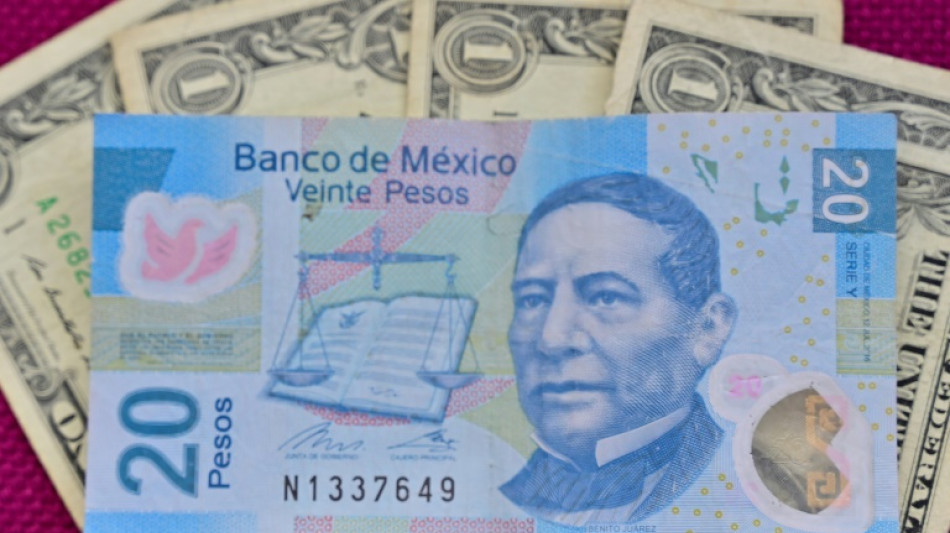
Mexico's 'super peso' creates both winners and losers / Photo: Pedro PARDO - AFP/File

 Number of missing in Nepal, China floods soars past 2,400
 Trump announces deal for huge US stake in Venezuelan oil reserves

 Kane confirms talks on Bayern extension

 Trump govt. mulls deal to give away part of Yosemite park

 Indian release of Sonia Gandhi memoir uncertain after publisher clarification

 Cities show cleaner transport policies can reduce severe air pollution

 Four patients harmed in Nashville hospital medication mix-up

 Essex council hires private guards as Wethersfield asylum centre expands

 Haakon VIII becomes Norway's king after Harald V dies at 89

 Six injured after sign falls at Christian festival in West Sussex

 Dubai airport expands scanners that keep laptops and liquids in bags

 Kuwait and Pakistan sign military cooperation agreement

 Ramos strikes as AC Milan beat Venezia

 Odisha faces very heavy rain as Sri Ganganagar reaches 41.4C

 Scammers in China exploit Microsoft Teams and other workplace apps to target victims

 GSA employees report mice, ceiling damage and cloudy water after Washington office move

 Cara and former scraper develop open-source tool to alert artists when work appears in AI datasets

 Google expands easier file sharing between Android phones and Apple devices

 UK chefs turn to induction cooking to reduce kitchen heat, energy use and pollution

 Restored Cheshire wetland becomes key UK breeding site for black-necked grebes

 Bayern steamroll Stuttgart in Bundesliga opener

 England pace quartet might keep Archer going until he is 40

 Driven by distraction? Trump steps up stunts as US midterms loom

 Springboks a wounded beast, warns All Blacks captain Savea

 Trump announces new US 'Space Academy'

Rosario Crisostomo thought she had been cheated when she counted the money sent by her son from the United States. But there was no scam, only a Mexican currency going from strength to strength.
Once a laggard of the international foreign exchange market, the peso is among the world's best performing currencies this year.
A combination of high interest rates in Latin America's second-largest economy, financial stability as well as inflows of remittances and foreign investment have seen the Mexican currency post double-digit percentage gains against the dollar in 2023.
"I thought they were cheating me, telling me that the dollar was low to give me less, but then I saw that they weren't," Crisostomo told AFP from the town of Piaxtla, in the central state of Puebla, where she lives with her grandson.
Some 4.6 million households across the country receive remittances -- the country's largest source of foreign currency -- largely thanks to the Mexican diaspora in the United States.
The government estimates that in 2023 remittances could exceed last year's record high of more than $58 billion.
This month the Mexican currency reached its strongest levels against the greenback since 2016, earning itself a new nickname -- the "super peso."
On Friday, it stood at around 17.1 per dollar, compared to 25 in March 2020 when the coronavirus pandemic began.
Analysts say the peso's strength is in part due to the high level of the Mexican benchmark interest rate, which is now 11.25 percent.
The lending rate has been raised to fight inflation but has also attracted investors seeking higher returns.
The peso has also been boosted by the so-called "nearshoring" trend of US companies like electric carmaker Tesla moving their production closer to home in Mexico instead of Asia, experts say.
"When investors look for where to invest and look at emerging markets, there's no other country with a narrative like Mexico with nearshoring," said Carlos Capistran, an economist at Bank of America Merrill Lynch.
- 'Mexican miracle' -
In a country that has suffered major currency devaluations in the past, the peso's strength has been mostly hailed as good news.
Leftist President Andres Manuel Lopez Obrador refers to it as "the Mexican miracle."
The touted benefits include a decrease in the size of Mexico's foreign debt, when its value is considered in pesos.
On the other hand, the strong currency reduces the earnings of exporters.
"But I would say a strong peso is better than depreciation or devaluation, in general terms," Lopez Obrador said.
Rogelio Garciamoreno, a farmer and vice president of the private National Agricultural Council, is both a winner and loser from the "super peso."
"The prices of many inputs in dollars are falling. We hope to buy them at a better price," he said.
The flip side is that the peso's strength is bad for food exports.
"These products are priced in dollars. It hits us very hard because we received fewer pesos than we thought," Garciamoreno said.
The United States accounts for 80 percent of Mexican exports.
The peso's appreciation also impacts "maquiladoras" -- factories set up mainly by US companies in northern Mexico that use local workers to manufacture products to sell in the United States.
"This big devaluation of the dollar is bad for the maquiladoras because they need more dollars to pay the payroll and taxes," said Jesus Manuel Salayandia of the National Chamber of the Transformation Industry.
However, some say the days of the "super peso" could be numbered.
Financial analysts expect a slight depreciation in the Mexican currency, partly due to narrowing interest rate differentials.
While Mexico's central bank says it expects to hold its key lending rate at the current level for "an extended period," the US Federal Reserve has flagged a possible further half percentage point of increases this year.
Capistran expects that the peso will return to levels around 19 per dollar toward the end of 2023.
That would be good news for Crisostomo, who is struggling with rising living costs.
"Everything's going up. Food's going up. But now we have less," she complained.
L.Torres--PC