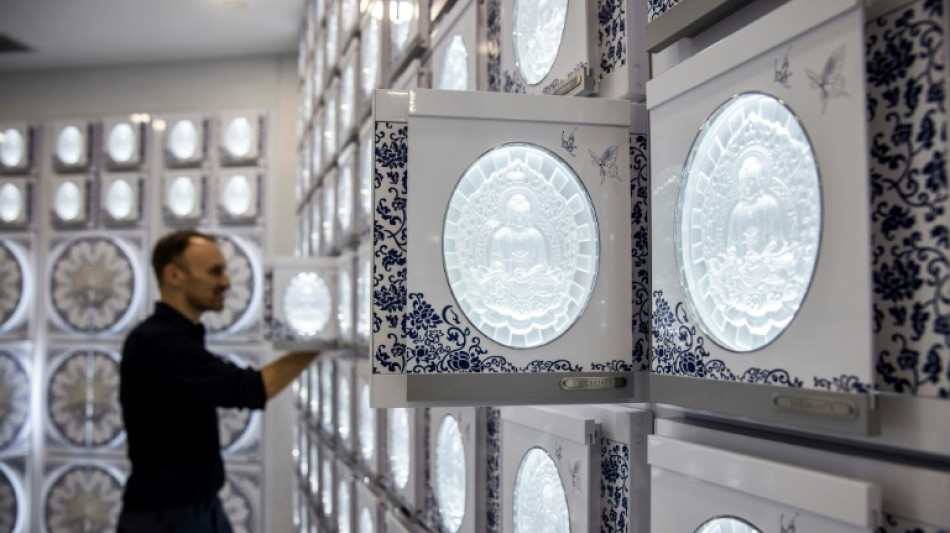
Hong Kong high-rise aims to become 'village' of the dead / Photo: ISAAC LAWRENCE - AFP

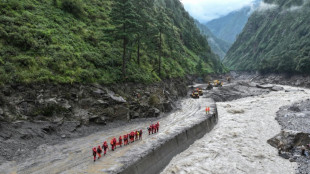
 Number of missing in Nepal, China floods soars past 2,400

 Trump announces deal for huge US stake in Venezuelan oil reserves

 Kane confirms talks on Bayern extension

 Trump govt. mulls deal to give away part of Yosemite park

 Indian release of Sonia Gandhi memoir uncertain after publisher clarification

 Cities show cleaner transport policies can reduce severe air pollution
 Four patients harmed in Nashville hospital medication mix-up
 Essex council hires private guards as Wethersfield asylum centre expands

 Haakon VIII becomes Norway's king after Harald V dies at 89

 Six injured after sign falls at Christian festival in West Sussex

 Dubai airport expands scanners that keep laptops and liquids in bags

 Kuwait and Pakistan sign military cooperation agreement

 Ramos strikes as AC Milan beat Venezia

 Odisha faces very heavy rain as Sri Ganganagar reaches 41.4C

 Scammers in China exploit Microsoft Teams and other workplace apps to target victims

 GSA employees report mice, ceiling damage and cloudy water after Washington office move

 Cara and former scraper develop open-source tool to alert artists when work appears in AI datasets

 Google expands easier file sharing between Android phones and Apple devices

 UK chefs turn to induction cooking to reduce kitchen heat, energy use and pollution
 Restored Cheshire wetland becomes key UK breeding site for black-necked grebes
 Bayern steamroll Stuttgart in Bundesliga opener

 England pace quartet might keep Archer going until he is 40

 Driven by distraction? Trump steps up stunts as US midterms loom
 Springboks a wounded beast, warns All Blacks captain Savea

 Trump announces new US 'Space Academy'

With its white marble foyer and lavish chandeliers, the 12-storey tower could be mistaken for one of Hong Kong’s newest hotels, but it offers a longer stay: a final resting place for thousands in one of the world's most crowded cities.
Hong Kong's 7.3 million residents share some of the most densely populated neighbourhoods on earth, and in the past, mourning families had to wait years to secure a spot for their loved ones' ashes.
The Shan Sum columbarium opened last month with plans to eventually offer 23,000 niches for funeral urns, part of the government's decade-long effort to bring in private companies to ease pressure on the deathcare sector.
That policy is now paying off after the city’s ageing population pushed death rates above government urn space capacity in the mid-2010s, creating a dire shortage.
The sleek, modern building is the work of German architect Ulrich Kirchhoff, 52, who told AFP he tried to blend elements of nature into a high-density space to create a "neighbourhood village feel".
"It's an apartment building for the dead ... It feels more like a close-knit neighbourhood," he said.
Kirchhoff said his design was inspired by traditional Chinese graveyards, which are often perched on mountainsides. His columbarium carried over those undulating lines, greenery and textures of hewn rock.
Ashes are stored in ornate compartments, some as small as 26 by 34 centimetres (10 by 13 inches), that line the walls of air-conditioned chambers.
Kirchhoff said he designed rooms on each floor to provide intimacy, in contrast to the cramped confines of public columbariums, which he said feel like being in a "warehouse".
"How do we maintain quality of life and dignity for the people in this high density?" he asked.
"Is it just a shoebox or is there something else?"
- Urn space shortage -
Much like apartments in Hong Kong, rent for the units is not cheap, putting them beyond the reach of most people.
A basic two-person option at Shan Sum is sold for $58,000 while the top-tier package, meant for a whole family, costs nearly $3 million.
The median monthly household income in Hong Kong is currently around $3,800, according to government data.
Places like Shan Sum were created in response to Hong Kong's shortage of urn spaces a decade ago.
At the time, cremated remains were often stored in drawers at funeral parlours for years while waiting for spots to open up, or were housed in unlicensed columbariums in temples or refurbished factory buildings.
Historian Chau Chi-fung, who wrote a book on Hong Kong's funeral practices, said the seeds of the crisis were sown decades prior by the British colonial administration, before the city was handed over to China in 1997.
"Laws at the time were strict about how to treat dead bodies, but once they were turned to ash, the government did not have a comprehensive policy for them," he told AFP.
The ethnic Chinese population in Hong Kong historically preferred burials, but the government popularised cremation in the 1960s -- a shift seen in dense urban centres across Asia.
Now around 95 percent of Hong Kong's dead are cremated each year, which Chau attributed to changing social mores.
The government estimates that deaths will increase by 14 percent to 61,100 per year by 2031.
Officials say that the city is prepared for the uptick, with about 25 percent vacancy among the current 425,000 public columbarium spots and more public and private supply in the pipeline.
"The situation has improved compared to a few years ago... The problem has been eased, but not solved," Chau said.
- 'Ocean view' -
Wing Wong, 43, last year laid her father to rest at Tsang Tsui Columbarium, a sprawling 4,800-square-metre complex in Hong Kong's northwestern corner that began service in 2021.
She said her experience was a far cry from the horror stories seen in headlines years ago.
"Losing a loved one was painful enough. It would be a torment for family members if they couldn't find a place for the ashes, with no idea how long they needed to wait," she said.
Wong said her family chose the government-run location for its good feng shui, adding that its affordable pricing meant they had no incentive to consider private options.
"My father once said he wanted an ocean view... His (niche) was angled towards the sea, and we felt it was what he would have wanted."
T.Resende--PC