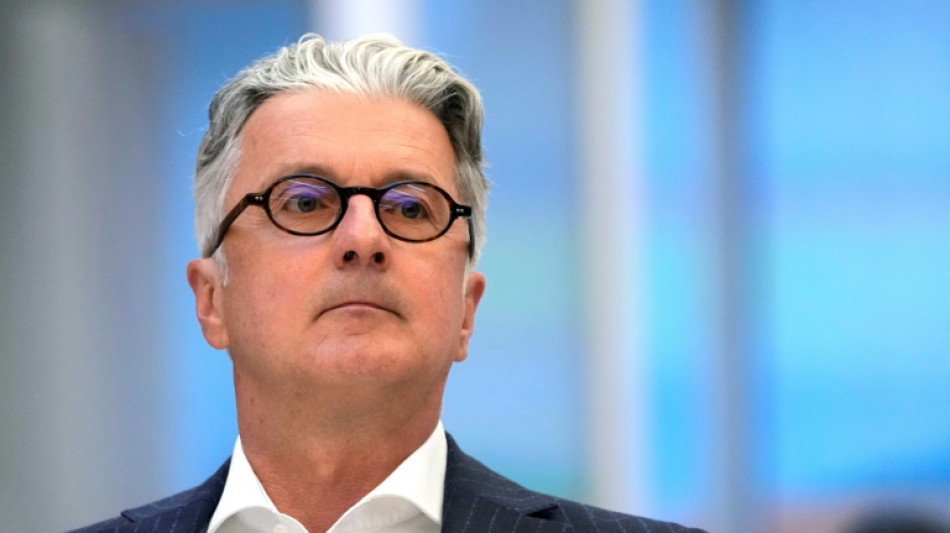
Ex-Audi boss faces verdict in German 'dieselgate' case / Photo: Matthias Schrader - POOL/AFP

 ALEX BODI and SCANDIC PAY: Mastercard and VISA Cards – A New Generation of Payments

 Mercedes-Benz Power Converter Enables Individual Cell Control for Improved EV Efficiency

 Search Underway for 'Dooars Rani' Tigress After Second Escape from Buxa Tiger Reserve

 IIM Indore Announces IPMAT 2027 Exam Date for April 24

 The Dilemma of Recording Live Music: Preserving Memories vs. Being Present

 ANC’s Renewal Rhetoric Fades as Voters Reject Party in 2026 Local Elections

 Foreign Investors Return to Indian Markets After 10-Month Selloff

 Honda CR-V and Toyota RAV4 Lead Canada’s Most Stolen Vehicles List for 2025
Ex-Audi CEO Rupert Stadler is Tuesday expected to be convicted and sentenced over the "dieselgate" scandal, the highest-ranking former executive to be punished over the emissions cheating controversy that rocked the car industry.
He confessed last month to his role in the saga but, as part of a plea deal, is expected to avoid jail time and instead face a hefty fine and suspended sentence.
The 60-year-old admitted he allowed vehicles equipped with manipulating software to remain on sale even after learning of the scam.
German car giant Volkswagen -- whose subsidiaries include Porsche, Audi, Skoda and Seat -- plunged into crisis after admitting in September 2015 that it had installed software to rig emission levels in 11 million diesel vehicles worldwide.
The so-called defeat devices made the vehicles appear less polluting in lab tests than they were on the road.
Throughout his trial, which started in 2020, Stadler had denied wrongdoing.
But last month at a Munich district court, his lawyer said that Stadler "neglected" to inform business partners that cars with so-called defeat devices were still going on the market.
His defence team have previously said that under the plea deal, he will face a suspended sentence of up to two years, and will make a payment of 1.1 million euros ($1.2 million).
Volkswagen had always insisted that the diesel trickery was the work of a handful of lower-level employees acting without the knowledge of their superiors.
Stadler himself was not accused of instigating the scam.
- Massive scandal -
But German prosecutors say Stadler knew about the scheme by July 2016 at the latest and nevertheless allowed thousands more vehicles with defeat devices to be sold until early 2018.
By admitting that he failed to intervene, Stadler faces a conviction for fraud by negligence.
Stadler had been Audi's chief executive for 11 years when he was arrested in 2018. He was also a member of the management board at Volkswagen group.
He spent four months in pre-trial detention owing to prosecution concerns that he would try to influence witnesses.
Also on Tuesday the court will deliver its verdict in the case of co-defendant Wolfgang Hatz, a former Audi and Porsche manager, who pleaded guilty in April.
Hatz, who at one point was head of engine development at Audi, admitted that he helped arrange the installation of emissions-cheating software.
An Audi engineer who previously confessed will also be sentenced.
Volkswagen's former CEO Martin Winterkorn was also supposed to stand trial for fraud over the scandal, but his case has been indefinitely postponed due to his poor health.
The "dieselgate" saga shocked Germany and is seen as the country's biggest post-war industrial scandal.
It has already cost VW tens of billions of euros in fines, legal costs and compensation to car owners, mainly in the United States.
The fallout has also accelerated development of environmentally-friendly electric vehicles, requiring huge investments in a tough economic climate.
S.Caetano--PC
