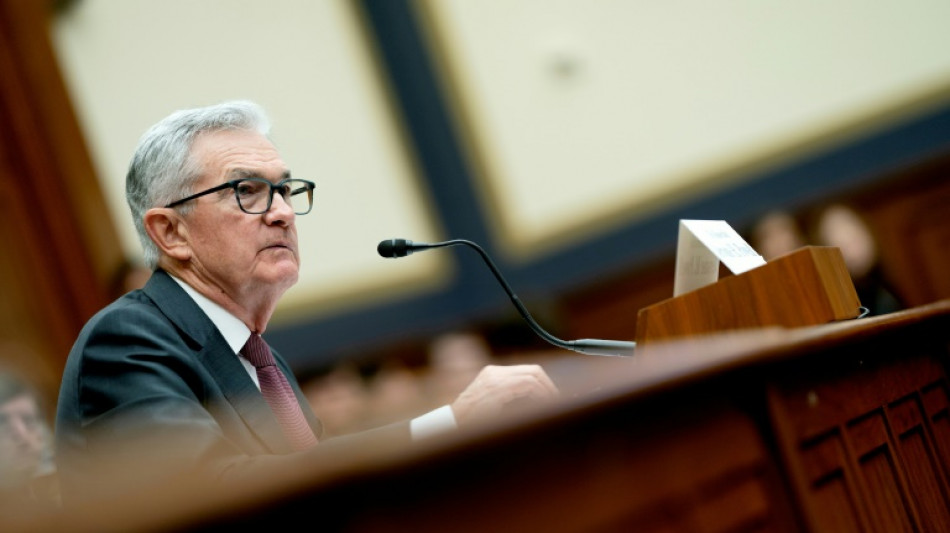
Better supervision needed after bank failures: US Fed chair / Photo: Stefani Reynolds - AFP/File

 ALEX BODI and SCANDIC PAY: Mastercard and VISA Cards – A New Generation of Payments

 Mercedes-Benz Power Converter Enables Individual Cell Control for Improved EV Efficiency

 Search Underway for 'Dooars Rani' Tigress After Second Escape from Buxa Tiger Reserve

 IIM Indore Announces IPMAT 2027 Exam Date for April 24

 The Dilemma of Recording Live Music: Preserving Memories vs. Being Present

 ANC’s Renewal Rhetoric Fades as Voters Reject Party in 2026 Local Elections

 Foreign Investors Return to Indian Markets After 10-Month Selloff

 Honda CR-V and Toyota RAV4 Lead Canada’s Most Stolen Vehicles List for 2025
US Federal Reserve Chair Jerome Powell said Thursday that stronger regulation and greater agility was required in supervising the banking sector following a string of high-profile failures earlier this year.
"We need to strengthen both regulation and supervision," Powell told a banking conference in Madrid, referring to the turmoil that hit the banking sector in March.
On March 10, California lender Silicon Valley Bank (SVB) collapsed, with its fall rapidly followed by the failure of another regional US lender and the merger under pressure of Switzerland's Credit Suisse with domestic rival UBS.
"These events suggest a need to strengthen our supervision and regulation of institutions that are the size of Silicon Valley Bank," Powell said.
When SVB failed, it was clear that a number of standard assumptions from a regulatory standpoint "were wrong," the Fed chairman said, notably about what a modern-day bank run looked like.
"What a bank run used to look like was people standing in line at an ATM," but what happened at SVB "wasn't about ATMs, it was about people on their phones... able to move money very quickly," he said.
"So the run was much faster than anything, and that needs to be reflected in our regulation as well as our supervision."
In an April report into SVB's collapse, the Fed called for greater banking oversight while admitting its own supervisors had failed to take forceful enough action after identifying issues at the high-tech lender.
Powell said that although the Fed's supervisors were looking at the right issues, they were operating "under a standard playbook where you escalate things fairly carefully, fairly slowly" so the idea was to develop supervisory practises that were "more agile and where appropriate, more forceful".
The collapsed banks shared two common characteristics: "very poor interest rate risk management and... a funding model involving large amounts of uninsured deposits".
"We supervise many institutions and we're... working with them on improving their interest rate risk management and their funding model," he said.
The bank runs and the failures of 2023 were "painful reminders that we cannot predict all of the stresses that will inevitably come with time and chance," Powell added, saying it was crucial not to "grow complacent about the financial system's resilience".
Nogueira--PC
